
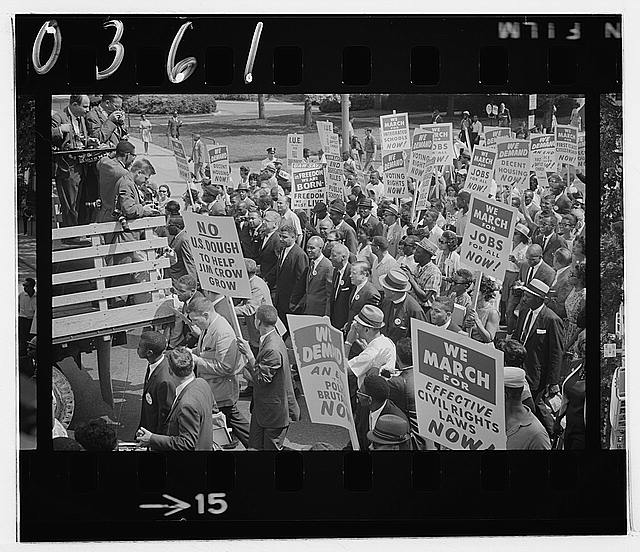
While the Cold War era produced McCarthyism, communist prosecutions, and other curtailments of First Amendment freedoms, another movement presented the Court with the ideal opportunity to expand these freedoms. In "The Negro and the First Amendment" (1965), Harry Kalven wrote that “we may come to see the Negro as winning back for us the freedoms the Communists seemed to have lost for us.”
The Warren Court (1953–1969) gave impetus to the civil rights movement with its landmark decision in Brown v. Board of Education (1954), which ended de jure racial segregation in schools and virtually all areas of public accommodation.
During the civil rights movement, the Supreme Court:
- Expanded protection from libel suits in New York Times Co. v. Sullivan (1964),
- Protected the right of organizations freely to associate without undue interference from the state in NAACP v. Alabama (1958),
- Struck down permitting schemes used to prevent demonstrators from marching on public streets in Shuttlesworth v. Birmingham (1969), and
- Ruled that demonstrators have the right freely to assemble and march on city streets in Edwards v. South Carolina (1963).
First Amendment and Vietnam War
The Court also expanded First Amendment rights in a number of cases during the Vietnam War in the 1960s and 1970s.
The Court:
- Ruled that a political protester could use crude political hyperbole without uttering a true threat in Watts v. United States (1969),
- Decided that high school students could wear black armbands to school in protest of the war in Tinker v. Des Moines Independent Community School District (1969),
- Held that the government could not force the press to stop printing material about the war (in this case, the Pentagon Papers) in New York Times Co. v. United States (1971).
- Ruled that a state legislature could not expel a legislator for making comments critical of the U.S. war effort in Bond v. Floyd (1966).
- Made it more difficult to convict speakers for inflammatory speech that did not create the likelihood of imminent lawless action in Brandenburg v. Ohio (1969).
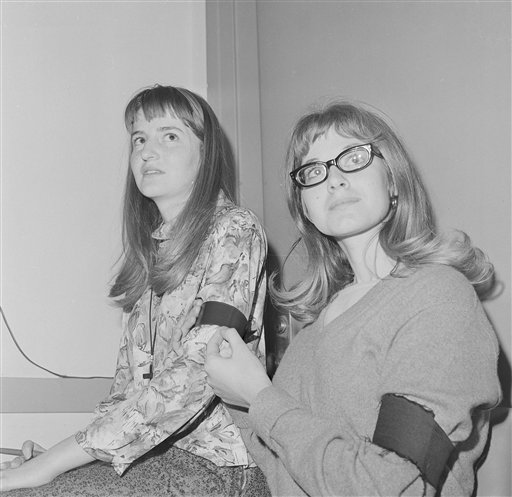
In this photo, Debbie Wallace, left, and Phyllis Sweigert, 17-year-old seniors at suburban Euclid High School in Cleveland, Ohio, display armbands they wore to school in mourning for the dead in Vietnam, Dec. 10, 1965. The girls were suspended from school until Monday. In Tinker v. Des Moines, the Court ruled that this qualified as protected speech. (AP Photo/Julian C. Wilson)
The Supreme Court’s increased judicial scrutiny of civil liberties issues dovetailed with its ongoing application of provisions of the Bill of Rights to the states. This process peaked during the Warren Court, especially with respect to the rights of criminal defendants.
Religion and the First Amendment
Also during this tumultuous period, when the nation often counterpoised the faith of its own citizens against communist atheism. Congress added the words “under God” to the Pledge of Allegiance in 1954 and judges gave increased scrutiny to the place of religion in public schools.
As discussed above, the dispersion of progressive Protestantism in public school curricula had been so pervasive that it truly took outsiders, most typically Roman Catholic immigrants, to recognize it. Beginning in the 1940s, the Court began to insist that secular education be truly secular, and it continued to prohibit most state funding of religious education.
Although the Court permitted New Jersey to provide aid for bus transportation to children in parochial schools, Justice Hugo L. Black articulated a strongly separationist position in Everson v. Board of Education (1947). Interpreting the establishment clause through the lenses of Jefferson and Madison, Black indicated that the Court would give particular scrutiny to governmental appropriations of money that seemed to benefit parochial schools.
In due time, Black’s dicta was translated into the oft-criticized Lemon test — set out in Lemon v. Kurtzman (1971) — which required that laws facing establishment clause challenges have a clear secular legislative purpose, have the primary effect of neither advancing nor inhibiting religion, and avoid creating excessive entanglement between church and state.
Around this time, the Court began also to look with increasing scrutiny at religious practices within public schools. First banishing most religious instruction from public school classrooms, the Court subsequently decided that devotional prayer, Bible reading, and recitations of the Lord’s Prayer were practices to be cultivated in homes and churches, but not in classrooms or at public school events.
John R. Vile, David L. Hudson and David Schultz are the editors of the two-volume Encyclopedia of the First Amendment, which was published in 2009 and the basis of the online encyclopedia. This was part of an introduction essay to the book.