
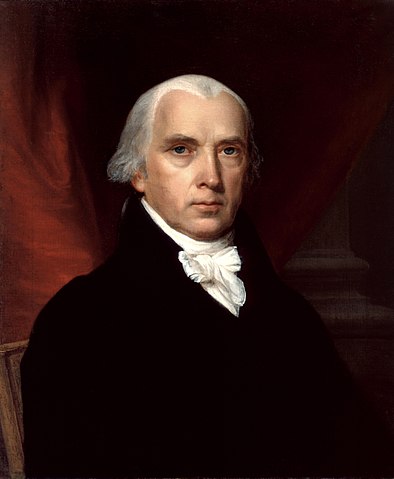
Scholars have documented the serendipity of why what is now the First Amendment became the first among the amendments of the Bill of Rights. James Madison, the chief author of the First Amendment, had actually hoped to incorporate the texts of the amendments within the Constitution rather than attaching them at the end as Connecticut’s Roger Sherman had insisted.
Moreover, the bill of rights that Congress proposed in 1789 contained 12 amendments, the first two of which the states did not initially ratify; both dealt with structural issues. In time, one putatively became the 27th Amendment.
Nonetheless, it was hardly accidental that an individual like Madison — who had helped adopt Virginia’s Statute for Religious Freedom and had consistently championed religious and political liberty throughout his life — began his list of individual rights with those enumerated in the First Amendment.
'Congress shall make no law...'
Scholars have noted that Madison replaced such words as should or ought, used in earlier state declarations of rights, with bolder and less equivocal language. As abolitionist supporters later demonstrated, the language of the amendment is succinct enough to be printed on a bread plate. Its 45 words seem more like the “thou shalt nots” of the King James Version of the Ten Commandments than mere aspirations:
Congress shall make no law respecting an establishment of religion, or prohibiting the free exercise thereof; or abridging the freedom of speech, or of the press; or the right of the people peaceably to assemble, and to petition the Government for a redress of grievances.
As unequivocal as these words are, Madison would have gone further. He had proposed including an amendment that would have guaranteed similar rights not only against congressional action, but also against state deprivation. His proposed amendment, which Madison considered his most important, read, “No state shall violate the equal rights of conscience, or the freedom of the press, or the trial by jury in criminal cases.” He realized that state governments often would be the greatest offenders of personal liberty, more so than the federal government. His proposal, however, became a casualty of the legislative process and would have to await later developments associated with changing views of federalism. Until adoption of the 14th Amendment, U.S. courts fairly consistently recognized the principle that Supreme Court chief justice John Marshall articulated in Barron v. Baltimore (1833) — that is, “Congress shall make no law . . . ” indicates that the Bill of Rights was designed to limit the national government rather than to hobble the states.
Modern scholars recognize that the First Amendment did not abolish established churches in states that had them; indeed, the amendment arguably perpetuated such establishments by prohibiting Congress from taking any action on the matter. Although no states seem to have provided for prior restraint of First Amendment freedoms, their laws varied in respect to standards for libel, obscenity, and some First Amendment issues that continue to bedevil jurists and lawmakers to this day.
NEXT: The Alien and Sedition Acts and 19th Century Developments
John R. Vile, David L. Hudson and David Schultz are the editors of the two-volume Encyclopedia of the First Amendment, which was published in 2009 and the basis of the online encyclopedia. This was part of an introduction essay to the book.