
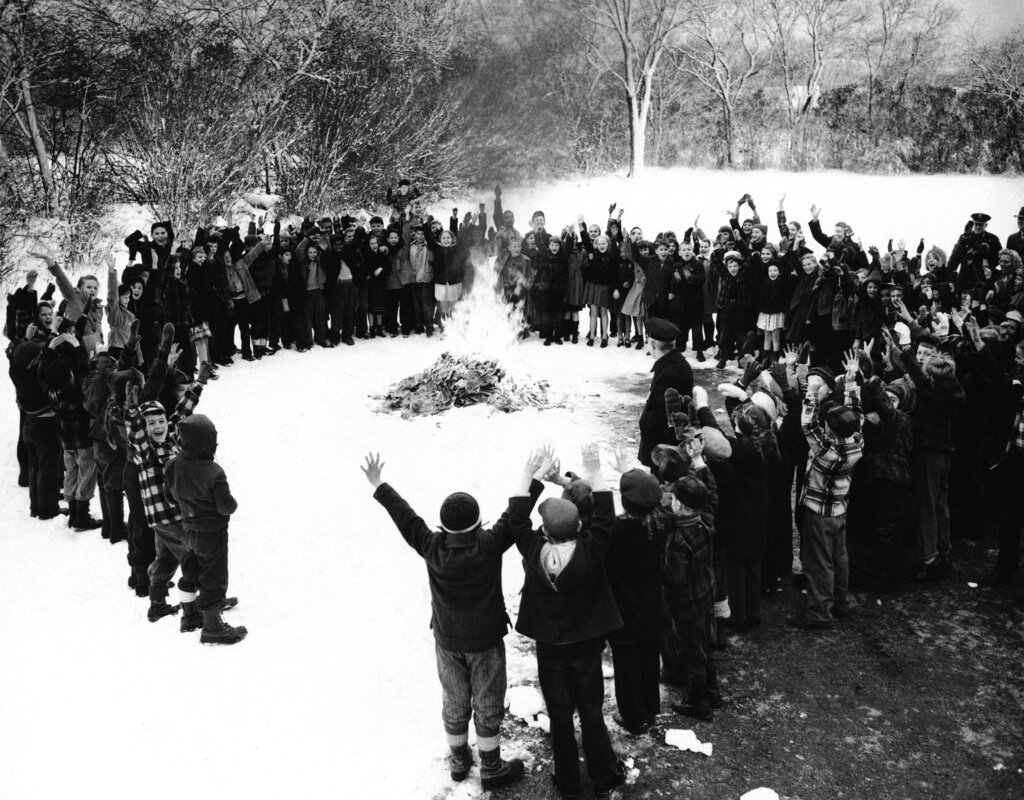
From 1948 through the mid-‘50s, America saw widespread efforts to limit political speech and popular culture. The former was fueled by the Red Scare and fear of Communist infiltration. The latter stemmed from public concerns about morality and potential influences on children. Comic books were among the earliest targets.
Burning comic books
The smell of burning comic books was almost as strong as the smell of burning leaves in the fall of 1948. In Spencer, West Virginia, six hundred grade-school children gathered around a small pyre of two thousand comic books that they had spent several weeks collecting. “We are met here today to take a step which we believe will benefit ourselves, our community and our country,” thirteen-year-old David Mace explained. “We also pledge ourselves to try not to read anymore,” he added, injecting a note of realism. In Binghamton, New York, Catholic students responded to a message from their bishop denouncing “the pictorial magazine and comic book which portray indecent pictures and sensational details of crime.” John Farrell, the president of the junior class, and a delegation of students visited thirty-five retailers and persuaded them to discontinue the sale of “indecent and objectionable literature,” then joined the other students at St. Patrick’s School in burning a pile of comics behind the school. In Rumson, New Jersey, the adult leaders of the Cub Scouts put their children on one of the town’s fire engines and toured the city with siren blaring, stopping occasionally to allow the scouts to hop down and ring the doorbells of private homes in search of comics books for burning. In the end, they decided against a bonfire, but the perverse idea of using a fire engine to burn books would appear again a few years later in a short story by Ray Bradbury, which became the novel Fahrenheit 451.
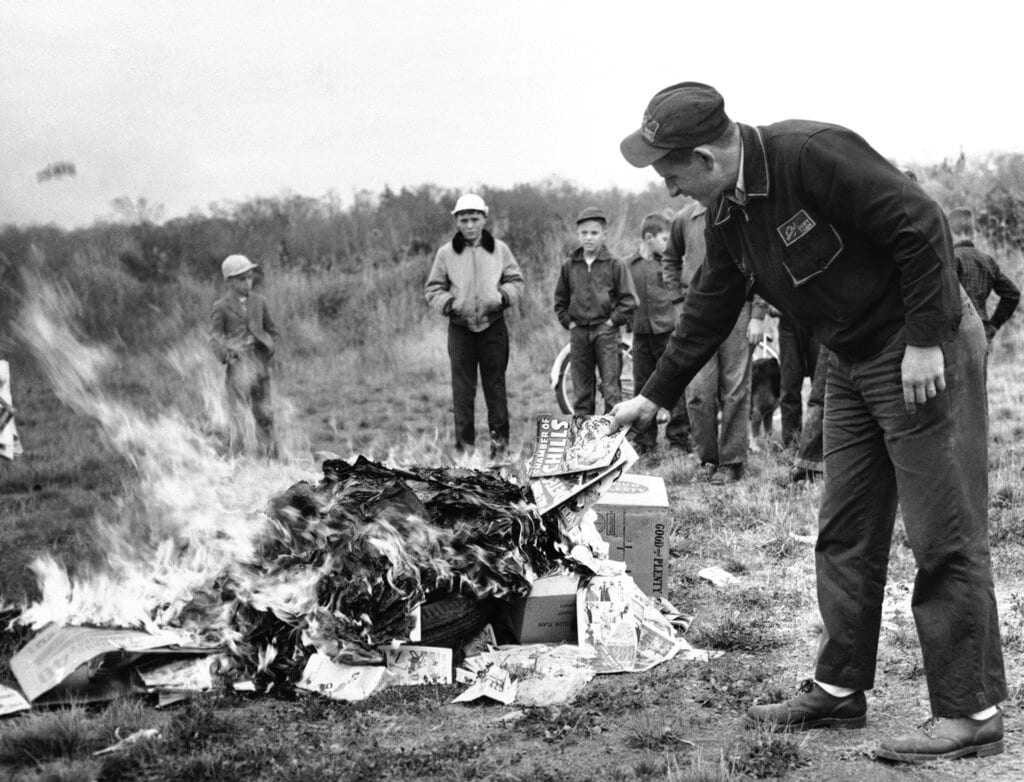
Scoutmaster Richard McKallip feeds a community bonfire with comics after a house-to-house collection netted some 1,000 books on horror, crime and sex in a drive to destroy them at Winslow, Maine on Oct. 10, 1954. The books were collected in a 2 ½ hour house-to-house canvass by Boy Scouts as Police Chief Raymond Lachance toured the town in a cruiser appealing to parents to contribute any objectionable publications on hand. (AP Photo)
Government crackdowns on obscenity after war
Comic books were not the only target of censorship in the postwar period. Despite the liberalization that had occurred in the 1920s, books, magazines, movies, and radio were still controlled either directly, by government, or indirectly, through “voluntary” codes of conduct like the Production Code Authority, which regulated the content of movies, and the code of standards adopted by radio and TV broadcasters. Private organizations were also active in forcing the removal of magazines and books that they found offensive. When they teamed up with government, they could have a devastating effect. In 1954, they would force comic-book publishers to fold their very lucrative horror titles, squelching efforts to broaden the content of comic art to appeal to adults. But the censors were beginning to lose their grip. Although they claimed to speak for the public, they were far more conservative than their neighbors, who were increasingly resentful of efforts to limit their choices in books, magazines, and movies. In addition, the censors found themselves confronting organized resistance on the national level. Librarians became increasingly aggressive defenders of free speech, and they received support from publishers, booksellers, and the press. A decisive blow would be struck by the U.S. Supreme Court in 1957 when, in the course of upholding a ban on “obscene” books, it legalized the sale of any sexually explicit work that was not “utterly without redeeming social importance.” By the mid-1960s, the censors were bemoaning their loss of influence.
The federal government’s power to censor had suffered a setback in 1930. Senator Bronson Cutting had clipped its wings when he won his fight against the customs bureau, and customs inspectors lost the freedom to suppress the importation of literary classics from abroad. Henceforth, they were forced to consider a book as a whole before deciding whether it was obscene. If they still refused to admit it, the decision could be challenged in federal court. This was what Random House did with Ulysses. Following Judge Woolsey’s ruling that it was not obscene and could be legally imported, Random House published the first American edition of Joyce’s book. But the federal government still possessed a potential stranglehold on artistic speech. Since the passage of the Comstock law in 1873, the post office had been charged with the responsibility of suppressing “any obscene or indecent book, pamphlet, paper, advertisement, drawing, lithograph, engraving, wood cut, daguerreotype, photograph, stereoscopic picture, model, cast instrument or other article for indecent or immoral nature.” Postal authorities pursued a fairly tolerant policy in the 1930s, after their disastrous effort to prosecute Mary Ware Dennett for mailing her sex education pamphlet, The Sex Side of Life. But in the 1940s, the post office once again sought to exercise sweeping censorship powers in the name of fighting obscenity.
Post office censorship grows
Postal authorities banned many novels because of their sexual content. A post office attorney acknowledged that Lillian Smith’s Strange Fruit was “a plea for social equality” for African Americans. “The book aspires to fill the role of Uncle Tom’s Cabin in the life of the modern negro problem,” he said. But that wasn’t enough to save it because it portrayed a sexual relationship between a white man and a mulatto woman in too much detail. “The worst part is the filthy language,” the lawyer explained. “It is obscene in that it is disgusting, repulsive, nauseating.” Erskine Caldwell’s Tobacco Road was declared unmailable, as were John O’Hara’s Appointment in Samarra and Ernest Hemingway’s For Whom the Bell Tolls. John Steinbeck’s The Grapes of Wrath was spared despite “numerous passages ... which, taken by themselves, must be regarded as obscene.”
Post office censorship had little impact on books because they were delivered to book- sellers by freight companies and therefore did not travel through the mail. Many of the condemned titles had become bestsellers long before. But the post office had the magazine industry by the throat. Most magazines were delivered through the mail under a second-class permit that saved the publishers hundreds of thousands of dollars over what they would have to pay for first-class delivery. Because second-class mail was subject to inspection, postal authorities could also easily determine the content of what was being mailed, and in the late 1930s they became increasingly alarmed by the profusion of new magazines that featured pictures of women wearing skimpy costumes, including Spark, Stocking Parade, and Peek. In 1940, a new postmaster general, Frank Walker, began a crackdown on the “cheesecake” magazines as well as romance and detective magazines that he deemed too sexual. He threatened to revoke the second-class permits of more than sixty publications, including some that were issued by leading magazine publishers.
Esquire challenges postal authorities
Walker was so confident of his role as a national censor that he attempted to ban one of the country’s most popular magazines, Esquire. Esquire premiered in December 1933, the depths of the Depression, but it was an instant hit and was selling over 700,000 copies monthly by 1937. The magazine had found its niche by catering to the burgeoning class of white-collar men who were looking for advice on how to dress and behave in an urban society. There had never been a fashion magazine for men before, and editor Arnold Gingrich realized that he would have to do something to overcome men’s fear of being regarded as sissies for concerning themselves with their dress. Advertising itself as “the magazine for men,” Esquire presented itself as a three-ring circus. “Gingrich’s three rings were fashion, off-beat masculine writing, and sex. And all three rings were to be hairy chested,” a historian of the magazine has written. Gingrich published journalism and short fiction by many of the leading male writers, including Ernest Hemingway, John Dos Passos, and F. Scott Fitzgerald. But the magazine was best known for its risqué cartoons and the sexy pinups that began to appear as centerfolds in 1939. Postal authorities objected to Esquire’s strong sexual content, forcing Gingrich to travel to Washington every month to show them the upcoming issue. When they objected to something, “I would make all the required changes on the spot,” Gingrich said. The editor could not afford to be resentful. The loss of the magazine’s second-class permit would cost $500,000 in additional postage annually, destroying its profitability.
Even Gingrich’s monthly visits to Washington, however, were not enough to placate the postmaster general. In 1943, he revoked Esquire’s mailing privileges, citing more than ninety “obscene” items in the magazine, including twenty-two pinups by artist Alberto Varga and numerous cartoons, photographs, and illustrations. One of the cartoons showed a group of soldiers surrounded by women with spears. “It’s no use, Sarge. We’re surrounded,” says one of the soldiers. “Yippee!” The post office also objected to the use of the words “bottom, juke, diddle, bawdy house, prostitute, street-walker, syphilis, sunny south (referring to a woman’s posterior), fanny and sonofabitch.” Postmaster Walker did not succeed in banning Esquire. The magazine went to court to challenge his authority to deny second-class privileges and was vindicated in 1945 by an appeals court ruling that urged the post office to stick to the “more prosaic” task of delivering the mail. A year later, the Supreme Court unanimously upheld this decision.
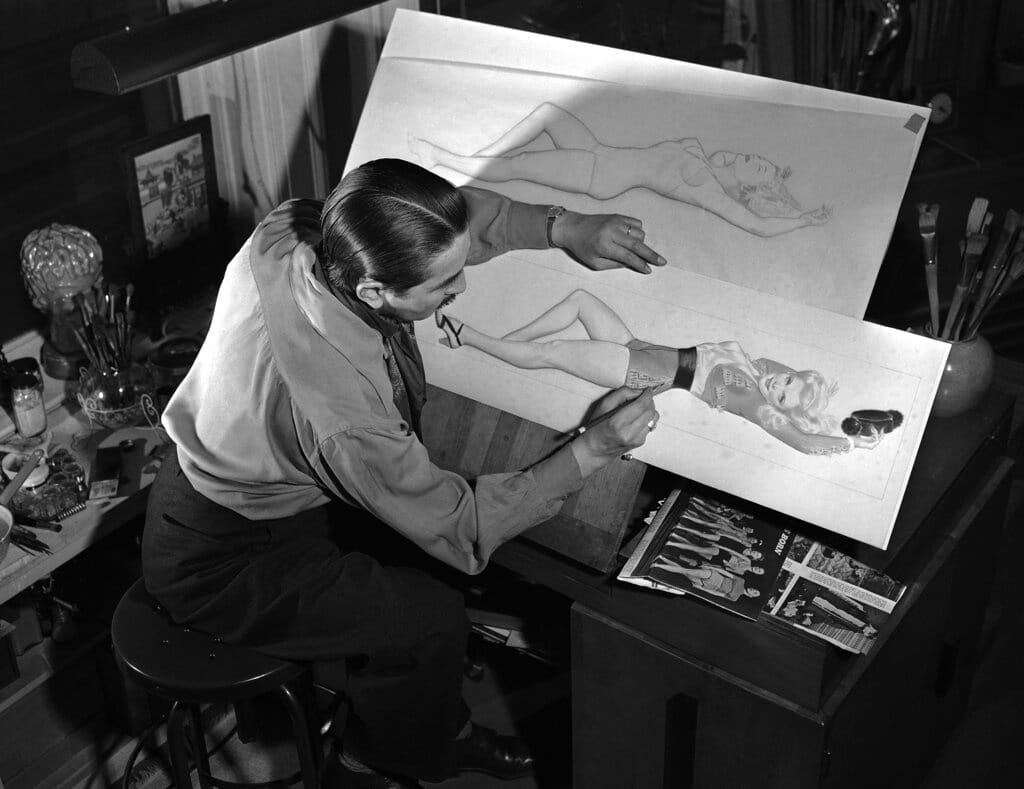
Alberto Varga, glorifier of the pin-up girl, works on small-scale drawings for the Broadway show "Mexican Hayride" in his Chicago studio on Feb. 8, 1944. A Varga drawing will become a mural on the largest painted sign on Broadway, atop the Winter Garden Theater. The sign will measure 157 by 30 feet. (AP Photo)
Obscenity laws encourage book bans
Author and critic Edmund Wilson was not so fortunate. In the same month as the Supreme Court decision in the Esquire case, the nation’s largest publisher, Doubleday, issued Wilson’s novel Memoirs of Hecate County, which included some unusually explicit descriptions of sexual intercourse between unmarried adults. Wilson was a highly respected critic who had worked at The New Republic and The New Yorker. He was also the author of thirteen nonfiction works and a previous novel. But he had little popular success until Memoirs of Hecate County, which was leaping off the shelves despite mixed reviews. “Well, Edmund, I’m glad to see that you’ve written a book that will sell,” Wilson’s mother told her boy. Wilson’s success was short-lived. In July, John Sumner of the New York Society for the Suppression of Vice raided several Doubleday bookstores in Manhattan and seized 130 copies of the book. New York District Attorney Frank Hogan charged Doubleday with selling obscene material. Hogan detailed his objections in a trial brief:
There are 20 separate acts of sexual intercourse [pages 109, 113, 114, 119, 120, 122, 153, 155, 159, 160, 161, 168, 180, 181, 189, 190, 191, 192, 194, 196, 197, 198, 207 and 231]. These take place between the protagonist and four different women. Eighteen of the acts occur in the space of an hour or two with two different women. Three of the acts occur with two married women.
While explicit, Wilson’s descriptions of sex were clearly artistic:
She became, in fact, so smooth and open that after a moment I could hardly feel her. Her little bud was so deeply embedded that it was hardly involved in the play, and she made me arrest my movement while she did something special and gentle that did not, however, press on this point, rubbing herself somehow against me—and then came, with a self-excited tremor that appeared to me curiously mild for a woman of her positive energy. I went on and had a certain disappointment, for, with the brimming of female fluid, I felt even less sensation; but—gently enough—I came, too.
One of the three judges who presided at the trial believed that Wilson “obviously had serious intentions” in writing the book that prevented it from being obscene. Nevertheless, Doubleday was convicted, and the Supreme Court later divided 4-4 on the case, which allowed the conviction to stand. Once Memoirs of Hecate County had been declared obscene in New York, its publisher withdrew it from circulation in the rest of the country to avoid the risk of another prosecution. Booksellers and librarians removed it from their inventories. Wilson’s book had been banned.
Media self-censorship
Much of the censorship that occurred during the 1940s and 1950s was exercised not by government but by industries that were anxious to forestall direct government censorship. To avoid transmitting any show that might cause them to lose their government licenses, radio broadcasters banned speakers with radical views and refused to permit the use of the words “sexual,” “syphilis,” “damn,” and “hell.” In 1939, the National Association of Broadcasters adopted a “voluntary” code of standards intended to guarantee that all programming would be in “good taste.” Self-censorship was extended to television when the new industry was born in the late 1940s.
It was the movie industry that set the example for other media industries in self-censorship. Will Hays’s rescue of the movie industry in the wake of the Fatty Arbuckle scandal had not ended the threat of censorship. As the Depression took hold, there was a dramatic decline in attendance at movie theaters. Desperate producers tried to save themselves by releasing pictures that heavily exploited sex and violence, outraging the industry’s many critics. In early 1934, a Catholic organization, the Legion of Decency, collected pledges from over eleven million people that they would boycott the movies unless the industry immediately took steps to eliminate the new explicitness. Already facing financial disaster, the movie moguls surrendered, adopting detailed restrictions on content and creating the Production Code Administration (PCA) to ensure that they were enforced.
The Production Code Administration encourages film censorship
The PCA was powerful. Censors reviewed film scripts in advance to ensure that nothing violated the code. Recognizing that audiences demanded sex and violence, the code did not ban them altogether but required that any display of bad behavior had to be balanced by “compensating moral value.” An evildoer had to either reform or be punished. While the code was flexible in places, it banned outright “a vast range of human expression and experience,” film historian Robert Sklar observed. Prohibited subjects included homosexuality (“sex perversion”), interracial sex, abortion, and incest. Profanity and many “vulgar” words, including “sex,” were also banned. There was no law that required a producer to submit a script to the PCA, but theater owners refused to exhibit any film that did not bear the PCA’s seal of approval. As a result, the review process usually became a negotiation. In 1950, director Elia Kazan knew that he would have to fight hard to get the censors to approve a script based on Tennessee Williams’s play A Streetcar Named Desire. In the play, Blanche DuBois visits her sister, Stella, who is married to Stanley Kowalski. Blanche’s husband, a homosexual, has killed himself, and Blanche has been fired as a teacher after seducing one of her students. At the climax, she is raped by Stanley and suffers a mental breakdown. Nevertheless, Stella remains with Stanley at the end of the play. The PCA demanded a series of cuts, but Kazan drew the line at eliminating the rape. He was allowed to keep it if it was done “by suggestion and delicacy” and if he was willing to supply “compensating moral values.” In the movie, Stella leaves Stanley, ironically creating one of the iconic denouements in the history of film as Marlon Brando, playing Kowalski, stands in the courtyard of his seedy New Orleans apartment house, screaming Stella’s name. Yet even the approval of the PCA was sometimes not enough to satisfy the censors. Over Kazan’s strenuous objections, Warner Brothers, which owned the picture, cut four more minutes in order to win the approval of the Legion of Decency.
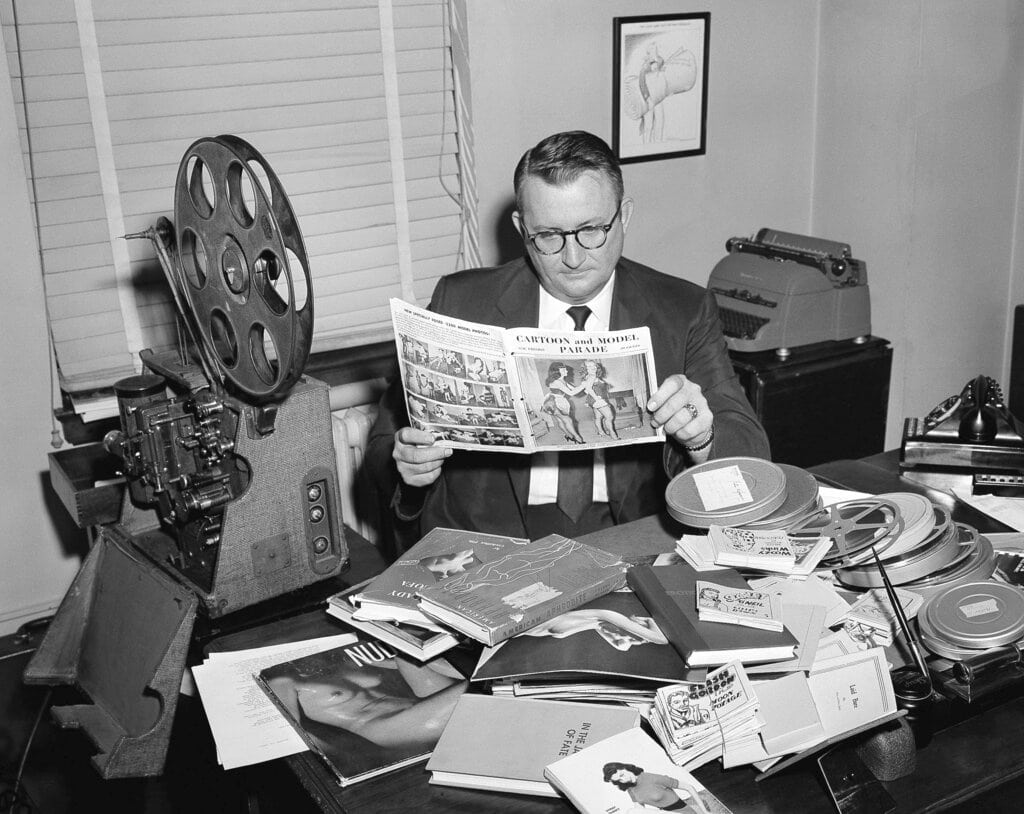
Joseph H. Bobo, general counsel, senate subcommittee on juvenile delinquency, poses with magazines, film, comic books, picture albums and other exhibits collected by the subcommittee as examples of pornography in Washington on Oct. 13, 1955. (AP Photo/Byron Rollins)
The National Organization for Decent Literature expands censorship
The censorship practiced by government and industry did not go far enough for some people. They joined private groups that sought to suppress objectionable works. The most prominent was the National Organization for Decent Literature (NODL), a Catholic group that had been organized in the 1930s as an adjunct to the Legion of Decency. The NODL’s original target was indecent magazines, but in 1947 it urged Catholic parishes to launch campaigns to remove objectionable comic books and paperbacks from their local newsstands. It recommended that a committee of church members visit retailers every two weeks armed with a list of titles that had been declared harmful by a NODL reviewing panel made up of 150 mothers. If they found any of the publications, they were to inform the manager. The NODL officially opposed the use of boycotts and other coercive measures against stores that refused to remove offending works. However, it applied pressure by encouraging the creation of a “white list” of stores that had agreed to cleanse themselves; the list was read in the local Catholic church and printed in parish publications. Approximately 25 percent of the population was Catholic in the 1950s. So, although a large group, Catholics were still a minority. Thus, the NODL urged Catholics to reach out to Protestants for support, joining citizens’ committees with members of the American Legion, church groups, women’s clubs, and parent-teacher groups.
One of the NODL’s main targets was paperbacks. The invention of paperback books had created a revolution in publishing by making it possible to sell compact and inexpensive editions of books at a much wider variety of outlets, including newsstands, drugstores, and groceries. From the NODL’s perspective, however, the publication of paperbacks encouraged the spread of salacious titles. As the sale of paperback books grew, so did the size of the NODL list. By 1954, it included over three hundred books. While many of these were not great works of literature, many were. Nobody would ever publicly protest the censorship of Hot Dames on Cold Slabs, but the list also contained works by William Faulkner, James M. Cain, Erskine Caldwell, James T. Farrell, W. Somerset Maugham, John O’Hara, and Emile Zola. The NODL condemned Ernest Hemingway’s Farewell to Arms, James Michener’s Tales of the South Pacific, and John Dos Passos’s The Forty-Second Parallel. Nor did it confine itself to fiction. It also targeted sex education books like The Sexual Side of Marriage and How Shall I Tell My Child. The proscriptions of the NODL were not only sweeping; they were effective. Most retailers could not afford to court the disapproval of the local censors, so they pulled the books off the shelves when they were told to do so. The problem became so pronounced by May 1957 that the ACLU issued a statement signed by 150 people prominent in literature and the arts blasting the NODL’s methods of operation.
Local governments enact book bans
The activities of the NODL inspired local police and prosecutors, who joined in the pressure campaign by warning retailers and distributors not to sell the works on the NODL list. The Georgia legislature and at least eight cities, including Miami and Milwaukee, established censorship boards to draw up their own lists of forbidden works. The most effective local censorship regime was established in Detroit, where the police department created a “license and censor bureau” that reviewed all paperback books that were submitted to it by distributors prior to their circulation in the city’s limits. More than one hundred titles were banned outright between 1950 and 1952. However, the police kept a second, longer list, consisting of titles that were “partially objectionable.” Retailers were told that they could sell these books unless someone complained. Since the NODL was active in Detroit, the overwhelming majority of retailers were unwilling to sell any books on the second list either. If the police were in any doubt about the legality of a particular work, they could submit it to an assistant prosecutor for a ruling. This didn’t often result in clearance, however. “The assistant prosecutor ... applied a simple test in arriving at his official opinion: if he didn’t want his young daughter to read the book, he decided it was illegal.” It was only when publishers began to seek injunctions to block the use of blacklists that police departments became more cautious about their censorship efforts.
Efforts to censor comic books did not arouse the same degree of opposition as the attack on paperback books. If there was one thing almost everyone could agree on during the late 1940s and early 1950s, it was that juvenile delinquency was a growing problem and that comic books were a contributing factor. Americans had been hearing predictions of an epidemic of juvenile crime since the early years of World War II. It seemed logical to assume that the traumatic social upheaval that was required to put the country on a war footing would inevitably undermine social stability. Millions of men, the husbands and fathers who had helped preserve order, suddenly disappeared overseas, and millions of women, including the mothers who had provided a stable environment for their children, were now working outside the home. Many Americans saw the “zoot-suit riots” that erupted in Los Angeles during 1943, when servicemen attacked teenagers wearing bizarre-looking costumes, as a harbinger of the trouble ahead. The predictions of juvenile mayhem did not end when the soldiers began returning home in 1945. The next year, Attorney General Tom Clark created the Attorney General’s Panel on Juvenile Problems and sponsored a national conference to develop strategies for dealing with an anticipated crime wave.
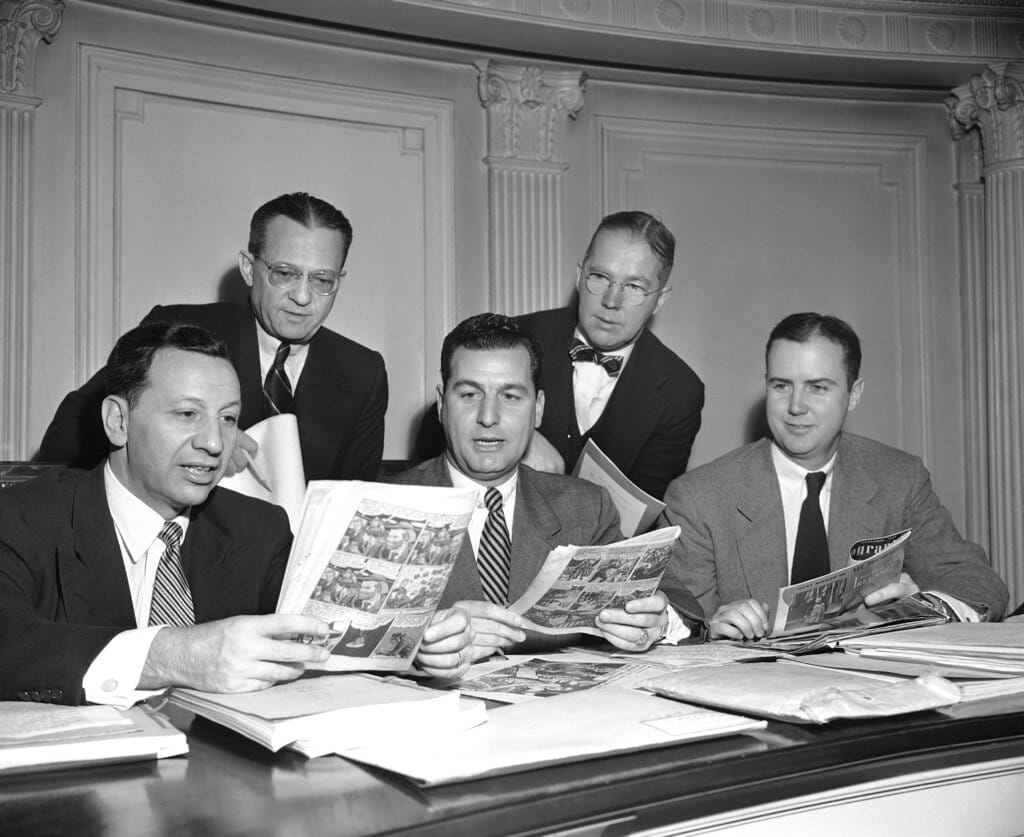
Members of a joint legislative committee to study the publication of comic books look over some of the books under discussion at hearing in New Yorks Bar Association Building on Dec. 4, 1951. Seated, left to right, are: State Senator Harold I. Panken of New York City; Assemblyman Joseph F. Carlino of Long Beach, N.Y., Committee chairman; and Assemblyman James A. Fitzpatrick of Plattsburg, N.Y. Standing, left to right; are: Reuben Lazarus of New York City, committee counsel, and Thomas A. Collins of Cold Spring, N.Y., legislative council to the committee. (AP Photo/Jacob Harris)
The juvenile "crime wave" causes panic
In retrospect, much of the concern over juvenile delinquency appears to have been misplaced. There is no clear evidence that the “epidemic” of juvenile crime actually occurred. Yet parents were not wrong in sensing that dramatic social changes were under way and that these changes were undermining traditional sources of control. An independent youth culture was developing, fueled by an expansion of the teenage workforce that could buy more of what it wanted, including the cars that were both a symbol and a source of its new independence. At the same time, many more kids were attending high school, where they encountered a peer group that exercised a far greater control over their tastes than their parents did. The growth of television created still more competition for parents. An industry that had barely existed in 1948 put fifteen million television sets into American homes by 1952 and more than doubled the number just three years later.
A few skeptics questioned the widespread conviction that kids today are just no damn good. “This wave of popularizing crime has emanated measurably from the Department of Justice,” Elisha Hanson, the counsel for the Newspaper Publishers Association, said in 1948. But concern about children deepened with the advent of the cold war. “Throughout the United States today, indeed throughout the free world, a deadly war is being waged,” Lois Higgins of the Chicago Crime Prevention Bureau told Congress in 1954. Higgins believed that there was a Communist plot to use drugs and dirty books to encourage juvenile delinquency. “Let us tell them [our children] about the secret weapons of our enemy,” Higgins urged. “Let us tell them, too, that obscene material that is flooding the Nation today is another cunning device of our enemies, deliberately calculated to destroy the decency and morality which are the bulwarks of society.” Even during the cold war, not everyone blamed juvenile delinquency on a Communist plot. But almost everyone seemed willing to believe the worst about comic books.
Fredric Wertham ignites comic book debates
The man who lit the fuse of the comic-book controversy was Fredric Wertham, a German immigrant. Wertham was no book burner. He was a psychiatrist who had emigrated to the United States in the 1920s to take a job as the chief resident of the psychiatric clinic at Johns Hopkins Hospital. During the decade he lived in Baltimore, Wertham became well known in the city’s intellectual community and a friend of its leading light, H. L. Mencken. He also developed a reputation as someone who cared about the poor and was one of the few psychiatrists in the city who had African American patients. In 1932, Wertham moved to New York City, where he served as the senior psychiatrist at Bellevue Hospital and launched a campaign to open a municipal psychiatric clinic in Harlem. Failing to secure the city’s support, Wertham opened his own clinic in the basement of a Harlem church and provided counseling for twenty-five cents per visit. His experience in Harlem convinced him that racial discrimination played an important role in creating psychological problems, a view that he presented during testimony in the Delaware case that later became part of Brown v. Board of Education and helped persuade the Supreme Court to outlaw segregation in education in 1954. Nor was Wertham a prude. In 1948, he testified that a nudist magazine, Sunshine and Health, was not pornographic and should not be excluded from the mail.
Nevertheless, Wertham hated comic books. Like many liberals, he believed they undermined reading skills and threatened the nation’s intellectual life. But this was not the main thrust of the campaign against comics that he launched with an article in Saturday Review of Literature in May 1948. The article, “The Comics ... Very Funny!” warned Americans that comics were making their children more violent and sexual. It offered no scientific evidence. Wertham acknowledged that many sociologists, educators, psychiatrists, and psychologists did not believe that comic books were harmful. But he denounced them as “apologists” and accused them of ignoring the obvious fact that children were imitating the violence they saw in comic books. The crime comics were obviously the worst, but Wertham believed that Superman and Batman were part of the problem of “this enormous overstimulation of fantasy with scenes of sex and violence.” (In a later analysis, Wertham, who criticized the comics for overemphasizing the sexual organs, would also charge that there was a clear suggestion that Batman’s relationship with Robin was homosexual.) Wertham was not reluctant to name the villain of his morality play. Comic-book publishers were using their product—the “marijuana of the nursery”—to “seduce the children and mislead the parents.” He could cite impressive statistics to prove that comic books were a growing problem. The sale of comics was growing at a rate that rivaled only television. The average monthly circulation of comic books jumped from seventeen million in 1940 to nearly seventy million by 1953 as the number of publishers rose to over 650, more than doubling between 1950 and 1953. Wertham may not have been exaggerating when he estimated that a child sat down with a comic book one billion times a year.
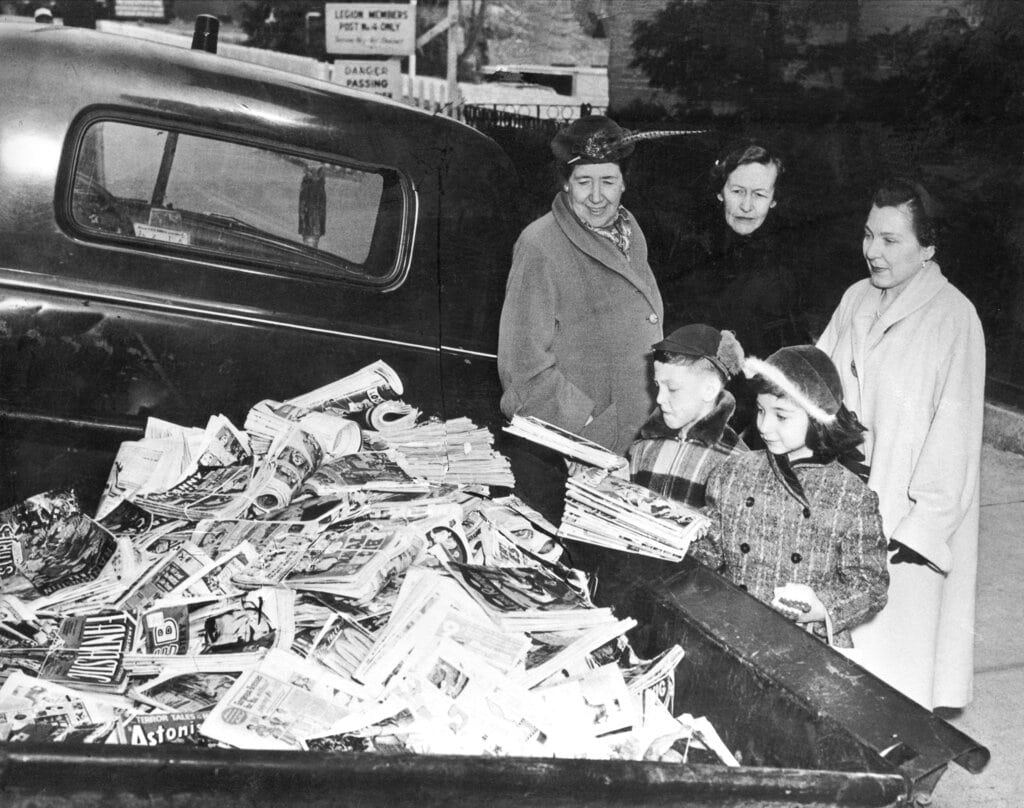
John Chiangi and Lisa Drobnes add their comic book collection in the back of a pickup truck at Norwich, Conn., Feb. 26, 1955. The Women's Auxiliary of the American Legion has scheduled a burning of such books, inviting children to bring in 10 books in exchange for a "clean" book. Looking on from left are, Mrs. Charles B. Gilbert, former national auxiliary president; Mrs. Edward Robinson; and Mrs. Webster Copp. The scheduled bonfire brought protests from the American Civil Liberties Union and the American Book Publishing Council. (AP Photo)
Comic book bans become popular nationwide
Unlike the NODL, which claimed that almost all retailers agreed to remove comic books when asked, Wertham believed that government censorship was necessary. The police were already acting as censors in some places, although they lacked statutory authority and guidelines that could help them identify the offending material. (They sometimes ordered a store to remove everything on the NODL list.) Wertham wanted to ban the sale or display to children under fifteen of any “crime comic books” that suggested “criminal or sexually abnormal ideas” or created an “atmosphere of deceit, trickery, and cruelty.” The National Congress of Parents and Teachers and the National Education Association (NEA) strongly supported censorship of comic books. This was not a free speech issue, the NEA Journal explained: “Press freedom ... was never intended to protect indecency or perversion of the child mind.” In September 1948, the Los Angeles Board of Supervisors passed the first comics ban, prohibiting the sale of crime comics to anyone under eighteen. Within weeks, Chicago, Hartford, Topeka, Des Moines, and Birmingham adopted the Los Angeles law. By the end of the year, fifty cities had approved comics legislation.
The publishers of comic books responded to the threat of censorship by creating a system of self-regulation that was intended to purge the comics of material that was inappropriate for children. But in 1950 the content of comic books became more controversial than ever when one of the industry’s most creative men, William Gaines, the publisher of Entertaining Comics, launched a number of new titles that emphasized the macabre and shocking, including Tales from the Crypt, The Vault of Horror, and The Haunt of Fear. Gaines believed that comics were not just for kids. Some of his titles reached for an adult audience through story lines that dealt with contemporary social problems, including racial discrimination, mob violence, and small-town parochialism. His horror comic books were an instant hit, and other publishers were soon introducing their own horror comics, which grew to include nearly one hundred titles.
Horror comics stir controversy
Already angry about the popularity of crime comics, the critics of the comics industry pointed to the new horror comics as proof that government must take further steps to protect the nation’s children. The pressure on the industry grew in the spring of 1954 when a Senate committee chaired by Estes Kefauver, a New Deal liberal from Tennessee, held hearings on the comic-book industry in New York. Wertham, a star witness, was the author of a new jeremiad against comic books, Seduction of the Innocent, which would become one of the most talked about books of the year. Wertham and other witnesses shocked the committee with examples from recent comic books. The cover of one of Gaines’s comics showed an ax murderer holding the severed head of a woman in one hand and a dripping ax in the other. Another book, Foul Play, featured a drawing of men playing baseball with severed body parts. “They play baseball with a dead man’s head,” Wertham told the committee. “Why do they do that?” The witnesses also summarized some of the latest plotlines. In one story from the comic The Haunt of Fear, a child discovers that his new foster parents are vampires. When they try to kill him, however, he turns into a werewolf and eats them. Another story summarized for the committee, “Stick in the Mud,” portrayed the comeuppance received by a teacher who marries and murders the wealthy father of one of her students. (She drowns in quicksand as the gleeful son looks on.)
A new comics code restricts speech and subject matter
In September 1954, the comic-book publishers responded to the threat of government censorship by creating a new trade association, the Comic Magazine Association of America (CMAA). A month later, the CMAA issued a new comics code that was far more restrictive than the original. The new code banned any comic that showed sympathy for criminals as well as “all of the visual elements and subject matter that defined horror comic books,” including the use of the words “horror” and “terror” in the title. There were new rules for sexual content as well:
Women were not to be drawn in “salacious” or “suggestive” dress and postures, and “passion or romantic interest” would “never be treated in such a way as to stimulate the lower and baser emotions.” Respect for parents, “the moral code,” and “honorable behavior” was to be fostered at all times. Romantic stories should always “emphasize the value of the home and the sanctity of marriage.”
The code was also more effectively enforced. Almost all of the publishers, wholesalers, engravers, and printers joined the CMAA, making it very difficult to produce a comic that did not carry its seal of approval. The new “comics czar,” Charles F. Murphy, a former New York City judge, described exactly how difficult it was to obtain the seal at a press conference in December. In the first 285 comics the CMAA examined, it had rejected 126 stories and 5,656 drawings, he said.
"Nothing left to ban"
The CMAA’s new code did not forestall direct government censorship. In 1955, thirteen states passed laws to restrict the sale of crime and horror comic books, either banning their sale to minors or outlawing them altogether. But there was nothing left to ban. Even Gaines had given up. In the wake of the Kefauver hearings, nervous distributors had been returning his comics. He tried to rally his customers. “Due to the efforts of various ‘do-gooders’ and ‘dogooder’ groups, a large segment of the public is being led to believe that certain comic magazines cause juvenile delinquency,” Gaines wrote in an editorial that appeared in his comics. He urged them to write to their representatives in Congress, but it was too late. A short time later, Gaines called a press conference and announced that he was closing his crime and horror comics titles to create a “clean, clean line” because that, apparently, was “what the American parents want.” Only one of Gaines’s titles continued to satirize American life—Mad magazine. Nothing else on the newsstand could interest any but the youngest child, according to Bradford W. Wright, a comics historian. “Reflecting a bland consensus vision of America, comic books now championed without criticism American institutions, authority figures, and middle-class mores,” he concluded.
This excerpt from Chris Finan’s book “From the Palmer Raids to the Patriot Act” is reprinted with permission from the author and Beacon Press.