One of the most striking forms of censorship, in contravention to the free speech and free press provisions of the First Amendment, involves not simply book banning but also book burning. Ray Bradbury’s novel "Fahrenheit 451," which was published in 1953 during the second Red Scare, features a dystopian world where the government uses book burning as a form of censorship.
Publicly burning books can have a chilling effect
At a time when the evolution of publishing means that most books are in multiple copies and some manuscripts are available online, the idea of book burning as a means of limiting ideas is probably not especially practical. Still publicly burning books can have a powerful chilling effect that serves to intimidate those who view it.
At other times, the destruction of printed materials might come about as a result of war. The famed library of Alexandria in Egypt, which held thousands of ancient scrolls, was subject to a number of fires that were the result of such conflicts. The British burned the Library of Congress during the War of 1812.
Book burning as a form of censorship
Most accounts of book burning focus on more deliberate acts motivated by concern that the books being destroyed were counter to the policies of the existing government.
In 213 B.C., Qin Shi Huang, the emperor of China, ordered a bonfire of books of poetry, philosophy and history (Boissoneault 2017). During the Middle Ages, Giordano Bruno and Jan Hus were burned at the stake with fires stoked by books they had written that the Roman Catholic Church considered to be heretical. In the late 15th century, Girolamo Savonarola, a Dominican preacher, burned books and other objectionable items in Florence, Italy, in what has become known as the “bonfire of vanities.”
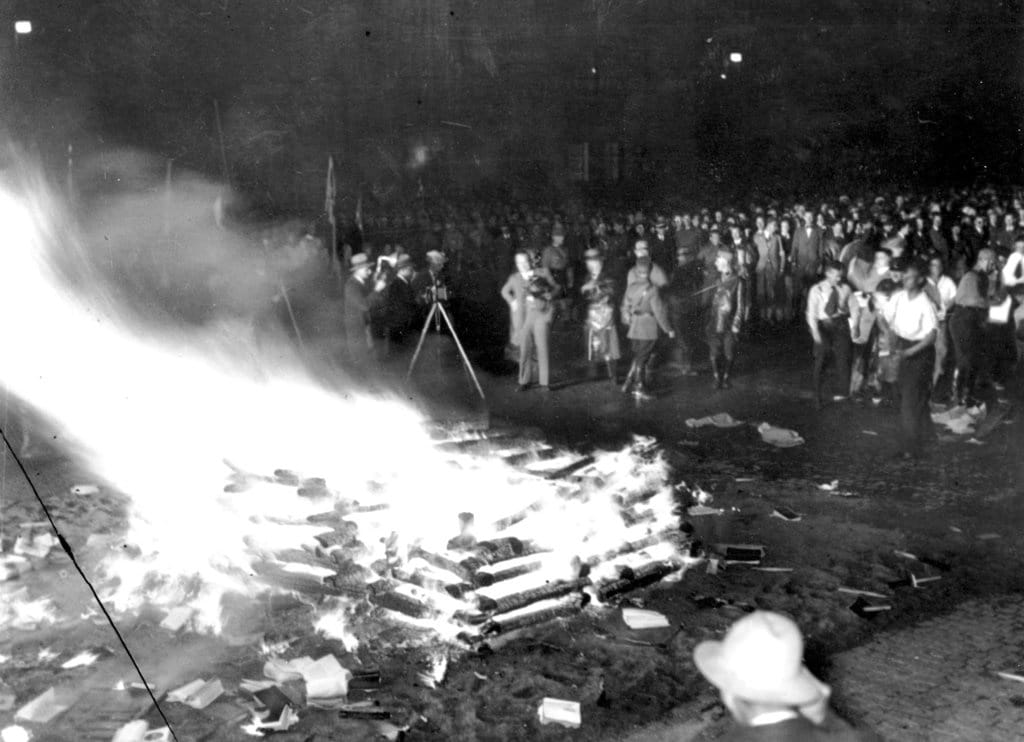
Lorraine Boissoneault notes in an article in Smithsonian Magazine that 20th century book burnings have most frequently been carried out when “the perpetrators feel like victims, even if they’re the ones in power.” She cites the Nazi bonfires in Germany in 1933 where students were often invited to find banned books and add them to the conflagrations. She also notes that Sinhales Buddhists burned books of Tamil history and literature in the Jaffna Public Library of Sri Lanka.
Apart from isolated threats to burn holy books and some burning of comic books during the second Red Scare in 1958, the most recent efforts to restrict books in the United States have involved removing books from libraries or restricting their access, especially to children in school libraries. Such actions, however, are sometimes the opening wedge to banning them in public libraries.
Jonathan Friedman who heads PEN America observes that “censorship begets censorship and says that book banning has reached a new high in the U.S., particularly focusing on books dealing with race or with LGBTQ issues (Dress, 2022).
John R. Vile is a political science professor and dean of the Honors College at Middle Tennessee State University.