
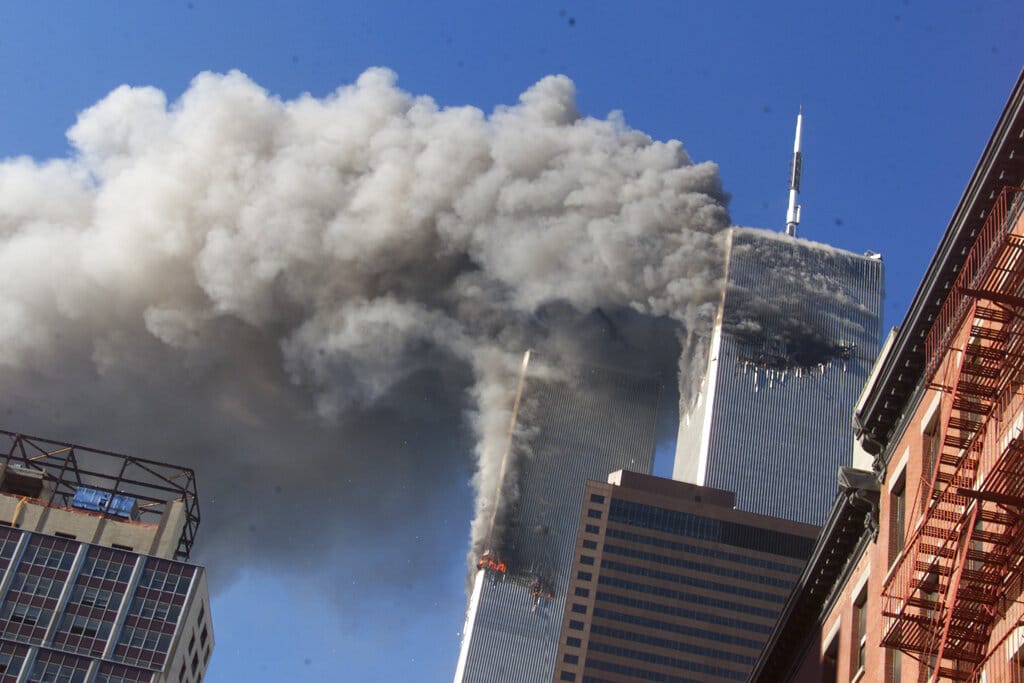
In the wake of the terrorist attacks on Sept. 11, 2001, Congress and the administration of President George W. Bush quickly took steps they believed would help protect the nation, including passage of the U.S. Patriot Act. These steps, however, had the effect of limiting civil liberties.
In this excerpt from Chris Finan’s book “From the Palmer Raids to the Patriot Act,” the author details the resurgence of support for First Amendment freedoms five years after 9/11.
The passage of the Patriot Act after 9/11
Although Congress had been the center stage for the civil liberties fight during the reauthorization of the Patriot Act, other important institutions were at work — the American press and the courts, both of which contributed significantly to the campaign to strengthen individual rights. Many civil libertarians had despaired over the failure of the press to be more aggressive in its coverage of the federal government in the wake of the 9/11 attacks. They remembered the bravery that the New York Times, the Washington Post, and CBS had displayed in covering Vietnam and Watergate. Since 9/11, however, the American press seemed to have succumbed to the notion that it is unpatriotic to criticize the government as it covered terrorism at home and new American wars abroad. While the flag waving of the Fox News Channel was difficult to bear, there was a special bitterness toward the Times, which many blamed for flawed reporting that helped the administration justify the invasion of Iraq. (The Times later acknowledged that its reporting about Iraqi weapons of mass destruction had depended too heavily on Iraqi exiles who were hostile to the regime of Saddam Hussein.)

President Bush delivers his remarks on the Patriot Act in the Chocolate Ballroom at the Hershey Lodge and Convention Center in Hershey, Pa., Monday, April 19, 2004. (AP Photo/Susan Walsh)
Beginning in 2004, however, the press began to display a new aggressiveness. In April 2004, a CBS News program, 60 Minutes II, revealed the mistreatment of prisoners at the Abu Ghraib prison in Iraq. In 2005, the Washington Post uncovered the existence of a system of secret Central Intelligence Agency prisons that were being used to circumvent American laws, and ABC News detailed the harsh interrogation tactics used by CIA officers. On December 16, the New York Times reported that the National Security Agency (NSA) had been wiretapping American citizens without warrants since 2002. In May 2006, an NSA program to collect the telephone records of millions of Americans was exposed by USA Today. Not surprisingly, these stories angered the administration, leading some officials to suggest the possibility of prosecuting reporters who revealed national security secrets. The revelations also generated more debate about threats to civil liberties and prompted the ACLU and the Electronic Frontier Foundation to challenge the NSA spying in court.
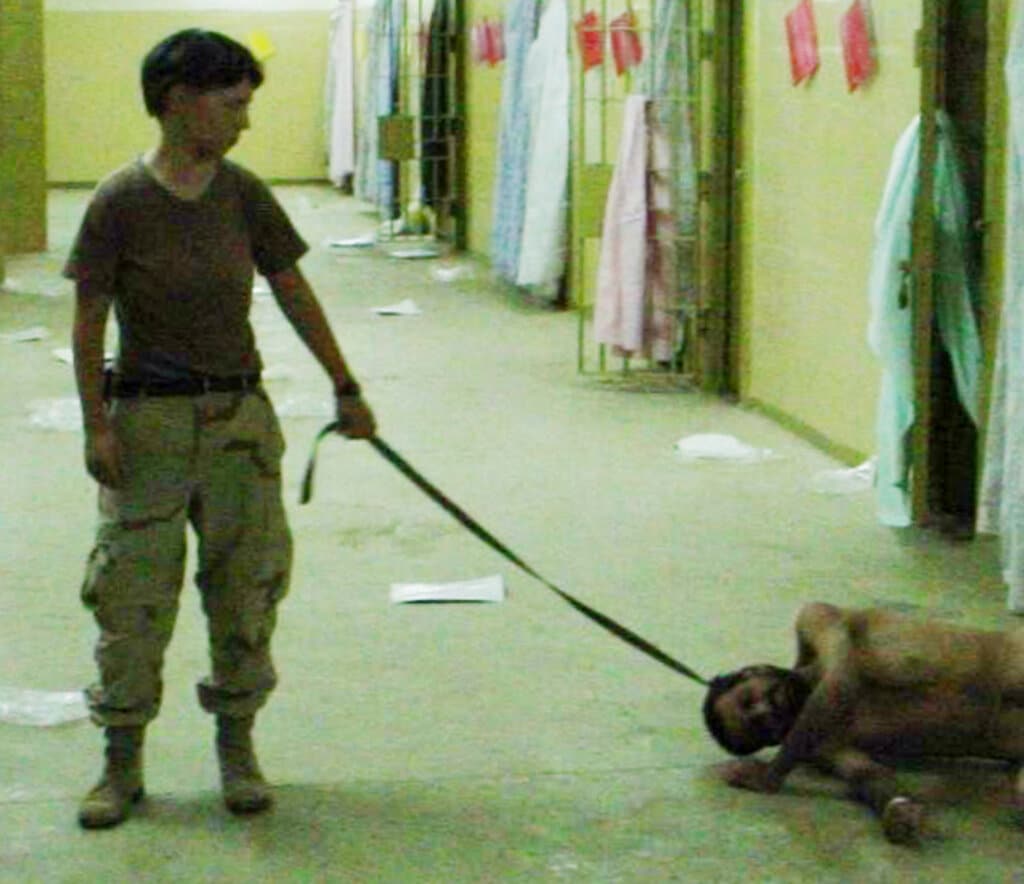
*This is an image obtained by The Associated Press which shows Pfc. Lynndie England holding a leash attached to a detainee in late 2003 at the Abu Ghraib prison in Baghdad, Iraq. (AP Photo)
Presidential authority during wartime
At the same time, the administration was facing a serious challenge to its authority in the courts. Since 9/11, it had claimed enormous power to conduct the war on terrorism, including the right to do almost anything it wanted with “enemy combatants,” including holding them in secret prisons and subjecting them to “waterboarding” and other forms of torture during interrogation; denying them access to the American courts; and trying them for war crimes in military tribunals that did not provide the rights required by the Geneva Convention. The president claimed this authority under a 2001 congressional resolution giving him the power to use military force against Al-Qaeda as well as the war-making powers granted to him by the Constitution. This claim was soon challenged by several of the men held as enemy combatants, including two American citizens, José Padilla and Yaser Hamdi. Considering the history of deference that the Supreme Court has shown for executive authority during times of crisis, it would not have been surprising if the justices had sought some compromise with the administration. Instead, in June 2004, they rejected the president’s claim that enemy combatants were not entitled to ask the courts to review their detention. In an eloquent 8-1 decision in the case of Hamdi v. Rumsfeld, Justice Sandra Day O’Connor, writing one of the last opinions before her retirement, declared that a citizen who is held as an enemy combatant must have the opportunity to rebut the claims of the government in court. O’Connor told the government it was making the mistake that governments so frequently make during times of war. “It is during our most challenging and uncertain moments that our Nation’s commitment to due process is most severely tested; and it is in those times that we must preserve our commitment at home to the principles for which we fight abroad,” O’Connor wrote. She also reproved the government for arguing that the judiciary had “a heavily circumscribed role” during wars and other national emergencies. “We have long since made clear that a state of war is not a blank check for the President when it comes to the rights of the Nation’s citizens,” she wrote.
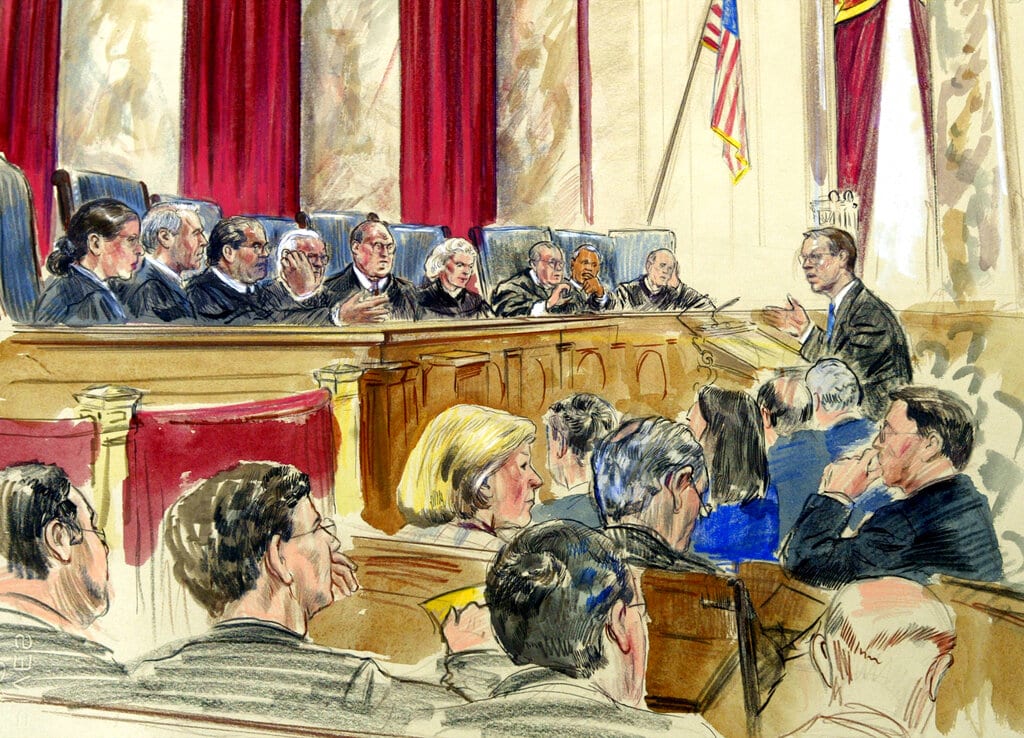
This sketch shows Deputy Solicitor General Paul Clement argue on behalf of the government before the Supreme Court on Wednesday, April 28, 2004 in Washington. Lawyers for both Yaser Esam Hamdi and Jose Padilla argued that President Bush has overstepped his authority since the Sept. 11 attacks by jailing American citizens suspected of links to terrorism and denying them access to lawyers and courts. (AP Photo/Dana Verkouteren)
Impact of Hamdi v. Rumsfeld
The Supreme Court’s decision in Hamdi sent a message to the federal courts that they must act to protect civil liberties. Judge Marrero was the first to heed the call when he overturned the NSL section of the Patriot Act three months later. A second NSL case became public in August 2005 when the ACLU challenged the FBI’s effort to force a Connecticut library consortium, Library Connection, to provide information about a patron who had used one of its computers in February. The case seemed star-crossed from the beginning. First, the FBI was confronting four very determined librarians — Barbara Bailey, Peter Chase, George Christian, and Janet Nocek. They were well aware that the NSL section had been declared unconstitutional by Judge Marrero. Although they were willing to consider complying with a court order that had been issued by a judge, they refused to turn over records just because the FBI was demanding it. Then, while requiring that the librarians and the ACLU strictly observe the NSL gag order, the government did not properly censor its own documents, inadvertently revealing the names of Peter Chase and Library Connection. In September, U.S. District Court judge Janet C. Hall ordered the government to lift the gag on the plaintiffs. They hoped to be able to speak out in time to influence the debate over the reauthorization of the Patriot Act. But the Justice Department appealed Judge Hall’s decision, and the gag stayed in place until the government dropped the case in the spring of 2006. At a press conference in May, George Christian, the executive director of Library Connection, said he regretted not being able to participate in the Patriot Act debate. “The fact that I can speak now is a little like being permitted to call the fire department only after a building has burned to the ground,” he said.

Families of 9/11 victims observe a moment of silence as they gather at a reflecting pool on the sixth anniversary of the Sept. 11 attacks, Tuesday, Sept. 11, 2007 in New York. (AP Photo/Pool, Justin Sullivan)
Civil liberties vs. national security
On September 11, 2006, the fifth anniversary of the 9/11 attacks, the American people were clearly ambivalent over the Bush administration’s national security policies. They were far more concerned about the threat of terrorism than the threat to civil liberties. A Gallup poll taken in August 2006 showed that 82 percent of the respondents were convinced that there would be a suicide attack on American soil in the next five years. It is not surprising that they expect their government to take active steps to protect them and that nearly 60 percent express support for the Patriot Act. However, it is also true that by a two-to-one margin the American people oppose taking any additional measures that violate civil liberties and that the number of people who believe the administration has gone too far has grown steadily and now stands at 41 percent. In addition, polls show that people are evenly divided over allowing government to search bookstore and library records, the wisdom of wireless wiretapping, and the NSA’s program of collecting the telephone records of millions of Americans.
Atoning for past mistakes in Montana

Montana governor Brian Schweitzer issued pardons to dozens of people convicted under the state's sedition law during World War I. (Public domain)
The surprise in the poll numbers is not that people are ambivalent. It would be foolish not to fear terrorism in the wake of the bombings that were carried out by Al-Qaeda agents or sympathizers in Madrid in 2004 and in London the following year. The latest Gallup poll was taken after the August 2006 arrest of twenty-four people in England who were suspected of planning to blow up as many as ten airplanes in flight. What is remarkable is that notwithstanding the very real danger of terrorism, the support for civil liberties is as high as it is. Many Americans are clearly worried about repeating the mistakes that we have made in the past. They include a group of law students at the University of Montana who in late 2005 launched a campaign to win pardons for seventy-five men and three women who were convicted during World War I under the state sedition law, which banned speech that criticized the government.
A law professor had suggested the idea after reading a book about the sedition cases by a colleague in the journalism department, Clemens P. Work. Not all of the students were enthusiastic in the beginning. “At first, I wasn’t sure it was important to exonerate these people,” one said. “But the more I thought about it, I realized that in the context of today’s world, it’s important to reaffirm the foundation of free speech.”
In May 2006, Montana governor Brian Schweitzer issued the pardons. “Across this country, it was a time in which we had lost our minds,” Schweitzer told the relatives of the convicted during a ceremony in the statehouse rotunda. “So today in Montana, we will attempt to make it right. In Montana, we will say to an entire generation of people, we are sorry. And we challenge the rest of the country to do the same.”
Who supports free speech?
The support for free expression involves more than the redress of past abuses. It also reflects the emergence of a constituency for free speech. Some of its supporters are members of minority groups who have experienced oppression directly or people who have seen its effect on friends and family. Governor Schweitzer’s grandparents were German-speaking immigrants from Russia who arrived in Montana only a few years before the use of German was banned and German-language school books burned in patriotic bonfires during World War I. Other free speech supporters work for the growing number of civil liberties groups that have been founded since the 1950s. Journalists and their associations have long played an important role in the fight for press freedom and open government. Clemens Work, the author of the book about the Montana sedition cases, is both a former reporter for U.S. News & World Report and a former deputy director of a journalists’ group, the Reporters Committee for Freedom of the Press. Finally, numerous professional and trade associations lobby actively on free speech issues. While the book and library community has taken a leading role, representatives of the other media groups have weighed in on issues affecting their members. One of the most beleaguered groups in recent years has been the video-game industry, which has been forced to challenge many laws banning the sale to minors of games with violent content. (The courts have repeatedly struck down these laws as violations of the First Amendment.)
Perhaps the best explanation for the expansion of free speech is that over the last century we have learned that it will survive only if we continue to cultivate it. The First Amendment was the law of the land for many years before it became an effective shield for dissent. The people of Montana during World War I saw no inconsistency between their belief in free speech and imprisoning people for saying things they disliked. The founding of the ACLU in 1920 was the critical first step toward making our professions about free speech mean something. Yet the labors of the activists alone would never have been enough if the Supreme Court had failed to recognize its responsibility for protecting the First Amendment, not only from the federal government but from the depredations of state legislatures, mayors, police chiefs, and sheriffs. The willingness of judges to look beyond the extreme and inflammatory opinions of the plaintiffs before them to the principle involved has placed free speech at the center of our constitutional system. Nor did the courts work alone. Although Congress acted as an oppressor during the McCarthy era, it has also approved critical reforms like the Freedom of Information Act that have strengthened free speech.
This excerpt from Chris Finan’s book From the Palmer Raids to the Patriot Act is published here thanks to the support of the author and Beacon Press.