
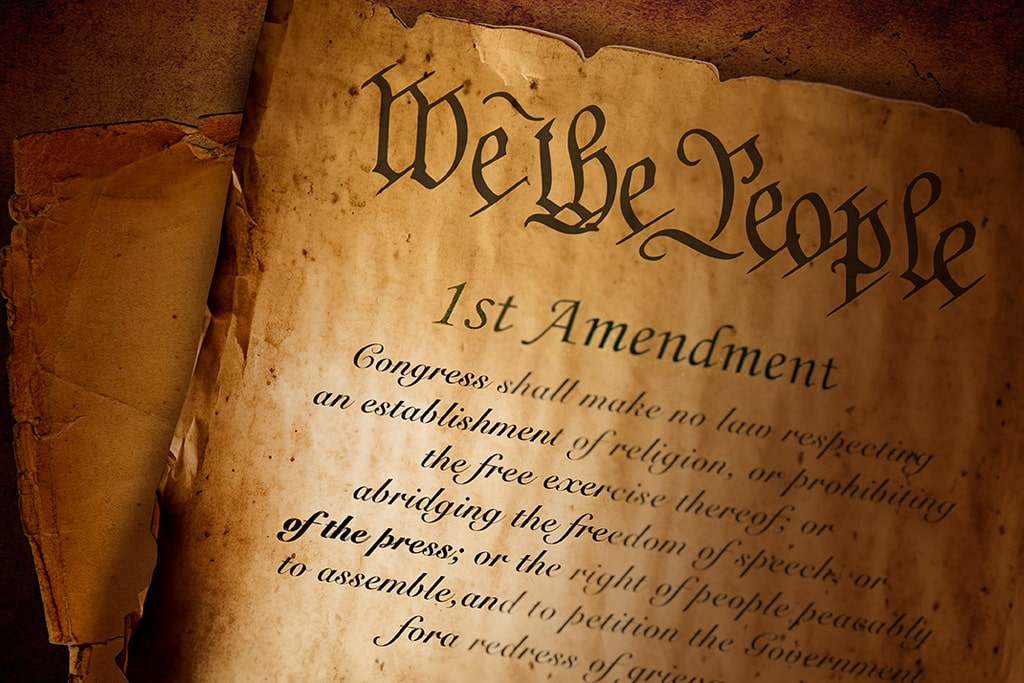
America’s journalists have long played a watchdog role in society, monitoring people in power and taking a stand in defense of our most cherished liberties. But sometimes the right to a free press — which makes good journalism possible — is itself under attack.
Here’s a recent sampling of voices in defense of journalism’s core mission:
The First Amendment is essential to democracy
By Robert Allen, Times News, Kingsport, Tenn., and Johnson City (Tenn.) Press, published on April 13, 2026
Federal Communications Commission Chair Brendan Carr recently said … “President Trump took on the fake news media and President Trump is winning … .”
The FCC is supposed to operate as an independent regulatory body, not a political scoreboard. … When the head of that agency frames changes in the media landscape as political wins, it raises serious questions about whether the FCC is acting as a neutral regulator or as an extension of partisan power.
The First Amendment exists precisely to prevent this kind of dynamic. … [A]ccountability should come from the public — from readers, viewers and voters — not from government agencies signaling winners and losers.
‘Charlie Kirk Bill’ going through Tenn. Legislature raises debate on campus free speech
By Nick Hill, WDEF, published on April 15, 2026
Does free speech on college campuses need extra protections? A bill named after the late conservative activist Charlie Kirk seeks to do that in Tennessee.
The bill in question, Senate Bill 1741, would require educational institutions to adopt policies affirming they will protect free speech.
… [S]ome Senate Democrats raised concerns that the protections outlined would effectively criminalize protest of any invited speaker, as the bill calls for schools to defend speakers from anyone who wishes to disrupt their events … . Senate Republicans argued that this bill would protect both speakers and protesters …
Erika Kirk parody may be offensive. It’s still free speech.
By James E. Causey, Milwaukee Journal Sentinel, published on May 11, 2026
In today’s climate, a growing number of people believe that if a comedian, talk show host, or media outlet offends someone, the First Amendment should not protect that speech. Increasingly, the response isn’t criticism — it’s lawsuits and threats of shutdowns.
… [T]he second Trump administration… has targeted institutions — including universities — that allow speech or protests he opposes…. [T]he message is clear: speech that is critical or uncomfortable [for the administration] is increasingly framed as something to be punished rather than protected.
The First Amendment exists precisely to protect speech that is uncomfortable, offensive, or unpopular. It guarantees freedom of religion, speech, press, assembly, and petition — not just for ideas we like, but for those we don’t.
If we start carving out exceptions based on offense or political alignment, we don’t just weaken those protections — we risk losing them altogether.
The Tenn. right’s perversion of free speech
By Ben Sessoms, the Chattanooga Times Free Press, published on May 8, 2026
… [T]hrough the Charlie Kirk Act, passed by state lawmakers and on its way to Gov. Bill Lee’s desk, the GOP supermajority in Nashville is forcing its exclusive worldview onto the college campus, under its distorted definition of free speech.
This legislation is not some good-faith effort to promote rigorous debate and free speech on campus. It is the enforcement, by the supreme authority of the state, of what amounts to conservative safe spaces at each public college and university in Tennessee.
… [By] essentially criminalizing dissent or demonstrations against conservative guest speakers, the state is distorting free speech into a draconian dichotomy where one side is told to shut up and listen while the other is given a deafening megaphone.
Shades of Comey case: ACLU says Ind. man did not threaten state officials by posting ‘86’ on social media
By Marilyn Odendahl, The Indiana Citizen, published on May 26, 2026
The ACLU of Indiana has filed a motion … to prevent … Indiana Attorney General Todd Rokita’s office from taking “any adverse action” against a Monroe County man who posted “86” on the social-media pages of several state elected officials.
… The ACLU maintained “86” is not a menacing term, but rather slang for “throw out,” “get rid of” or “refuse service to.” Lawmaster, according to the ACLU, was exercising his First Amendment rights by urging some elected officials, including Rokita, Lt. Gov. Micah Beckwith and U.S. Sen. Jim Banks, R-Indiana, “be thrown out and gotten rid of,” because he did not like their policies and actions.
… [I]n a press release [the ACLU said,] “Sending a state investigator to his home to warn him that he could be indicted for that speech is exactly the kind of government intimidation the First Amendment forbids.”
The case is Lee Lawmaster v. Kurt Spivey, 1:26-cv-923.
This column was compiled by Kara Hooper of the Free Speech Center. The press and public are invited to submit examples of commentaries and editorials about the value of freedom of the press at freespeechcenter@mtsu.edu.
The Free Speech Center newsletter offers a digest of First Amendment and news-media news every other week. Subscribe for free here: https://bit.ly/3kG9uiJ