
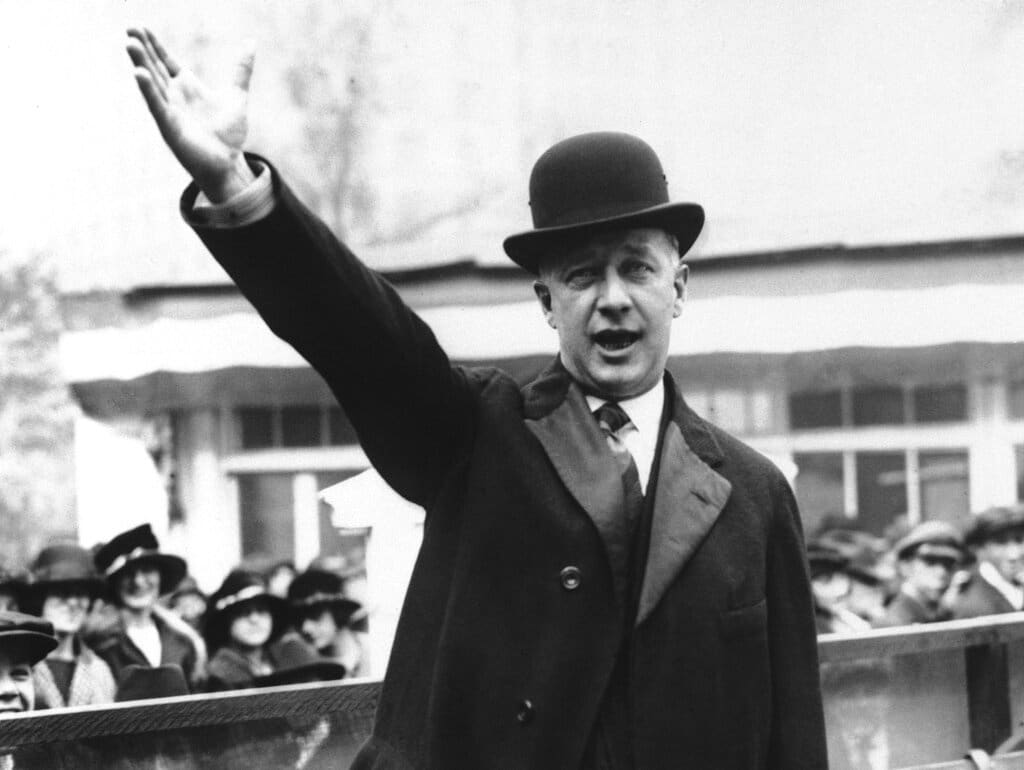
Alfred (Al) E. Smith (1873-1944) was a New York governor nominated by the Democratic Party for president in 1928. He lost the general election in a landslide to Herbert Hoover. Although Smith’s membership in the Roman Catholic church probably gained some votes, it also stirred anti-Catholic sentiments that may have contributed to his loss.
Letter by Charles C. Marshall
These sentiments were raised in part by a letter written by attorney Charles C. Marshall that was published in the April 1927 issue of The Atlantic Magazine. Although Marshall commended Smith for his spirit of “fair play, and justice even to your political opponents,” Marshall, who was a member of the Episcopal Church, thought that Smith needed to confront accusations that he would be beholden to Roman Catholic doctrine over that of the Constitution. Marshall believed that many Americans feared that, as a Roman Catholic, Smith might hold views that “are irreconcilable with the Constitution which as President you must support and defend, and with the principles of civil and religious liberty on which American institutions are based.”
Citing a variety of Catholic encyclicals that suggested that the Roman Catholic Church was paramount to civil governments, Marshall thought that this was inconsistent with the religious clauses of the First Amendment and with Supreme Court decisions such as Watson v. Jones (1871), which indicated that the U.S. government did not take sides in religious disputes.
Given the large number of Catholic parochial schools, Marshall was particularly concerned about the stance that Smith might take toward public schools. He also raised concerns about civil marriages and foreign policy toward Mexico, which had imposed limits on the Catholic Church.
Marshall noted that the Catholic Church had seemed to condone disobedience when in 1886 Pope Leo XIII had beatified John Felson, who had in 1570 posted a papal decree, contrary to the British law against treason, that had supported deposing Queen Elizabeth I from her throne.
Al Smith’s Reply
Although Smith reputedly initially responded by asking “What the Hell is an Encyclical?” he crafted a respectful and careful response in which he disclaimed “without mental reservation” many of the views that Marshall had attributed to Roman Catholic authorities. Noting that he was neither a lawyer nor a theologian, Smith relied on other Catholics who had fought and died for the nation, had served as chief justices of the United States, and who had affirmed their adherence to the separation of church and state.
Citing the manner in which he had never inquired into the religious beliefs of those with whom he had employed in New York government, he noted his own record of “the preservation of freedom of speech and opinion against the attack of war-time hysteria.” He said that since both his faith and the law of the land were built “upon the Commandments of God,” there could be no conflict between them.
Smith accused Marshall of misunderstanding or taking out of context many of the encyclicals and other documents he had quoted, and he noted that a number of Catholic leaders had specifically commended separation of church and state as practiced in the United States. If U.S. law and Catholic teachings diverged, a Catholic would face no greater challenge than would a Protestant whose own church differed from state policies.
The Catholic Church taught that “obedience to law is a religious obligation, binding in God’s name the conscience of the citizen.” Having attended parochial school, Smith said that he had never been taught that the state should prefer the Roman Catholic religion over others.
Smith further denied that he or the Catholic Church believed that governments should use force to instruct the Mexican government how it should rule. Rather sagely, he did “recognize the propriety of Church action to request the good offices of this country to help the oppressed of any land, as those good offices have been so often used for the protection of Protestant missionaries in the Orient and the persecuted Jews of eastern Europe.”
Acknowledging that he believed “in the worship of God according to the faith and practice of the Roman Catholic Church,” Smith said that he recognized “no power in the institutions of my Church to interfere with the operations of the Constitution of the United States or the enforcement of the law of the land.” He further affirmed his belief “in absolute freedom of conscience for all men and in the equality of all churches, all sects, and all beliefs before the law as a matter or right and not as a matter of favor.” This included his belief “in the absolute separation of Church and State and in the strict enforcement of the provisions of the Constitution that Congress shall make no law respecting an establishment of religion or prohibiting the free exercise thereof.”
Reaffirming his support for both public and parochial schools and his opposition to interference in the internal affairs of other nations, Smith ended his response by joining “with fellow Americans of all creeds in a fervent prayer that never again in this land will any public servant be challenged because of the faith in which he has tried to walk humbly with his God.”
John F. Kennedy faces a similar issue
Despite Smith’s wish and the U.S. Constitution’s prohibition of religious oaths as a condition for public office, John F. Kennedy faced similar concerns when he ran for president in 1960. In a speech to the Greater Houston Ministerial Association, Kennedy made a similar reply in affirming his commitment to uphold the U.S., a Constitution and to the doctrine of separation of church and state as embodied within the First Amendment.
In running for president in 2012 against Barack Obama, Mitt Romney made similar arguments after concerns were raised about his membership in The Church of Jesus Christ of Latter Day Saints. In a hopeful sign that religious bigotry might be subsiding, neither John Kerry, who ran in 2004, nor Joe Biden, who was elected president in 2020, faced major questions related to their Roman Catholicism.
John R. Vile is a political science professor the dean of the Honors College at Middle Tennessee State University.