
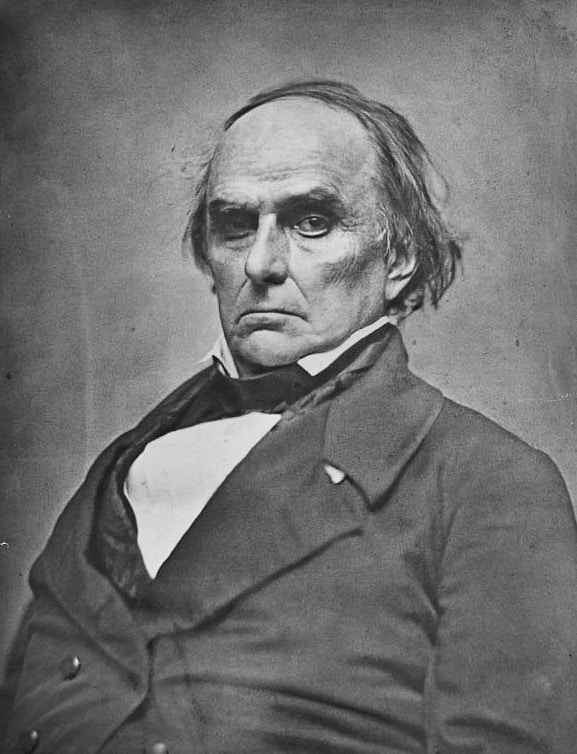
Daniel Webster (1782-1852) was a lawyer who is recognized as one of the greatest U.S. lawyers, orators and senators of the 19th century. Educated at Dartmouth College, and then as a law clerk, he served first in the U.S. House of Representative on behalf of New Hampshire, where he had been born, and then in the House and later the Senate from Massachusetts. He also served as Secretary of State under presidents William Henry Harrison, John Tyler and Millard Fillmore.
Webster was a strong nationalist with regional pride
Webster was a strong nationalist who argued numerous cases before the U.S. Supreme Court. They included successful arguments for the constitutionality of the national bank in the case of McCulloch v. Maryland (1819), for the sanctity of contract in Dartmouth College v. Woodward (1819) and for the supremacy of congressional powers over conflicting laws dealing with interstate and foreign commerce in Gibbons v. Ogden (1824).
As a New Englander, Webster expressed great pride in the Pilgrims who came to America and in the principle of religious liberty that is embodied in the free exercise clause of the First Amendment.
As a committed unionist, Webster was a strong opponent of the doctrines of state nullification of federal laws and of the doctrine of secession, but he was willing to compromise on issues related to slavery in order to preserve the Union.
Webster’s defense of freedom of the press
Nowhere was this clearer than in a speech that Webster delivered in the U.S. Senate on March 7, 1850, in which he defended the Compromise of 1850 that Senator Henry Clay of Kentucky had crafted to resolve issues involving slavery that were dividing the North and South. In the opening line, Webster expressed his desire to speak “not as a Massachusetts man, nor as a northern man, but as an American, and a member of the Senate of the United States.”
Webster presented an extended discussion in which he noted that whereas early Americans in both North and South had regarded slavery as an evil that they hoped could be confined and would die out, later southerners, most notably John C. Calhoun, began to argue that it was a positive good that should be expanded. He discussed his own initial opposition to the admission of Texas as a slave state but argued that once admitted as a slave state, the Union had no right to abolish slavery there or in any other state where it currently existed.
Most of the controversy over congressional gag orders rejecting anti-slavery petitions had taken place in the House of Representatives, and Webster regretted the “state of crimination and recrimination between the North and the South.” He thought that states had an obligation under the fugitive slave clause, and under the Compromise of 1850 that he was supporting, to return runaways.
Although he believed that many abolitionists were good men, he did not think that abolition societies were very “useful.” Although he understood southern concerns about sending incendiary anti-slavery pamphlets into the South, he observed that as late as 1832, southern states had engaged in debates over the desirability of abolishing slavery, which literate slaves could have read.
Webster defended what southerners viewed as “the violence of the press.” In a strong defense of a free press, Webster observed that “the press is violent everywhere. There are outrageous reproaches in the North against the South, and there are reproaches in not much better taste in the South against the North.”
Acknowledging that extremists in both camps often “mistake loud and violent talk for eloquence and for reason,” and “think that he who talks loudest reasons the best,” he clearly thought that freedom of speech and press deserved constitutional protection.
He observed that strong speech was to be expected: “when the press is free, as it is here—and I trust always will be—for, with all its licentiousness, and all its evil, the entire and absolute freedom of the press is essential to the preservation of government, on the basis of a free constitution.’ He continued. “wherever it exists, there will be foolish paragraphs, and violent paragraphs, in the press, as there are, I am sorry to say, foolish speeches, and violent speeches in both houses of Congress.”
While southerners objected to abolitionist literature, Webster noted that arguments by southern apologists who claimed that slaves had better working conditions than the laborers in the North were hurtful to those northern laborers. Observing that laws should address whether free blacks who were employed on ships should be imprisoned when their boats arrived on shore, Webster distinguished such “matters of law” from “matters of opinion,” protected by the Constitution, where all that could legally be done was “to endeavor to allay the agitation, and cultivate better feeling and more fraternal sentiments between the South and the North” that would preserve the Constitution and the Union.
Abolitionists felt betrayed by Webster’s speech
Many abolitionists felt betrayed by Webster’s speech. For example, Ralph Waldo Emerson said that “the word ‘Liberty’ in the mouth of Mr. Webster sounds like the word ‘love’ in the mouth of a courtesan.” Webster subsequently resigned from the Senate in order to become Secretary of State.
Abraham Lincoln was later elected as president on a platform, similar to Webster’s position, in which he regarded slavery as a moral evil that should be contained within states where it was already established but that he did not think (absent war) the national government had the power to eliminate in states where it already existed.
Although the Compromise of 1850 provided the nation with a temporary respite, calls like Webster’s and Lincoln’s, for continued Union, ultimately failed to prevent secession by the southern states, and the issue of slavery was resolved by Civil War (1861-1865) and the adoption of the 13th Amendment (1865).
John R. Vile is a political science professor and dean of the Honors College at Middle Tennessee State University.