
The issue of censorship usually involves First Amendment protections for freedom of speech and press. However, as Federalists once argued, the entire Constitution was intended to protect fundamental rights through such mechanisms as the division of national powers among three distinct branches of government (separation of powers) and between local, state, and national authorities (federalism).
City of Philadelphia v. Burgum, Civil Action No. 26-434, (2026), which was decided by the judge of the U.S. District Court for the Eastern district of Pennsylvania, provides a good example of this.
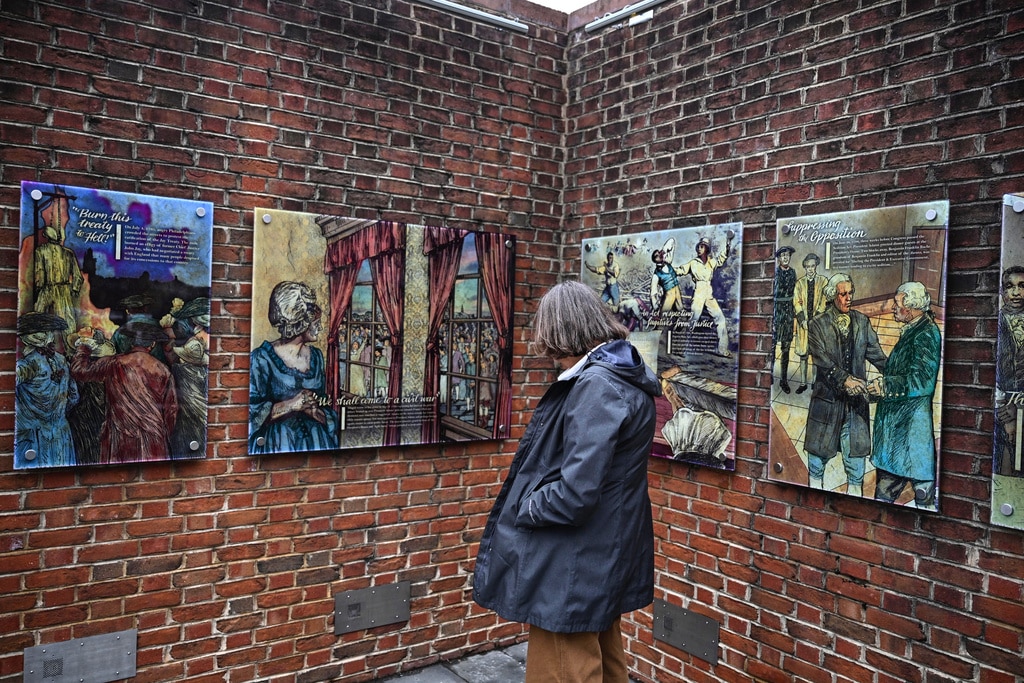
Exhibit on slaves who had lived in President's House in Pennsylvania
This case arose from a dispute in Philadelphia. It involved displays at the President’s House, a component of the Independence National Historical Park, which also includes Independence Hall (where the Declaration of Independence and the U.S. Constitution were signed) and the Liberty Bell pavilion. The site commemorates the U.S. president’s first official residence where George Washington and (for a time) John Adams lived during their time in that office.
The site had included information about nine slaves whom Washington had cycled in and out of the house during his presidency, one of whom, Oney Judge, had escaped to freedom in New Hampshire. The National Park Service, the city, and the U.S. Congress had all decided that their stories should be told. When the House exhibit opened in December 2010, it was announced as the “President’s House: Freedom and Slavery in the Making of a New Nation.” The park service’s Foundation Document had further detailed “Liberty: The Promises and Paradoxes” as one of the interpretative themes of the park.
In subsequent years, on the basis of Oney Judge’s escape to freedom, the House was also nominated to be a National Underground Network to Freedom site as part of the National Underground Railroad Network to Freedom Act of 1998.
Trump’s order to remove exhibits that 'disparage Americans'
On March 27, 2025, President Donald Trump issued Executive Order 14253, which was entitled “Restoring Truth and Sanity to American History.” Trump explained that “Americans have witnessed a concerted and widespread effort to rewrite our Nation’s history, replacing objective facts with a distorted narrative driven by ideology rather than truth,” which had in turn undermined “the remarkable achievements of the United States by casting its founding principles and historical milestones in a negative light.”
Trump ordered the Secretary of the Interior “to ensure that all public monuments, memorials, statues, markers, or similar properties within the Department of the Interior’s jurisdiction do not contain descriptions, depictions, or other content that inappropriately disparage Americans past or living . . . and instead focus on the greatness of the achievements and progress of the American people or, with respect to natural features, the beauty, abundance, and grandeur of the American landscape.”
Secretary of Interior removes slavery history from President's House
In implementing this order, Secretary of the Interior Doug Burgum removed 34 educational panels at the President’s House that referenced slavery and deactivated accompanying video presentations. In response, the City of Philadelphia filed a lawsuit under the authority of the Administrative Procedures Act, asking for a preliminary injunction to restore the exhibit as it was and to prevent any further alterations to the house.
Burgum and other defendants did not present any evidence at a hearing on Jan. 30, 2026, but did present arguments before the district court which issued a ruling on Feb. 16, 2026, granting the injunction.
Judge: President does not have power to rewrite history
Judge Cynthia M. Rufe, who had been appointed by President George W. Bush in 2002, issued the preliminary injunction.. As in the case of Mark Kelly v. Pete Hegseth (2026), Rufe relied on the Administrative Procedures Act and other agreements between Philadelphia and the National Park Service rather than on the First Amendment.
Rufe prefaced her decision by quoting from George Orwell’s dystopian novel "1984," in which the governing “Big Brother” attempted to rewrite history. She posed the question of the case as that of deciding “whether the federal government has the power it claims – to dissemble and disassemble historical truths when it has some domain over historical facts.” She forcefully answered, “It does not.”
Removal violates agreements between National Park Service and Philadelphia, judge says
She decided that Philadelphia had standing to bring the case, and that its interests were “concrete, particularized, and actual.” They rested both on its interest in tourism and on statutory rights to which it was entitled by agreements it had entered with the National Park Service.
One of these agreements had included a “Survival Clause,” which provided that existing agreements involving exhibits would remain in effect unless all parties agreed to changes. She further decided that these agreements included not only Independence Hall and the Liberty Bell Pavilion but also “surrounding historic sites and buildings,” including the President’s House. She further decided that the suit was not blocked by the doctrine of sovereign immunity and that “contrary to Defendants’ arguments, the dismantling of the President’s House is not an unreviewable act of ‘day-to-day operations’ but rather a jarring alteration to the integrity of the site” that the national government had made unilaterally.
Acknowledging that the standards for obtaining a preliminary injunction alleging “arbitrary and capricious agency action” and “ultra vires” claims [those beyond powers allocated to governments] were high, Judge Rufe believed that the City of Philadelphia had met them.
She noted that, from the beginning, Congress, the city, and the National Park Service had agreed that the site would highlight the “Paradox of Freedom and Slavery.” Whereas President Trump’s Executive Order professed to prevent the replacements of “objective facts with a distorted narrative,” Judge Rufe said that “NPS’s action did the opposite by dismantling objective historical truths.”
Judge: Government can't 'arbitrarily decide what is true' based on whims
She pointed out that there is no dispute that Washington owned slaves and that some had escaped. Again, after citing Orwell’s “1984,” she observed that “The government here likewise asserts truth is no longer self-evident, but rather the property of the elected chief magistrate and his appointees and delegees, at his whim to be scraped clean, hidden, or overwritten. And why? Solely because, as Defendants state, it has the power.”
The judge dismissed the idea that the government-speech doctrine applied, observing that the government “cannot arbitrarily decide what is true, based on its own whims or the whims of the new leadership, regardless of the evidence before it.” She observed that “Congress specifically limited the authority of the Department of the Interior and NPS to unilaterally alter or control Independence National Historic Park. The agencies do not have the authority to flout that Congressional directive.” To do so would be to “impede the separation of powers instituted by the Constitution.”
Judge Rufe observed that “The President’s House represents the City fulfilling an obligation to tell the truth — the whole, complicated truth.” The injunction was necessary to prevent those visiting from receiving “a false account of this country’s history.” The government’s action also violated principles of federalism that call for cooperation between state and national governments.
Although the author’s visit to Philadelphia can confirm that as of April 18 displays remain down and have been replaced by white sheets of paper explaining that the president ordered them removed, it seems likely that with Philadelphia having already met the high bar needed to obtain a preliminary injunction, that the city will ultimately prevail.
John R. Vile is a political science professor and dean of the Honors College at Middle Tennessee State University.