
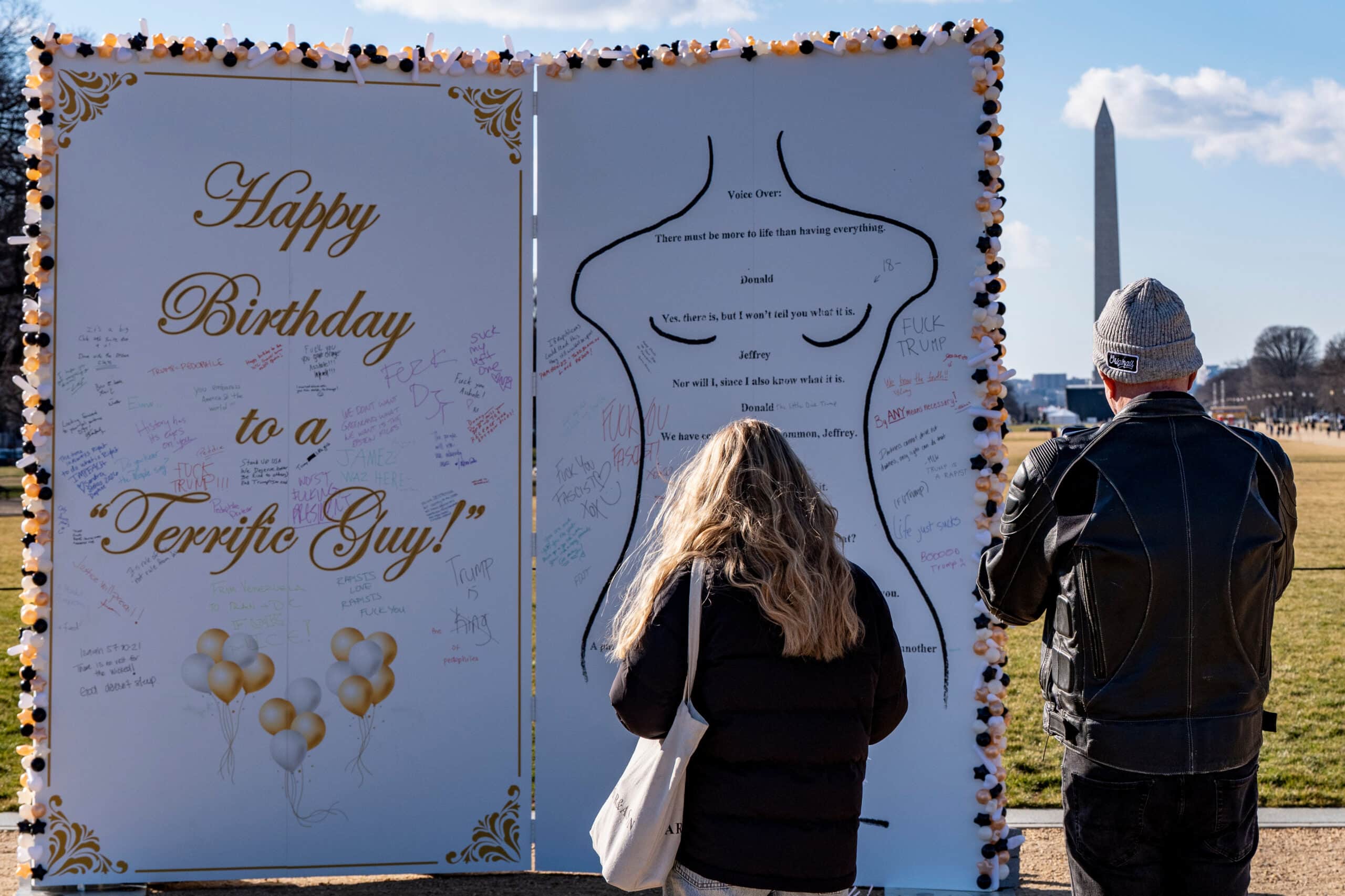
In Trump v. Dow Jones & Co., a federal judge dismissed a $10 billion defamation suit that President Donald J. Trump brought against the company that owns The Wall Street Journal, the company’s owner Rupert Murdoch and Journal reporters.
The Wall Street Journal had published two stories that alleged that Trump had contributed a bawdy page to a birthday book for Jeffrey Epstein’s 50th birthday in 2003. Epstein was a child sex offender who later committed suicide while in prison. The book, which contained a page with a typed text and a drawing of a naked woman with Trump’s signature mimicking pubic hair, had been compiled for Epstein by Ghislaine Maxwell, a close associate of Epstein who continues to serve prison time for child sex trafficking.
Judge Darrin P. Gayles, an Obama appointee, dismissed the case on Oct. 31, 2026, with prejudice, meaning that Trump cannot file the complaint again.
Actual malice standard in libel cases by public figures
Gayle began his ruling with a quotation from the Supreme Court’s decision in New York Times v. Sullivan (1964), which in turn quoted from Justice Louis Brandeis’ concurrence in Whitney v. California (1927). He cited the Sullivan decision for the principle that public figures (like Trump) would have to establish actual malice — that a publication was published with knowledge that it was false or with reckless disregard for its truth. Gayles said that this standard, designed to prevent the chilling of speech, required plaintiffs to establish such malice at the outset of the proceedings, which he found they had not done in this case.
In reviewing the facts, Judge Gayles observed that the page for the birthday book in question had been released as part of an investigation of the Committee on Oversight and Government Reform of the U.S. House of Representative and that it matched the picture that the Wall Street Journal had published. The ruling also noted that the Journal had included Trump’s denial that he wrote the letter or drew the picture in question. The judge decided that Trump’s denial of authorship was an insufficient cause for the Journal to suppress it; that the Journal did not have to have the original page to report it; and that it was not required to state how it had obtained its copy.
In focusing on whether Trump had established actual malice, Judge Gayles reasoned that the First Amendment provided publishers with “breathing space.” The judge further concluded that Trump’s allegations were “conclusory, vague, sometimes inconsistent with the Article, and often irrelevant to whether Defendants knew or should have known that the statements in the Article were purportedly false.”
The judge reiterated that the Journal was not required to suppress a story simply because the president denied its veracity. Moreover, by printing the president’s denial, the Journal had allowed readers to decide on its veracity for themselves. Although Trump claimed the Journal’s investigation had been inadequate, the judge noted that it had contacted the president and his team before publishing the story, and that most of the individuals it contacted had not responded. Moreover, the Journal had published pictures of other presidential sketches and signatures similar to the one on the birthday card so readers could judge authenticity for themselves. The judge concluded that efforts “to manufacture flaws with the investigation” amounted to “grasping at straws.”
Because of the uncertainty of which state laws applied to this case, the judge delayed deciding on the awarding of attorneys’ fees until the issue was more fully briefed.
Libel lawsuits lost by Donald Trump
This case is one of a number of libel suits that Donald Trump has lost, although he had received some major financial settlements with ABC and CBS news for defamation cases that were resolved out of court.
The case demonstrates that lower courts continue to apply the actual malice standard established in New York v. Sullivan in libel cases. The issue of attorneys’ fees serves, however, is a reminder that wealthy individuals with good legal teams might still inflict damages in the form of attorneys’ fees on publishers even in suits that plaintiffs do not win.
John R. Vile is a political science professor and dean of the Honors College at Middle Tennessee State University.