
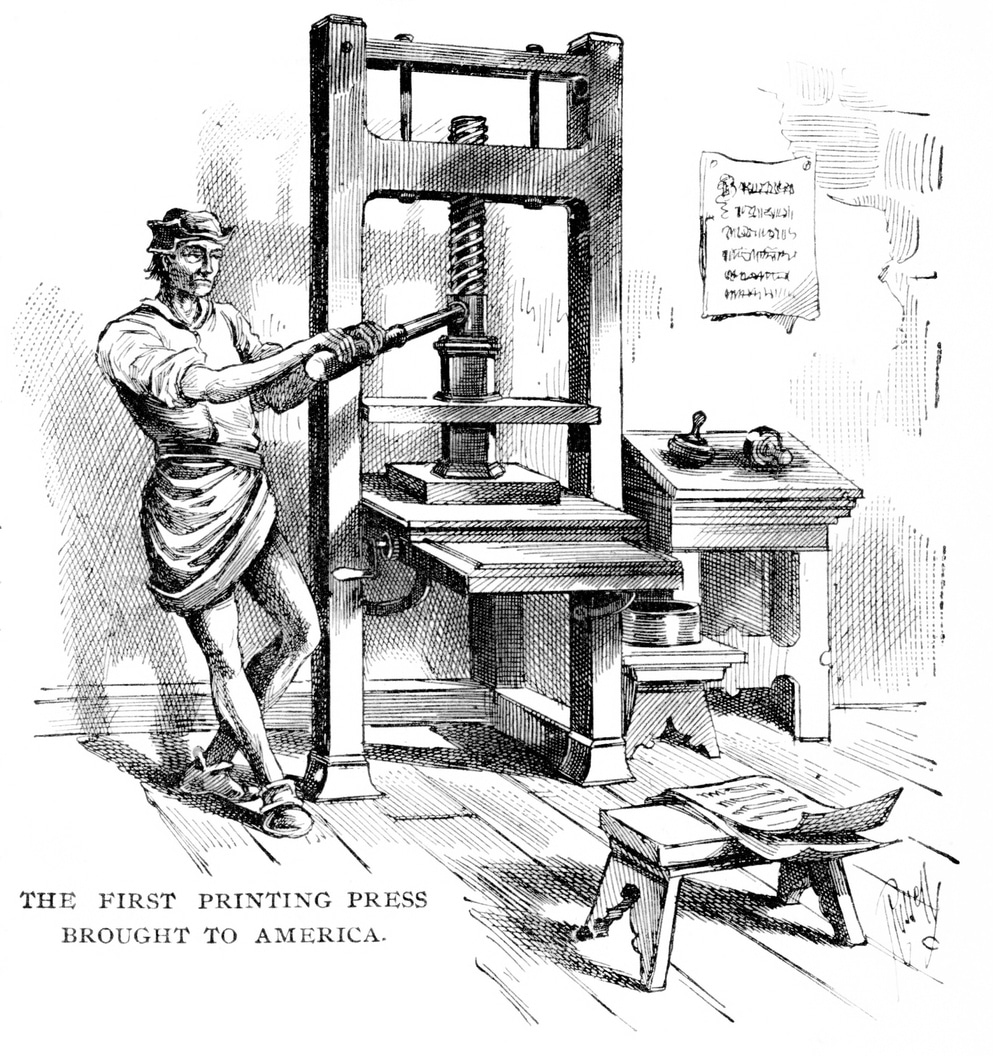
The American Revolution had a major impact on newspapers. Newspapers had been around for a long time in the colonies, but the Revolution gave them new functions to fulfill.
As the 13 colonies slowly dissolved their ties with Great Britain, newspapers played an increasingly important role in the growing dispute. Both Patriot and Loyalist writers used the weekly newspapers to attempt to convince their neutral countrymen to support their side. The Patriots were more successful, so much so that by the time the Revolution had begun, pro-British newspapers had disappeared from most colonies.
It was in the conflict over the Stamp Act that newspapers discovered a new role to play. The Stamp Act, to become effective November 1, 1765, was aimed at raising revenue to help Britain pay off its war debts. The act required that all legal documents, official papers, books, and newspapers be printed on stamped paper that carried a special tax. It placed an additional tax on advertisements.
It portended immediate disaster to printers, requiring that taxes be paid at the rate of a halfpenny per halfsheet, a penny for larger page sizes, and two shillings for each advertisement. The income that printers received from subscribers and advertisers was only slightly greater than the taxes. Striking as hard as it did at printers, the tax gave them a special reason to use their newspapers to oppose the Stamp Act. The press war against the Stamp Act began in Boston. Awakened to the dangers building against them, printers there took to their job cases to argue against the act as a frontal attack on the liberty of the people in general and the freedom of the press in particular.
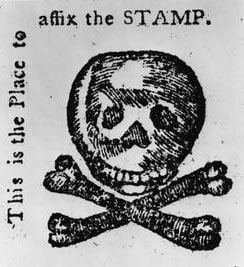
As the deadline approached, printers debated what to do. Some temporarily suspended publication while others came out defiantly as usual, appearing without the detestable stamp and declaring that the Stamp Act was a direct attack on liberty itself. Some printers also claimed that they continued publishing because of threats from Americans who wanted them to continue to protest the Stamp Act.
In late October, several newspapers published with black borders and a skull at the top to protest the impact of the Stamp Act. The most garish design was in the PENNSYLVANIA JOURNAL AND WEEKLY ADVERTISER which published in the funereal black columns of a tombstone, topped with skull and crossbones, mourning over the death of press liberty. It is notable that not a single newspaper published on stamped paper. In March 1766, Parliament, recognizing that the Stamp Act was unenforceable, repealed it.

Press regarded as a strong arm of Patriot movement
The Patriot press of the Revolutionary period is best understood as an organ for promoting ideology. Before the war, printers intensified their propaganda efforts against Britain but escaped prosecution because of popular opposition to British authority. The government grew increasingly lax in restricting printers. Having set the precedent during the Stamp Act crisis, authorities discovered they had more and more difficulty reining in insolent printers afterward. They faced the dilemma of wanting to punish offenders while fearing the result if they attempted to do so.
Concerted opposition to the British had begun with the Stamp Act. The newspapers’ success in helping to get the act repealed emboldened printers to defy British authorities and showed that the press could be used as an effective propaganda tool. The press therefore came to be regarded as a strong arm of the Patriot movement.
Influence of Boston newspapers
Boston Patriots were the most industrious in the colonies in promoting independence, and to that end they produced a widely circulated “Journal of Occurrences.” Published from late 1768 through the first half of 1769, it detailed Boston’s suffering under British military rule. Newspapers throughout the colonies picked up items from it, resulting in the publication of Boston Patriots’ views throughout the land.
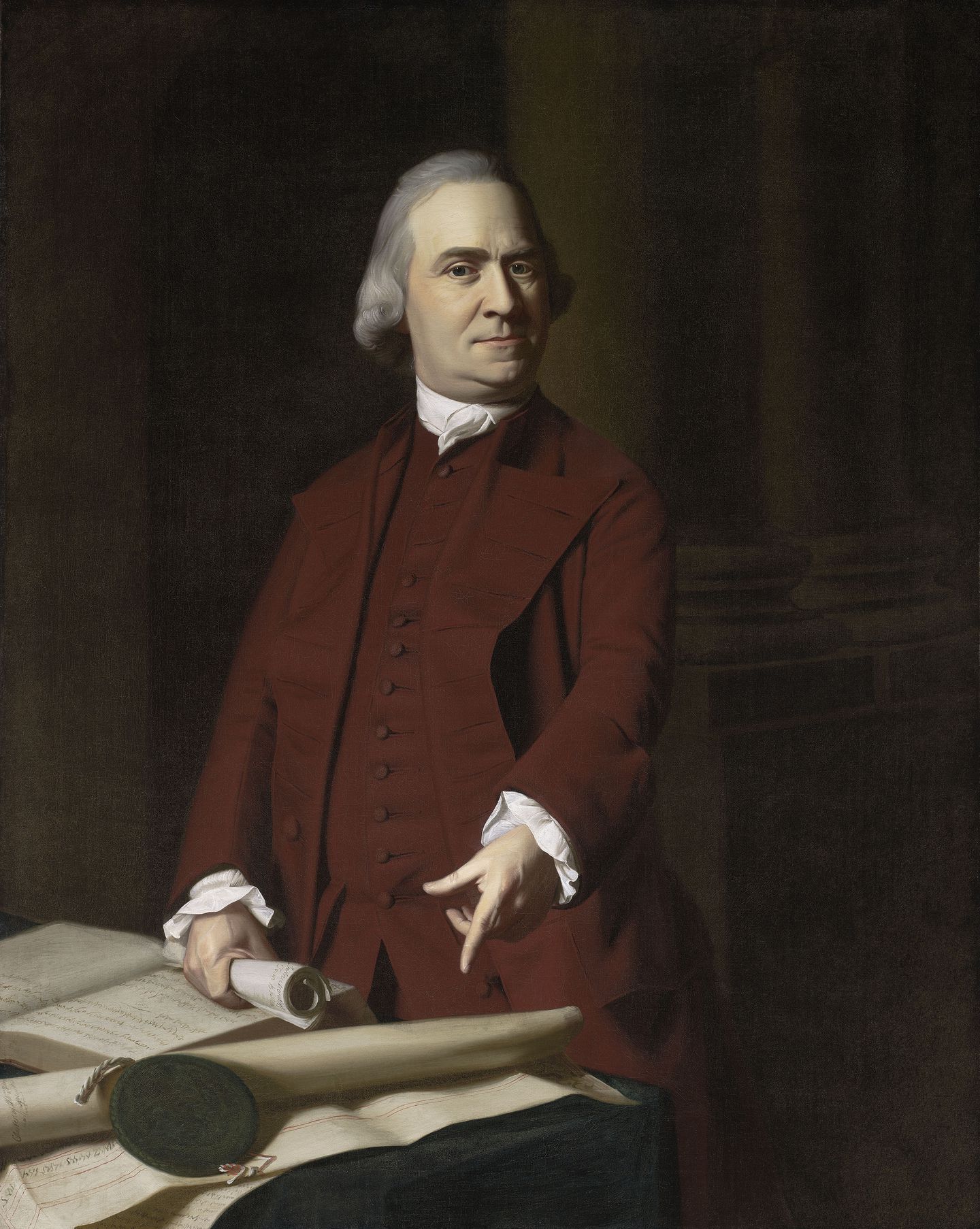
Samuel Adams of Boston did more than anyone else during his period to promote colonial independence from Britain as a realistic action. (image, public domain)
The most aggressive writer was Samuel Adams. It was said that America’s course was determined by Massachusetts, that Massachusetts’ course was determined by Boston, and that Boston’s was determined by Adams. It was Adams who, because of his GAZETTE writing and his talent for propaganda, did more than anyone else to promote colonial independence from Britain as a practical, realistic action.
The GAZETTE was the chief radical newspaper in the colonies; and its owners, Benjamin Edes and John Gill, were the most strident critics of the British prior to the Revolution. When the Tea Act of 1773 brought the issue of British trade monopoly to a boil, Edes was one of a number of Bostonians who guarded the wharves to prevent the opposition from landing the now hated tea. On December 16, 1773, a group of radicals joined Edes at his home. There they discussed the tea issue and at dark went to the GAZETTE office nearby. Others who had attended another meeting at Old South Church met them, and all donned Indian disguises. They then proceeded to Boston Harbor, where they boarded three ships and dumped 342 chests of tea overboard.
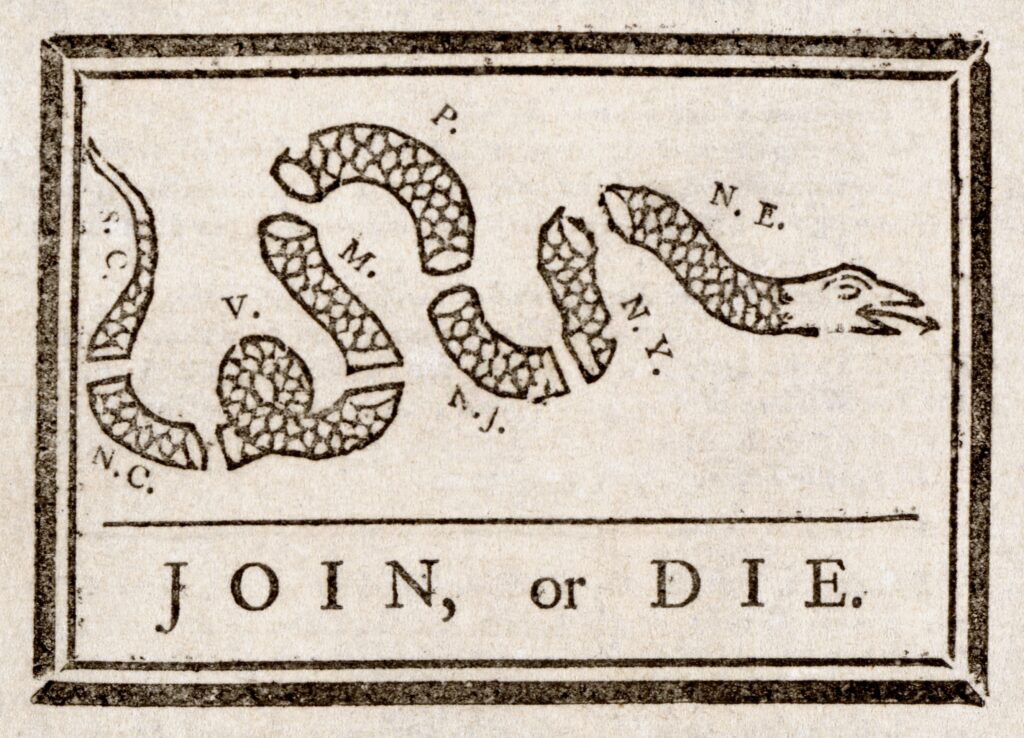
Whereas Edes and Gill’s BOSTON GAZETTE was the leading radical newspaper before the American Revolution, Isaiah Thomas’ MASSACHUSETTS SPY was the most incendiary publication during the Revolution. Prior to the war, Thomas had been outspoken in his support for independence. He revived the “Join or Die” divided-snake device that Benjamin Franklin had created in 1754, and he never softened his attacks on British trampling of colonial rights and liberties. Accounts such as his reporting of the battle of Lexington in 1775 were designed to stir up the anger of colonials. That account began with this call for action:
“Americans! Forever bear in mind the BATTLE OF LEXINGTON – where British troops, unmolested and unprovoked, wantonly and in a most inhuman manner, fired upon and killed a number of our countrymen, then robbed, ransacked, and burned their houses! Nor could the tears of defenseless women, some of whom were in the pains of childbirth, the cries of helpless babies, nor the prayers of age, confined to beds of sickness, appease their thirst for blood! – or divert them from their DESIGN OF MURDER and ROBBERY!”
'Committees of Corresondence' distributed information
More important than any single writer, however, were the Patriots’ committees of correspondence. They were created to distribute information and ideas among towns and colonies and to newspapers.
The impetus for the establishment of standing committees devoted to the Patriot cause came in 1772. In the wake of the attempts by Massachusetts’ Governor Thomas Hutchinson to insulate the courts from colonial influence, Samuel Adams issued a call for standing committees to be set up to resist the action. A Boston town meeting in November appointed a standing committee, and Patriots in other towns and colonies soon followed. They eventually established more than 80 committees. Each circulated letters to other committees and provided propaganda to newspapers. In that way, through informal organization, they succeeded in their goals of keeping the colonies informed of events, issues, and opinions and stirring up antagonism to British efforts to suppress colonial opponents.
Press became primary morale boosters during war
During the years of actual fighting, the press played a vital role as it provided information about the war. More than any other institution, it encouraged the people to support the war effort. Newspapers became the primary morale boosters throughout the Revolution. Printers used a variety of means to lift public confidence in the drive for independence. Throughout the war, essays and news stories emphasized the tyranny and corruption of the British and the glory and justness of the American cause.
Patriot newspapers sought to destroy any remaining colonial ties to Great Britain. Describing George III as the “whining King of Great Britain,” the press urged Americans to discard all loyalty to the mother country. Accusations of cruelty and barbarity by the British and their Tory supporters filled newspapers.
Even more important for morale than attacks on the British were discussions of American successes and future prospects. Printers filled their pages with material on the success of the Continental Army in battle. There was no doubt that the United States would be victorious, for, as one newspaper writer averred, “it is allowed on all hands that the American Army is now equal at least to any in the world for discipline, activity and bravery. There are no soldiers in Europe more exemplary for subordination, regularity of conduct, patience in fatigues and hardships, perseverance in service, and intrepidity in danger.”
Newspapers worked to increase public resolve by urging all readers to put the war above all other concerns. In 1776, Isaiah Thomas proposed: “Let us not busy ourselves now about our private internal affairs, but with the utmost care and caution, attend to the grand American controversy, and assist her in her earnest struggle in support of her natural rights and freedom.” Similar sentiments appeared throughout the war. According to Revolutionary printers, such efforts would produce final victory. Through such discussions, the press sought to help achieve victory by assuring that American morale remained high throughout the armed conflict.
During the war, printers filled their newspapers with stories and essays about the fighting. While obviously seeking to keep readers informed, they also hoped to keep them concerned as well. Newspaper efforts to encourage support and involvement and to boost morale went on for years, for the war proved to be a long one. As it came to a close, Benjamin Franklin praised newspapers for their usefulness, for, he explained, “by the press we can speak to nations…. And we now find, that it is not only right to strike while the iron is hot, but that it may be very practicable to heat it by continually striking.” This the Patriot newspapers had clearly done, through both defeat and victory, by their nonstop discussion of the war.
What influence did press have on success of Revolutionary War?
One of the most intriguing questions about the Revolutionary press is what influence it may have had. What role did newspapers, pamphlets, broadsides, and other printed forms have on the initiation and execution of the Revolution?
Most people at the time believed that the press exercised a major influence. Printers, Patriot spokesmen, and government authorities clearly thought the press was important. Otherwise, they would not have placed so much emphasis on it. Washington and other Patriot leaders went to great lengths to aid it, writers and printers used it to express their views to attempt to sway public opinion, and British authorities tried to suppress it. As early as the mid-1760s, the view was widespread that newspapers were playing a central role in affecting public opinion. A writer in the PROVIDENCE GAZETTE in 1766, commenting on newspapers’ success in opposing the Stamp Act, expressed that view. “The Press,” he declared, ‘hath never done greater Service since its first Invention.”
Thus it is clear that newspapers filled an important role during the war. They constituted the primary sources of information about the conflict. Although reports were not always accurate, printers hoped they would boost morale by helping to maintain interest in, and support for, the war effort. By publishing accounts from throughout the colonies, the newspapers helped foster a sense of unity and solidarity of purpose that was essential for a successful revolt.
Although not telling the whole story, the figures on newspaper mortality reveal something of the effect of the Revolution. At the beginning of the war, 37 newspapers were publishing in the colonies. Seventeen of those died during the war, leaving 20 publishing at its end. Thirty-three new papers were started. Of those, 18 died and 15 survived. Thus, at the end of the war, 35 newspapers were publishing, two fewer than at the beginning. While a difference of two may seem of little importance, it does not indicate the magnitude of the war’s effect. At one time or another, 70 papers were being published during the Revolution; only half survived. Such a high death rate during a period of seven years illustrates the hazards war posed for publishing.
The most important impact of the Revolution on the press, however, lay in the change the War of Independence brought to America. Freedom had been gained from the mother country, a new political philosophy took firm root, and the foundation was laid on which would be built a wholly new governmental system.
Carol Sue Humphrey is the author of "The American Revolution and the Press" and professor emerita of history at Oklahoma Baptist University where she taught for several years.