
As this encyclopedia demonstrates, Americans rely on historical documents to understand who they are. Although many such documents are public speeches, others consist of interdepartmental correspondence that may not be accessible to the public but that can especially be useful to historians or to others attempting to understand past administrations and their actions.
Presidential Recordings and Material Preservation Act of 1974
Congress has guaranteed access to all but the most top-secret government documents through the Freedom of Information Act and other access laws. But what happens when a president who has left office seeks to destroy documents from his administration?
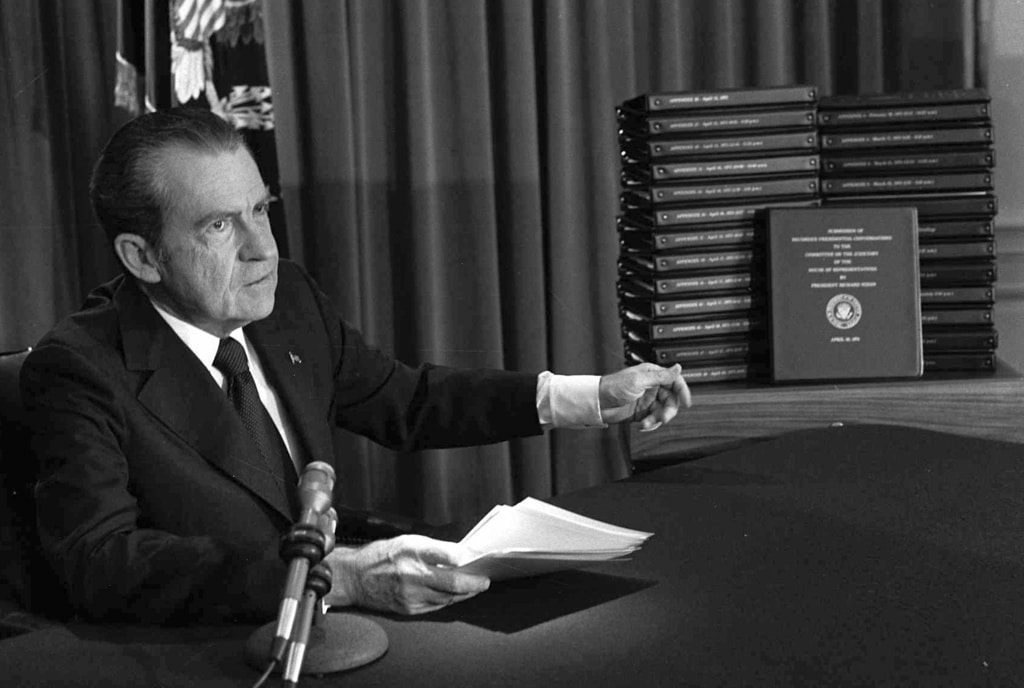
This was the issue that Congress addressed in the Presidential Recordings and Material Preservation Act of 1974 when it decided that preservation of the papers that Richard M. Nixon had claimed from his administration would not be solely left to his discretion.
Nixon had resigned and had entered into an agreement with the General Services Administration to allow him to destroy tapes he had recorded during his presidency within 10 years or upon his death. Congress reacted by passing the records preservation, which was signed by President Gerald R. Ford and defended by President Jimmy Carter.
Supreme Court says presidential records law did not violate separation of powers
Nixon challenged the law, which required that materials related to the president’s duties or abuse of governmental power be retained and prepared for public release by the National Archives.
The case went to the Supreme Court, which upheld the law in Nixon v. Administrator of General Services, 533 U.SS. 425 (1977) in a majority opinion written by Justice William Brennan Jr.
Recognizing that presidents previously were considered to own their documents, Brennan thought that the circumstances surrounding the adoption of the law and President Nixon’s actions were unique. Brennan denied that the law violated the doctrine of separation of powers or presidential confidentiality, or that it invaded the president’s privacy or interfered with his First Amendment associational rights.
Brennan pointed out that the separation of powers doctrine had never been interpreted completely to separate the three branches of government, and that the procedures that the law had established for the release of materials constituted only “limited intrusion” on the presidency that did not unduly impinge on his privacy rights. In dealing with Nixon’s claim that the law interfered with his First Amendment associational right and might therefore “chill” the advice that his aides might otherwise be willing to give, the Court noted that the law provided for a way to separate out conversations dealing with personal matters or partisan politics rather than those dealing with public policy, and that presidents Ford and Carter, who were both members of the executive branch, had both supported the law.
The Court also denied that the law constituted an unconstitutional bill of attainder, or legislative punishment of an individual without benefit of a trial. It also pointed out that the president was entitled to “just compensation” for his papers.
The decision involved a number of concurring opinions, including one by Justice Lewis Powell, who believed that the law was a justified exercise of congressional “investigative and informative powers.”
Interestingly, the opinion included dissents by then-Chief Justice Warren Burger and future Chief Justice William Rehnquist, both of whom thought that the law did violate separation of powers and unduly interfered with the independence of the executive branch.
In 2026, Trump Administration argues Presidential Records Act is unconstitutional
In 2026, T. Elliott Gaiser, the assistant attorney general in the Office of Legal Counsel in the Department of Justice, authored an opinion on behalf of the President Donald Trump Administration arguing that, despite the Supreme Court decision in Nixon, the Presidential Records Act is unconstitutional because it exceeds Congress’ enumerated and implied powers and because it violates the separation of powers. (The Presidential Records Act was passed in 1978 and is more comprehensive, establishing public ownership of all presidential records.)
Gaiser’s interpretation has already been challenged and will almost certainly end up back in court should Trump attempt to ignore or violate the law.
John Vile is a political science professor and dean of the Honors College at Middle Tennessee State University.