
As detailed in the essay in this Encyclopedia on “Pentagon Rules for the Press,” in 2025, Secretary of War Pete Hegseth adopted new rules for members of the press, who had already undergone security clearances, covering the Pentagon. The new regulations required them to sign statements limiting their solicitation of information, pledging not to report information that the Pentagon had not approved for public release, and granting the Pentagon the power to exclude those whom they thought posed security risks.
Hegseth and Sean Parnell, as chief Pentagon spokesman, withdrew the Pentagon Facilities Alternate Credentials for reporters who failed to comply. Seven journalists from The New York Times, as well as most other journalists who had held Pentagon credentials (including those from Fox News, which has generally been supportive of the Trump Administration) left rather than comply.
Those who were subsequently excluded from Pentagon briefings included Julian Barnes, a national security reporter for The New York Times, who had held Pentagon credentials since 2004. The Times, which has more than 12 million subscribers, applied for a summary judgment declaring the new rules to be unconstitutional on their face and enjoining their enforcement.
Judge Paul L. Friedman of the U.S. District Court for the District of Columbia, who had been appointed by President Bill Clinton in 1994, ruled on behalf of The New York Times on March 20, 2026 in New York Times v. Department of Defense.
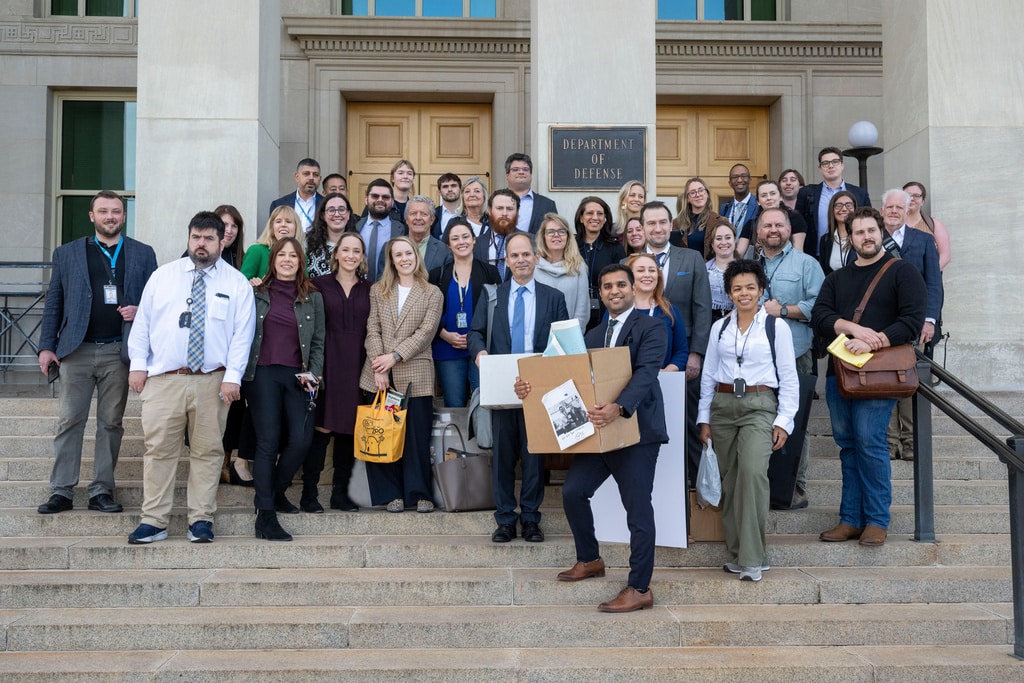
Journalists lost credentials when they refused to sign agreement to allow the Pentagon to restrict their reporting
Friedman observed that the Supreme Court had ruled in Nebraska Press Association v. Stuart (1976) that it looked with skepticism on efforts to control the press. He reviewed the history of press access to the Pentagon and the efforts of Secretary Hegseth to restrict it by seeking to have journalists sign a form limiting the information they would solicit and by granting discretion to exclude individuals that they thought posed unspecified “security or safety risk[s].”
Friedman observed that after most journalists had refused to sign and had been excluded, the Pentagon replaced them almost exclusively with individuals who had pledged favorable coverage to the administration. The replacements included: Mike Lindell, the CEO of My Pillow who had questioned the legitimacy of the 2020 presidential election and promised to make the administration “proud” of his coverage; Laura Loomer, a pro-Trump activist who had solicited sources via her tipline; and James O’Keefe, the founder of Project Veritas, who had pled guilty to entering federal property under false pretenses.
Judge: Rules violate Fifth Amendment, too vague
The New York Times raised issues under both the First and Fifth Amendments as well as the Administrative Procedures Act, although the judge thought the constitutional arguments were sufficient to decide the case.
In addressing due process claims under the Fifth Amendment, the judge relied heavily on a decision in Sherrill v. Knight, 569 F.2d 124 (D.C. Cir, 1977), involving a similar attempt to restrict press passes to the White House Rose Garden event that the court had found to be based on criteria that were too vague because they failed to provide proper notice of the basis for the exclusion. In the case at hand, reporters were left unsure as to what kind of “solicitation” would be considered inappropriate and as to what kind of penalties they might be subjected were they to ask a question that resulted in the disclosure of information that the Pentagon considered to be inappropriate.
Judge: Rules violate First Amendment and constitute viewpoint discrimination, censorship
The judge also believed that the new restrictions violated the First Amendment because they constituted viewpoint discrimination. Recognizing that the Pentagon was a nonpublic forum rather than a traditional or designated public forum, and thus subject to greater access control, this control did not extend to viewpoint discrimination, which the judge identified as an “egregious form of content discrimination.”
He observed that the policy was intended to chill the speech of news that the Pentagon considered to be unflattering. He noted administration statements referring to excluded news organizations as “fake news” and “scum” and noted its clear intent “to weed out disfavored journalists.”
Friedman further said that the “unbridled discretion” that the Pentagon had exercised was “unreasonable.” It resulted in “censorship” by vesting those issuing or denying passes “boundless discretion” in violation of the First Amendment. Indeed, he found that the policies had “layers upon layers of discretion” rather than being “guided by objective, workable standards.”
Citing an earlier decision, the judge further found that the denial of First Amendment rights even “for minimal periods of time, unquestionably constitutes irreparable injury,” and accordingly vacated the Department’s policy.
Judge: Public needs access to variety of perspectives about military actions
It is notable that this decision follows another court decision in which another judge found that the Trump Administration was required to reinstate employees of the Voice of America that it had dismissed, largely on ideological grounds and despite a congressional appropriation to support their activities.
As he ended, the judge observed that President Donald Trump had recently initiated military actions in Venezuela and Iran and that “it is more important than ever that the public have access to information from a variety of perspectives about what its government is doing—so that the public can support government policies, if it wants to support them; protest, if it wants to protest; and decide based on full, complete, and open information who they are going to vote for in the next election.”
He also quoted Justice Louis Brandeis’s statement that “sunlight is the most powerful of all disinfectants.”
Pentagon plans appeal, further restricts journalists access
Pentagon spokesman Sean Parnell said that the government will appeal the ruling. In the meantime, the Defense Department has announced that although it would reissue credentials to the journalists that were previously barred, it would now confine them to a Pentagon annex and that journalists would no longer be able to enter the Pentagon itself without an escort.
The Times went back to court to contest the new rules and received another ruling on its behalf by Judge Friedman who claimed that the Pentagon’s new rules were also unlawful. The judge observed that “The Department cannot simply reinstate an unlawful policy under the guise of taking ‘new’ action and expect the Court to look the other way.”
John R. Vile is a political science professor and dean of the Honors College at Middle Tennessee State University.