
The institution of democratic-republican government through the Constitution of 1787 provided an incentive to educate children in the principles of good citizenship and to develop textbooks toward that end.
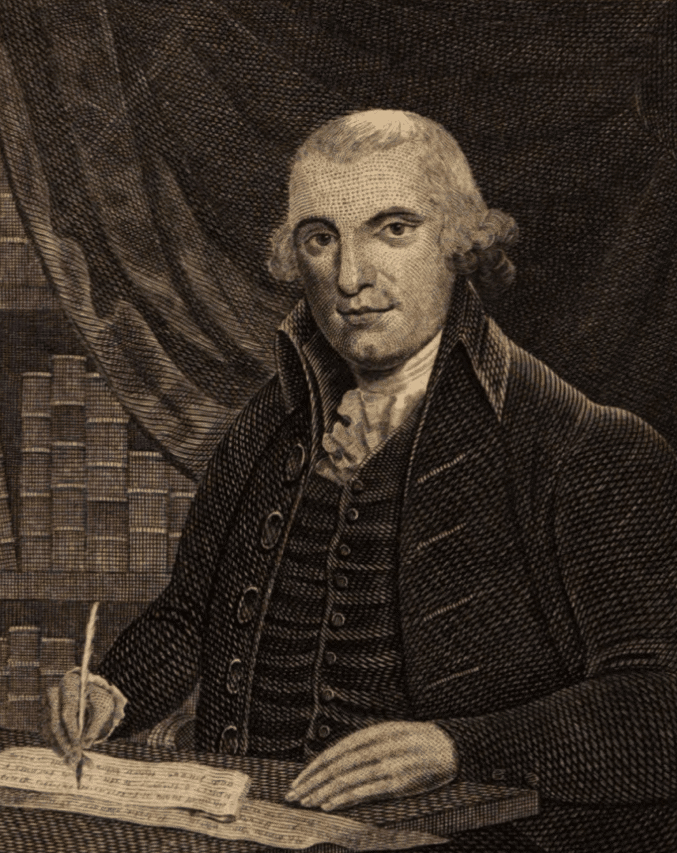
One of and perhaps the earliest of such attempts was that of Elhanan Winchester (1751-1797), a Baptist universalist, who was born in Massachusetts, where he was largely self-educated, but went on to hold several pastorates in Philadelphia, South Carolina (where he preached to slaves), and London, England, and evangelize throughout New England (Parry 2011).
Winchester’s textbook for children
In 1796, Winchester published "A Plain Political Catechism intended for the Use of Schools, in the United States of America: wherein the Great Principles of Liberty, and of the Federal Government, Are laid down and explained, in the way of Question and Answer" (here and throughout this discussion f’s are changed to s’s where appropriate). The title page further explained that the book was “made level to the lowest capacities,” presumably to indicate that it was designed for students in beginning grades.
Although this book highlighted certain portions of the Constitution, it mainly concentrated on larger principles (Lepore 2025, 185-86). In Lockean fashion, the opening pages thus described the differences between natural society among family members and the broader voluntary society by which individuals emerged from a state of nature, necessitated by their “weakness” and motivated by their desire to provide for their “wants” (5).
Discussion of First Amendment religious freedoms
As one might expect, the book lauded American freedom and contrasted it to the tyranny of many other nations. In describing such freedom, Winchester made several observations that related to the role of religion and to First Amendment freedoms.
In thus asking “Are not some principles of religion absolutely necessary to the existence of government?” Winchester responded affirmatively. Pointing to the importance of oaths in the Constitution, Winchester observed that such oaths were based on the idea “that there exists a Supreme Being, the great Creator, and Sovereign of the Universe”; “That he pays attention to the words and actions of men”; “That he loves and approves truth and abhors and detests falsehood”; and “That there is a future state of rewards of punishments” (17). At the same time, Winchester indicated that the Constitution did not require any religious test for public office, and that, by failing to do so, it helped discourage hypocrisy (18).
Although Winchester did not go clause by clause through the Constitution, he did quote the First Amendment in full (42). Moreover, he elevated the specific words of the Constitution and its amendments by observing that “A written constitution in government, is almost as necessary as a positive and written revelation is, in religion” (p. 62). Although Winchester proceeded to decry “deism, infidelity, and atheism” (p. 64) as undermining democracy, he did not advocate persecution but “the investigation of truth and a liberal enquiry into the principles of religion, liberty, government, the constitution of our country, etc.” (75).
Moreover, Winchester argued that one of the lessons that American government had demonstrated was that “the existence of the Christian religion, does not depend upon a legal establishment or setting up one sect above another” but that “a free air is the most congenial to real religion; and to allow all Christians to think freely for themselves and worship God according to the dictates of their own consciences, is certainly, not only most consistent with our natural rights, but the best policy” (79). He explained that “the way to destroy animosity and strife, all bigotry, persecution, and intolerance, and to promote peace, harmony, and goodwill amongst all denominations of Christians, is to place them all upon an equal footing; as the United States have proved by experience” (79).
Although it might appear that Winchester is only advocating freedom for Christians, as a premillennialist who believed that Christ would come to earth before setting up a thousand-year reign, he believed that Jews were still part of God’s plan and observed that “The United States teach the world, that no danger arises from naturalizing the Jews, as well as other nations. It doth not, and cannot make void the promises of God respecting them; neither will it in the least hinder them from returning to their own land, when the time comes” (81).
Assessing America’s future prospects, Winchester noted that they included “the continuance of the gospel amongst us to the latest period, and that true religion will rise and shine here, in all its native beauty and purity, and that civil and religious liberty, piety, virtue, benevolence, and morality will forever adorn these western regions; and that God will be our God, and we shall be his people” (pp. 84-85). He further connected the support and preservation of American rights and freedoms to “the spirit of liberty,” which he identified as “a living principle” that could be furthered through education (90-91).
Attention to other First Amendment Rights
Although Winchester did not devote as much attention to freedom of speech, press, assembly, and petition as to the religious provisions of the First Amendment, he made it clear that the preservation of these rights should perpetuate constitutional government.
Winchester thus noted that, should elected rulers abuse their powers, “we shall soon have it in our power to displace them constitutionally, and to choose such as are agreeable to our wishes. So that no riots, mobs, nor tumultuous proceedings are necessary, to gain, what we can much easier obtain by legal, peaceable, and constitutional means; and the minority should never try to rule the majority” (56).
Stansbury’s Catechism
In a later book entitled "Elementary Catechism on the Constitution of the United States" published in 1828 and designed for civic education, Arthur Stansbury (1781-1865), a Presbyterian minister, also chose to construct his publication in the form of a catechism.
Defining religious freedom as “the right every man has to worship God in such a way as he thinks fit, without being called to account for his opinions, or punished for them” (69), Stansbury observed that this right “ought to be guarded with the greatest care.” He explained that “God alone is the Judge of our religious belief and service, and no man has a right to interfere with it, so long as it does not lead us to injure or disturb our neighbor” (69). He further observed that “A great part of the misery and oppression which has existed in the world, began with forcing men to do what their conscience disapproved” (69).
In similar fashion, Stansbury described freedom of speech and press by noting that:
“In a free country like ours, every citizen has a right to express his opinion of the character and conduct of our rulers, and of the laws they make for our government; to forbid this, or punish it, would be highly dangerous to our liberty. If those chosen by their fellow citizens to rule the State, rule in a foolish or wicked manner, it ought to be known, that they may be speedily turned out of office; but if nobody might find fault with them without danger of punishment, their bad conduct would never be exposed, and they might continue in power to the great injury of us all. The right to speak our opinions is the freedom of speech; and the right to print them, that they may be read by others, is the freedom of the press” (69-70).
Stansbury further distinguished peaceable petitions and assemblies from behaving “in a riotous or disorderly manner” for which individuals could be justly punished (70).
Most contemporary educators continue to believe that civic education requires not only teaching about the Constitution of 1787 but also about its amendments, especially the First.
John R. Vile is a political science professor and dean of the Honors College at Middle Tennessee State University.