
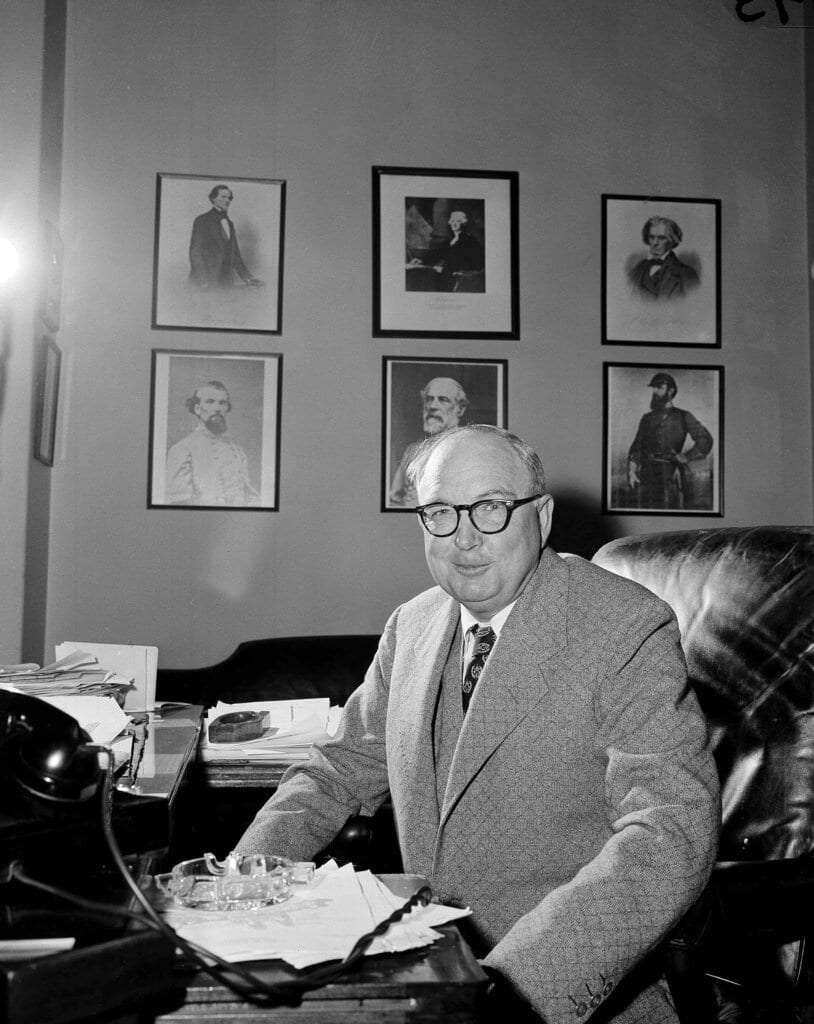
Although First Amendment rights are extremely important, they sometimes conflict with other rights. Such proved to be the case in Eastland v. United States Servicemen’s Fund, 421 U.S. 491, which the U.S. Supreme Court decided in 1975, citing the speech and debate clause in the U.S. Constitution that protects legislative speech by members of Congress.
Nonprofit said Senate subpoena of bank records was designed to stifle speech
The case involved a suit by the United States Servicemen’s Fund, a nonprofit organization that set up coffeehouses near military bases and was associated with opposition to the Vietnam War. It filed the suit against U.S. Sen. James Eastland of Mississippi and members of his Senate Subcommittee on Internal Security, which the U.S. Congress had commissioned to “make a complete and continuing study and investigation of . . . the administration, operation, and enforcement of the Internal Security act of 1950.” The subcommittee had subpoenaed bank records related to the organization.
The Servicemen’s Fund claimed that the subpoena was designed “to stifle the freedom of the press and association” guaranteed by the First Amendment. It sought and received a temporary injunction by a U.S. District court. Despite the decision in NAACP v. Alabama (1958), which had upheld the right of the NAACP not to disclose its membership list to state authorities, the court then concluded that it should not interfere with the congressional power of investigation.
The Court of Appeals for the District of Columbia reversed on the basis that the subpoenas threatened the right of association.
Burger upheld subpoena under Speech and Debate Clause
In a decision authored by Chief Justice Warren Burger, the U.S. Supreme Court reversed the circuit court decision chiefly on the basis of the Speech and Debate Clause, which protected members of Congress from being questioned about their speech. The Court observed that “Without exception, our cases have read the Speech or Debate Clause broadly to effectuate its purpose.”
The ruling observed that the clause had not been enacted simply to benefit individual members of Congress but to protect the right of Congress to exercise its independent authority. It further noted that “issuance of subpoenas such as the one in question here has long been held to be a legitimate use by Congress of its power to investigate.”
The investigation at issue corresponded to “a legitimate task of Congress,” and precedents had established that courts would not question congressional motives. In Gravel v. United States (1972) the Court had cautioned against congressional invasions of personal privacy, but it had been based on the view that Congress had engaged in an activity, unlike the one at question in this case, that was unrelated to its legislative function.
Citing “the absolute nature of the speech or debate protection,” the Court further denied that it could void the subpoena for the possible “chilling effect” it might have on speech or press rights.
3 justices concurred, 1 dissented
Justices Thurgood Marshall, William Brennan and Potter Stewart concurred in the judgment with the understanding that a party that was subpoenaed still had the right to test its rights in court.
By contrast, Justice William O. Douglas dissented. He argued that congressional powers “may not be used to deprive people of their First Amendment or other constitutional rights.” He added that he believed that “no official, no matter how high or majestic his or her office, who is within the reach of judicial process, may invoke immunity for his actions for which wrongdoers normally suffer”
Sen. Mark Kelly invoked Eastland in 2025 in challenging reprimand
No prosecutions resulted from the congressional investigation. U.S. Sen. Mark Kelly of Arizona has recently invoked the Eastland decision and the Speech and Debate Clause in challenging a reprimand he received from Secretary of Defense Pete Hegseth and threats to cut his military pension on the basis of statements he had made critical of Trump Administration policies.
John R. Vile is a political science professor and dean of the Honors College at Middle Tennessee State University.