
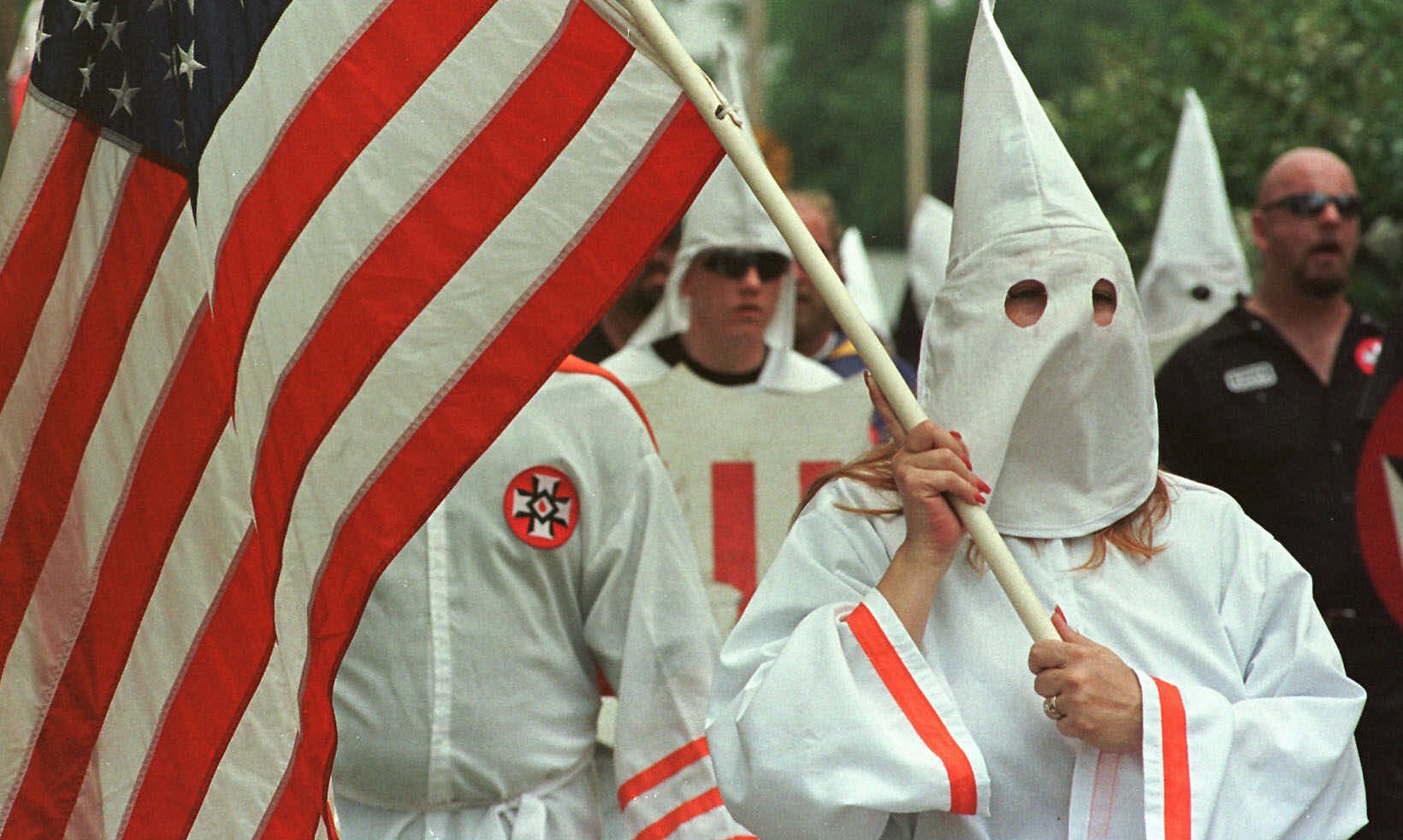
The earliest laws banning masked demonstrations date back to the antebellum era. In 1845, New York made it illegal to appear “disguised and armed.” Most anti-mask laws were passed, however, in response to the Ku Klux Klan, whose members used masks to hide their identities as they terrorized their victims.
Around 15 states have anti-mask laws, as do many counties and municipalities. Most anti-mask laws do not target specific groups explicitly. Instead, they use neutral language, typically banning mask wearing that intimidates others.
Supporters of such laws argue that wearing masks emboldens people to commit crimes and makes those crimes more frightening to the victims.
Opponents, in turn, make three arguments.
Mask laws and freedom of anonymity needed to express views
First, they invoke freedom of association, claiming that mask laws deprive wearers of the anonymity needed to express their views. They rely on NAACP v. Alabama (1958), which held that because its members feared harassment from opponents of civil rights, the NAACP did not have to reveal its membership list unless Alabama could supply a compelling state interest.
Klan members argued that if their masks were removed, they would face harassment. The Klan’s unpopularity added fuel to this argument. For example, in American Knights of the Ku Klux Klan v. City of Goshen (N.D. Ind. 1999), a court found that Klan members had indeed suffered harassment, through vandalism and bomb threats, and ultimately invalidated the city’s anti-mask law.
The Second Circuit Court of Appeals, in Church of the American Knights of the Ku Klux Klan v. Kerik (2d Cir. 2004), held that harassment of Klan members was irrelevant because the Constitution guarantees only the right to speak, not the conditions under which one speaks. Furthermore, in most cases involving the Klan, courts held that protecting citizens from intimidation was a compelling state interest.
Non-Klan mask wearers generally fared better when making freedom of association claims. In Aryan v. Mackey (N.D. Texas 1978) and Ghafari v. Municipal Court (Ct. App. 1978), political opponents of the shah of Iran successfully argued that they needed masks to avoid reprisals from the shah’s security forces.
Anarchists convicted under New York’s anti-mask law failed, however, to raise a constitutional claim in People v. Aboaf (Crim. Ct. 2001) because they could not show any harassment beyond famous anarchists having been persecuted in the past.
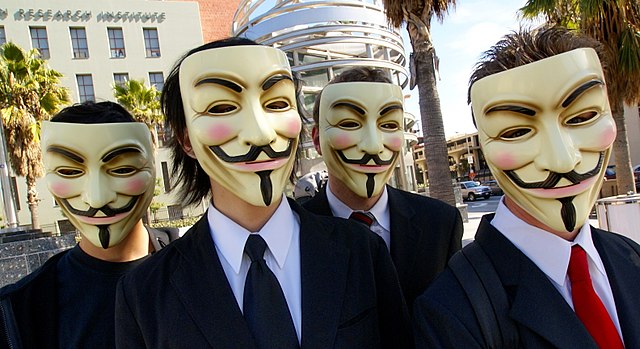
The earliest laws banning masked demonstrations date back to the antebellum era. In 1845 New York made it illegal to appear “disguised and armed.” Some 15 states have anti-mask laws, as do many counties and municipalities. Most anti-mask laws do not target specific groups explicitly. Instead, they use neutral language, typically banning mask wearing that intimidates others. In this photo, members of the Anonymous group wear Guy Fawkes masks in Los Angeles, California. (Image via Vincent Diamante on Flickr, CC BY-SA 2.0)
Masks and symbolic speech
Second, opponents of anti-mask laws argued, largely unsuccessfully, that masks constitute symbolic speech.
In Klan cases, courts held that the masks added little to the expressive content of the rest of the Klan regalia. They also ruled that the state’s concerns about safety and avoiding intimidation easily satisfied the substantial state interest test for symbolic speech cases.
Threatening and nonthreatening masks
Third, opponents contended that most anti-mask laws violate the equal protection clause because they make exceptions for Halloween masks, masquerade ball masks, and masks worn for medical reasons, but not masks for political acts.
These arguments convinced the California court in Ghafari but not the Georgia Supreme Court in State v. Miller (S.E. 2d 1990), which defended Georgia’s exemptions as distinguishing between threatening and nonthreatening masks.
Masks and immigration
Many citizens and some judges have responded negatively to government officials wearing masks, particularly Immigration and Customs Enforcement (ICE) and other immigration enforcement agents who wear masks during arrests and raids. The government contends that such masks are necessary to prevent doxing and other acts of retaliation, but opponents claim that masks make it difficult for the public to know whether they are being legally accosted or illegally kidnapped and that such masks lead to intimidation and unaccountability.
The government is challenging a California law that prevents federal agents from wearing masks in such circumstances.
This article was originally published in 2009 and has been updated by Encyclopedia staff. Professor Rob Kahn teaches at St. Thomas University School of Law in Minneapolis, Minnesota.