
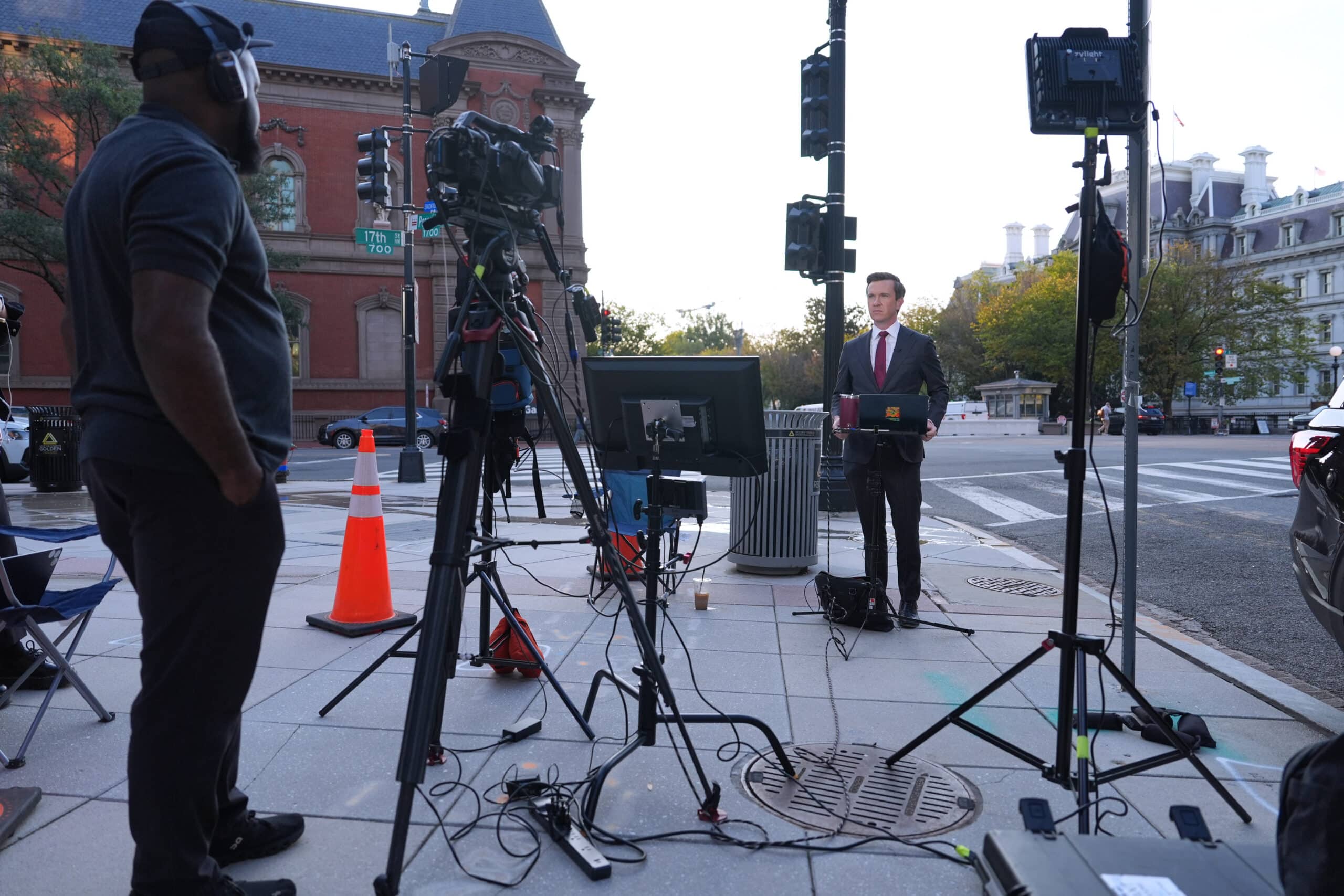
President Trump is continuing his unprecedented assault on a free press, announcing on Sept. 18 that CNN, Politico and MS NOW are all banned from the White House.
Trump’s action is clearly unconstitutional. The First Amendment says that the government may not use its power to punish the press for what it reports. The ban is a clear case of viewpoint discrimination, with the president punishing outlets for doing the job our nation’s founders intended that they do.
As with most cases of constitutional overreach by the president, though, it’s one thing to be certain of an eventual court intervention and another to see immediate relief. All three news outlets have sued, but justice can be slow and a final resolution may take weeks or months.
Immediate action needed
Something more immediate had to be done, and this morning ABC, CBS, Fox News and ABC announced they would not continue the TV pool that covers presidential events. This means that a media-savvy president will lose an important platform.
There are other efforts to push back on the president’s attacks on news media. Some of the same veteran journalists who promoted a petition calling for confronting the president at the White House Correspondents dinner are back with a new proposal for news organizations: Boycott the White House.
The call from former ABC News correspondent Lisa Stark calls on the White House Correspondents Association to “tell Trump that if these three networks are banned, other news organizations won’t be there either. Present a united front and force the president’s hand.”
Stark says it’s the president’s need for attention that gives the press leverage in this scenario.
“Let’s face it — this president likes nothing more than press coverage,” Stark wrote in a Substack post. “It’s his oxygen. He’s a performer who treats those who cover him as his audience and a vehicle for a viral soundbite. It’s terrible that journalists find themselves in this position. So, try something different. Don’t give the president a microphone for him to demonize reporters, launch sexist tirades against women journalists, and debase the fundamental role that a free press plays in a democracy.”
The TV press-pool approach strikes me as the more effective path. It’s a surgical strike that maintains news coverage, but should curb some of the bombast.
Journalists as potent force
Journalists can be a potent force when united in the defense of a free press, as the Obama administration learned in 2009 when it foolishly attempted to limit Fox News’ access and the rest of the press corps rallied to the network’s defense.
Still, the press has to be selective as it finds ways to blunt the Trump administration’s unconstitutional attacks. Standing up to bullying while navigating professional responsibilities is a high-stakes chess game, and they’re playing against a man who makes up his own rules. There are multiple factors to consider.
First, it’s the job of the news media to show up and report the news, particularly when the most powerful man in the world is conveying it. The press can’t just walk away.
Second, we all saw what happened when Secretary of Defense Pete Hegseth imposed unreasonable restrictions on the press and journalists walked out of the Pentagon. Hegseth replaced them with pro-Trump outlets who would not challenge him and then pretty much ignored the press entirely as the nation went to war with Iran.
Third, any plan requires some unity among the press corps. This press corps has been infiltrated with unabashed Trump supporters.
Press solidarity
Still, it would be absolutely unacceptable for three prominent outlets to be frozen out while others continue to show up. At a minimum, the remaining press corps needs to ensure that CNN, Politico and MS NOW are virtually in the room by sharing reports with them and even relaying their questions.
The freeze on pool coverage is a good start. Whereas Hegseth wants no coverage, Trump wants as much as possible. Eliminating still images is a logical next step.
Be there to capture every development, record audio of every announcement. Provide detailed coverage in print and online — in text, but not images.
Reality check: Trump will miss the television coverage and the networks will miss Trump. But journalists need to stand firm and united. Those who would cave or shrug off this unprecedented campaign against liberty of the press are of no value to a democracy and were never really news organizations in the first place.
See also: Presidents and the press: Trump’s unprecedented assault
Ken Paulson is the director of the Free Speech Center at Middle Tennessee State University and a former editor-in-chief of USA Today.
The Free Speech Center newsletter offers a digest of First Amendment and news-media news every other week. Subscribe for free here: https://bit.ly/3kG9uiJ