
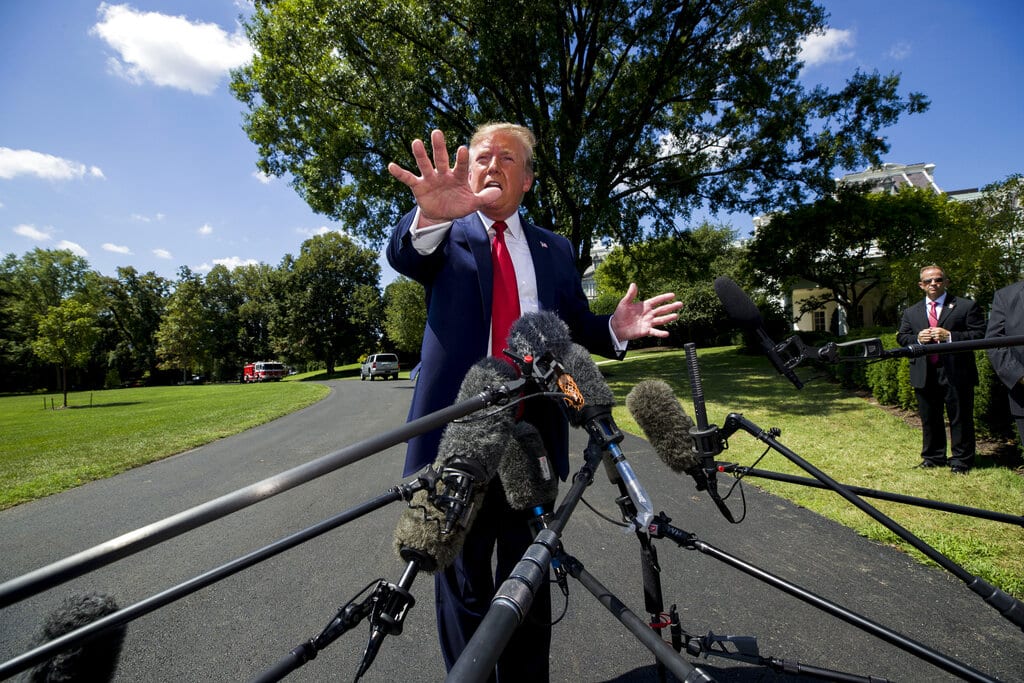
It’s no secret that President Donald Trump is openly hostile to American journalism, a trait shared by many people in power who resent scrutiny and having their decisions questioned. The occupants of the Oval Office since the launch of this nation were no exception.
From the first – meaning George Washington – presidents have largely seen the free press as an uncomfortable reality. Washington even had a nickname for journalists: “Infamous scribblers.” Washington felt it beneath his office to criticize newspapers, but their attacks on him contributed to his decision that two terms as president were quite enough.
Tension between our chief executive and the press has persisted ever since.
Founders bridled at free press
Even the nation’s founders – all on board with a nation founded on freedom – struggled with the notion of a free press when they became targets of newspapers published by politically motivated journalists.
John Adams, our second president, was a prickly sort who used the newly passed Alien and Sedition Act to attack his critics, including journalists. The statute provided that “if any person shall write, print, utter or publish … any false, scandalous and malicious writing or writings against the government of the United States, or either house of the Congress … or the President” with an intent to harm their reputation could be fined up to $2,000 and sentenced to prison.
Trump is taking a page from Adams when he accuses journalists of “treason” for reporting leaks and pushes the Justice Department to prosecute.
In 1787, Thomas Jefferson declared: “Were it left to me to decide whether we should have a government without newspapers, or newspapers without a government, I should not hesitate a moment to prefer the latter.” That, of course, came before his election as president and vicious personal attacks by newspapers of the era. His take in 1807: “Nothing can now be believed which is seen in a newspaper.”
Abraham Lincoln has long been regarded by historians as our finest president, but during the Civil War, he shut down pro-Confederacy newspapers and jailed editors after suspending the right of habeas corpus.
William McKinley may have been the first president to see that a relationship with the press could be of real value in shaping public opinion. He was the first to set aside space for reporters in the White House and pioneered press briefings on important issues. Teddy Roosevelt built on that relationship, adding a permanent press room to the newly constructed West Wing.
Franklin Roosevelt and John Kennedy both had fairly cordial relationships with the press, but also liked to go straight to the public. FDR broadcast fireside chats over the radio and JFK’s regular televised news conferences. Both also counted on the press of those eras to keep secrets. Reporters hid Roosevelt’s disability and Kennedy’s infidelities.
Richard Nixon had an ugly relationship with the news media, even compiling a enemies list targeting journalists and political foes. Trump, who has not been as secretive, created a government website listing disfavored reporters. His retaliations against journalists have also been very public.
Nixon could berate reporters, but left many of the assaults to his vice president, Spiro Agnew, who described TV network commentators as an “effete corps of impudent snobs.”
Vanderbilt University history professor Thomas Alan Schwarz has described Agnew as “Trump before Trump.”
In an article for The Conversation, Schwarz explained that “Agnew argued that the television network news programs, and the ‘tiny and closed fraternity of privileged men’ who produced them, had acquired ‘a profound influence over public opinion,’ with few checks on their ‘vast power.’”
How Trump is different
Given that some of Trump’s conduct with the news media echoes the actions of some earlier presidents, it’s fair to ask whether Trump’s actions are that different from his predecessors’.
The answer is indisputably yes. A thorough documentation can be found in the ongoing Press Freedom Watch from the nonprofit and non- partisan Poynter Institute.
No president has ever mounted such an unrelenting and angry attack on a free press. From declaring any article that questions his performance as ‘fake news” and calling journalists “the enemy of the people,” Trump has orchestrated a government campaign to undermine the First Amendment role of reporters to hold the powerful accountable.
To Trump’s credit, he has been highly accessible to the press, though his comments tend to fluctuate between information and insults. He has been insulting and aggressive when face to face with reporters, particularly female journalists. Among others, he has called Bloomberg News reporter Catherine Lucey “piggy” and New York Times reporter Maggie Haberman a “maggot.”
Trump has banished The Associated Press from the Oval Office because the news service dared to continue to call the Gulf of Mexico the Gulf of Mexico. Pete Hegseth, his secretary of war (nee “defense”), imposed Pentagon restrictions that many ethical journalists could never accept and repopulated the press corps with partisan figures before largely abandoning briefings.
Trump pressed his Justice Department to prosecute reporters who have used leaks to report on his administration. He has characterized some reporting as “treasonous.”
His administration has cut funding for public media in the U.S. and accused NPR and PBS of spreading “radical, woke propaganda disguised as ‘news.’”
Trump largely eviscerated the Voice of America and its parent Agency for Global media, eliminating efforts to provide the world with unbiased reporting about the U.S. Courts have since reinstated some of those operations.
Legal assaults
Trump has been litigious against media companies, filing libel suits that few experts saw as likely to succeed. Nonetheless, he secured handsome settlements from companies wary of fighting with the president.
Trump’s FCC chair Brendan Carr has targeted late-night TV host Jimmy Kimmel and ABC’s local stations in ways none of his predecessors have, leading ABC to sue the government. “Acting through the Federal Communications Commission, the Administration has waged a retaliatory campaign against ABC for a single reason: it disapproves of what ABC broadcasts,” ABC alleges in the lawsuit. “That campaign began in this Administration’s earliest days and has only intensified since.”
The common thread in Trump’s targeting of news media is that he found their coverage to be unflattering. That includes private media, public media and even government media.
There’s never been a president who was consistently pleased with his press coverage, but no president in history has ever harnessed the power of his office against journalists in as relentless and retaliatory a manner.
Freedom of the press is hanging on. So far.
See also: Presidents and the First Amendment
Ken Paulson is director of the Free Speech Center at Middle Tennessee State University.
The Free Speech Center newsletter offers a digest of First Amendment and news-media news every other week. Subscribe for free here: https://bit.ly/3kG9uiJ