
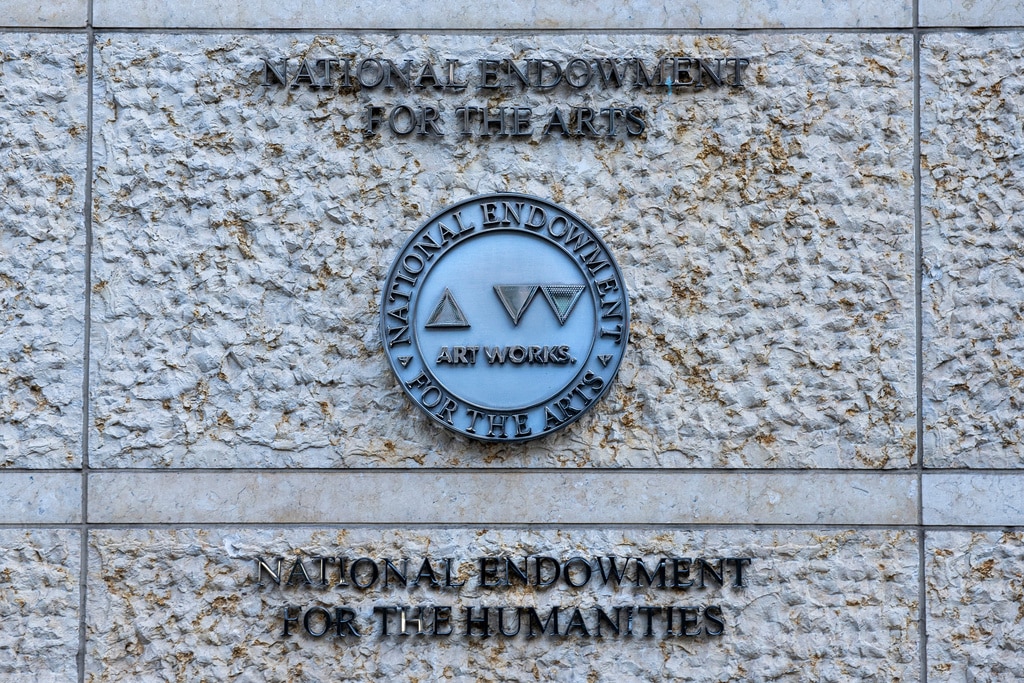
A federal judge ruled that the mass termination of grants by the National Endowment for the Humanities that were supposedly related to “diversity, equity and inclusion” violated the free speech clause of the First Amendment because it targeted grants based on the viewpoints they expressed.
The judge used additional rationales to enjoin the government from additional grant terminations and took a swipe at the government’s use of artificial intelligence to identify grants to cut and then blaming AI for its recommendations.
The grants were cancelled in the beginning of President Donald Trump’s second administration after he appointed a Department of Government Efficiency (DOGE) headed by billionaire (now trillionaire) Elon Musk.
Following a mandate by Trump to eliminate waste and to end funding for efforts related to “diversity, equity, and inclusion," the Department of Government Efficiency had used artificial intelligence, including ChatGPT, to identify any grants that examined issues related to race, sex or ethnicity, especially if they had been granted during the previous Joe Biden presidential administration.
Grants were terminated after DOGE recommendation
Congress created the National Endowment for the Humanities in 1965 as part of the National Foundation on the Arts and Humanities to foster research in the humanities.
Relying on information supplied by subordinates, Acting NEH Chair Michael McDonald cancelled some 1,400 grants valued at more than $100 million. Not longer after, cases brought by the American Council of Learned Societies, the American Historical Association, and the Modern Language Association of America against the National Endowment for the Humanities, the new government efficiency department, and their respective leaders were consolidated and heard by Senior Judge Colleen McMahon of the U.S. District Court for the Southern District of New York. McMahon had been appointed by President Bill Clinton.
On May 7, 2026, McMahon granted a motion for summary judgment against the government and permanently enjoined it from “enforcing, implementing, or giving any effect to the Mass Termination.” The National Endowment for the Humanities has begun restoring the grants that it has cancelled.
Procedural Issues
McMahon’s 143-page decision is relatively complex, summarizing considerable oral testimony and numerous documents. Part of the decision was devoted to establishing that the parties challenging the terminations had legal standing to bring their cases on behalf of their members.
Much of the decision was based on the view that the mass termination was ultra vires, meaning that it exceeded presidential authority. Judge McMahon noted that neither the new government efficiency office nor the actions that it took had been authorized by Congress and that the executive orders on which the actions had been based were inadequate because they ran counter to the congressionally designated mission of the National Endowment for the Humanities, which included promoting diverse views. She further observed that the government’s own arguments over whether the new government efficiency department was or was not an “agency” under relevant law, had been inconsistent.
The judge also addressed a number of other issues. They included: why her court, rather than the Court of Federal Claims was an appropriate body to be issuing a decision in the case; how the case centered on more than violations of contracts, which the latter court typically reviews; and how issuing an emergency injunction did not displace settled jurisdictional principles as established in other relevant cases.
First Amendment Issues
Viewpoint Discrimination
McMahon found that the mass termination of grants had violated the free speech clause of the First Amendment by targeting grants based on the viewpoints they expressed. Noting the First Amendment not only prohibits “direct regulation of speech,” but also indirect control through discriminatory funding of grants, she said that the actions of the the National Endowment for the Humanities violated the doctrine of unconstitutional conditions.
The judge cited the decision in Rosenberger v. Rectors and Visitors of the University of Virginia (1995) to demonstrate that “when the government speaks for itself, it ‘is entitled to say what it wishes,’” but that “when it creates a program that facilitates private speech, it ‘may not favor one speaker over another.’”
She further cited the decision in National Endowment for the Arts v. Finley (1998) for the proposition that “while Congress may confer some discretion in administering grant programs, that discretion does not extend to viewpoint discrimination.”
Examining the history of the of the National Endowment for the Humanities, Judge McMahon said that Congress’ authorizing legislation had “reflected a deliberate choice to foster, not control, intellectual and cultural projection,” She further observed that the agency had not exercised “the type of editorial or expressive control characteristic of government speech.”
Identifying the government’s actions as viewpoint discrimination, the judge was particularly critical of the manner in which the government had sought to ascertain DEI-related grants using artificial intelligence rather than individualized grant reviews. She thought that many of the proposed grants that the government had cancelled were not DEI-related and that many others had nothing to do with the goal of promoting efficiency.
In one entertaining observation, which could well set a precedent in other artificial intelligence cases, the judge likened governmental efforts to claim that ChatGPT rather than the National Endowment for the Humanities was engaged in viewpoint discrimination as akin to comedian Flip Wilson’s character Geraldine Jones, who excused her misbehavior by saying that “The devil made me do it.”
She pointed to a number of examples, including a proffered rationale to cancel a site interpretation of the whaling industry, another transcribing Greek and Latin texts, and yet another attempting to digitize audio reels of live Boston Pops concerts, which had no relation to their professed goals.
Political Association
In a second First Amendment argument, the judge argued that the government’s actions had constituted political-association discrimination. Noting prior court decisions in which the Supreme Court had linked political association to the First Amendment, the judge was particularly critical of attempts to target “Biden-era” grants for cancellation.
She said that this was “not a permissible funding criterion. It is discrimination based on perceived political association.” She likened it to attempts, rejected in West Virginia Board of Education v. Barnette (1943), to prescribe orthodoxy.
Other Rationales
The judge also ruled that the government’s actions had constituted a denial of the equal protection guarantees associated with the due process clause of the Fifth Amendment. She decided that any attempts to disqualify grants on the basis that they dealt with race, ethnicity, or sex were subject to strict judicial scrutiny, which could not in this case be satisfied.
Reaction to the Decision
Joy Connolly, president of the American Council of Learned Societies, praised the decision by noting that “The humanities are not a luxury. They are how a democracy understands itself. Today’s decision is a step toward honoring the will of Congress and our mission as a nation — to seek the truth, know ourselves, and build a better future on that knowledge.”
John R. Vile is a political science professor and dean of the Honors College at Middle Tennessee State University.