
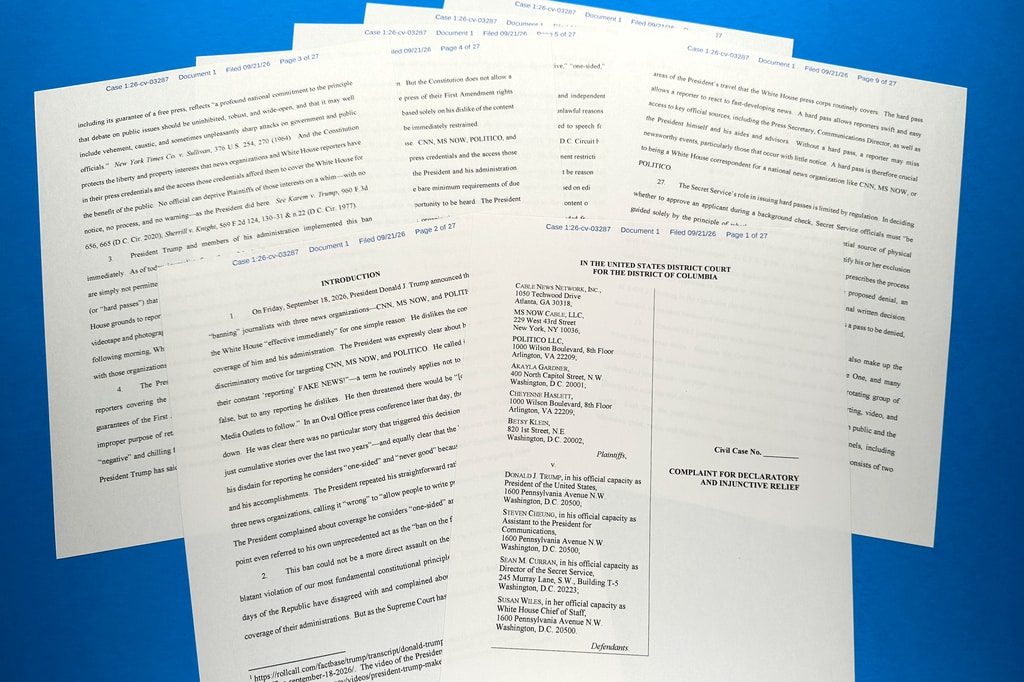
On Sept. 18, 2026, President Donald J. Trump announced that he was banning reporters from CNN, MS NOW, and POLITICO from access they had long enjoyed at the White House.
He said he was doing so because of their negative reporting, which he identified as “Fake News.” The next day, Betsy Klein of CNN, Akayla Gardner of MS NOW and Cheyenne Haslett of POLITICO were denied access to the White House, and their hard passes to the premises were revoked.
Viewpoint discrimination, non-public forum
On Monday, Sept. 21, 2026, the organizations filed a complaint for declaratory and injunctive relief in the U.S. District Court for the District of Columbia. Referring to the ban as a “direct assault on the First Amendment” and a “blatant violation of our most fundamental principles,” their complaint argued that they were being targeted on the basis of the “content of their coverage” of the president and his administration in a manner that constituted viewpoint discrimination.
The networks said that their ban had been done without proper notice or due process in that they were not given “advance notice based on clear standards and an opportunity to be heard.”
On a more technical matter they argued that the White House constituted “a nonpublic forum,” to which, once admitted, organizations could not be excluded on the basis of their viewpoints or on grounds that were unreasonable. In this case they argued that debarring members that the president disliked was “far too vague and arbitrary a standard to qualify as reasonable under the First Amendment and undermines the very purpose of press access to the White House, which is to facilitate fact-based reporting for the benefit of the pubic.”
Chilling effect
The complaint said that the president’s actions had an adverse effect not only on their businesses but also on the public. They also suggested that the actions would have a chilling effect upon coverage by other news organizations.
The complaint indicated that all three networks had long had access to the James S. Brady Press Briefing Room, press spaces in the West Wing, and access to the North Lawn of the White House and had been part of the pool of reporters who accompanied the president and shared reporting, video, and photographs with other news outlets.
Comparison to 2018 Jim Acosta case
The complaint noted that in November 2018, a federal court had ordered that the press credentials of Jim Acosta of CNN News should be restored after Trump had attempted to exclude him after an exchange with him that Trump had disliked.
The complaint further observed that, in making his announcement, Trump has actually referred to his ban as “the ban on the free press.” He had said that he wasn’t responding to any particular story but to “cumulative stories over the last two years” that constituted “negative” and what he considered to be “dishonest” news. The complaint pointed out that this standard failed to provide fair notice and was effectively void for vagueness.
Allegation of retaliation
The complaint said that the reporters involved had both “liberty and property interests” in their press passes and access to the White House. They further alleged that their reporters had been subject to unconstitutional retaliation.
The decision by the D.C. Circuit Court in Aref v. Lynch, 833 F.3d 242 (2016) had indicated that plaintiffs could establish such retaliation by showing that they were “engaged in conduct protected under the First Amendment,” that they had suffered from retaliation “sufficient to deter a person of ordinary firmness in plaintiff’s position from speaking again,” and that there was a causal link between their exercise of First Amendment rights and the retaliation. The complaint said that the news organizations had met this burden.
In elaborating on the doctrine of a “nonpublic forum,” the complaint cited case law to indicate that “any restrictions on access to these press areas be both viewpoint neutral and reasonable in light of the purpose served by the forum,” and that the government had not met either standard.
In addition to asking that the president’s action be enjoined and declared unlawful, the complaint asked for reasonable costs and attorneys’ fees.
Other events and likely outcomes
In a show of solidarity, major television networks announced that they will halt their coverage of White House events in the interim.
The networks’ complaint appears to be on solid First Amendment grounds. Judicial rulings permit individuals to sue news organizations for disseminating libelous reports, but they require plaintiffs in cases involving public figures to prove that such reports were made with knowledge that they were false or with reckless disregard for their truth or falsity.
U.S. courts have not awarded damages for expressions of opinion, which are clearly protected by the First Amendment, and a characterization of reporting as “fake news” is far too vague a charge to be likely to justify actions against news outlets.
Judge Timothy Kelly, a Trump appointee who previously ruled in favor of Jim Acosta when the White House had suspended his credentials, has been randomly assigned to the case.
John R. Vile is a political science professor and dean of the Honors College at Middle Tennessee State University.