
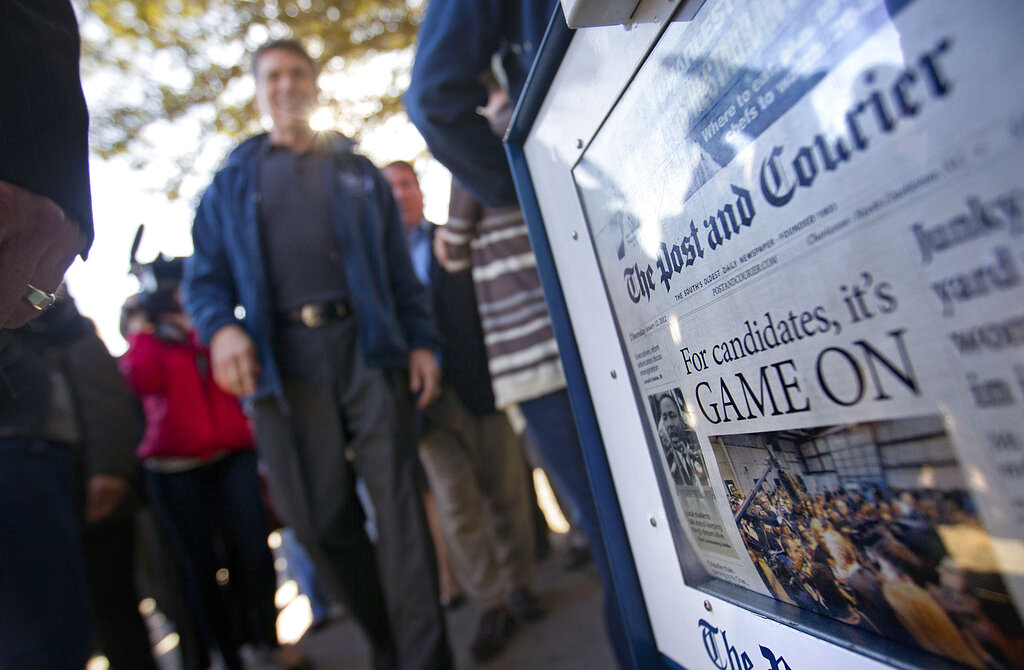
This is National Newspaper Week, a celebration of the role that papers and their online platforms play in our society. Candidly, it’s a tough sell. There are no parades, stores don’t have big sales and no one gets a holiday off from work or school. Besides, it’s hard to generate a lot of hoopla around a product introduced to America in 1690.
But that longevity cuts both ways. Those 336 years also suggest something that has served the American people long and well. We live in cynical and divided times with endless media platforms and it’s sometimes easy to forget how important it is to have a local news source with deep roots and a true history of commitment to the community.
That said, local newspapers need to show that commitment every day. In an ever-more competitive environment, newspapers – and that includes print and online editions – cannot take your loyalty for granted.
Readers are entitled to ask, “I’ve subscribed for a long time. Is this still worth my investment?”
As an editor of a number of newspapers, including USA Today, I daily assessed the quality of each edition, asking myself if we were still doing the job that our readers expected. I’m sure many editors today do the same. I would invite all readers to do the same exercise, particularly if they’re on the fence about subscribing.
Here are some questions you might ask:
- Does my newspaper carry more news and information about my town than any other outlet? Note that the question is not, “Does it carry more than it once did?” The economics of the news business have taken a toll on every outlet. My guess is that you’ll find local television to be outstanding on crime and weather. Local radio news is very timely and covers traffic in detail. But what about the big picture? What single outlet does the best job on news, sports, the arts and events?
- Does my newspaper keep an eye on government and people in power? That need for accountability is the reason the first generation of Americans insisted on a free press. Does my newspaper cover the basics of local government? Is it telling me what my mayor and town council are up to? Does it run investigative pieces and reveal important information that otherwise would have gone unreported? Bonus points for thoughtful editorials and endorsements.
- Does my newspaper tell me what I need to know? Does it sometimes surprise me? Is it giving me information I need to have? (A closed bridge, an important new school policy.) Does it sometimes tell me something that I would never have seen elsewhere? (A fun feature, a local success story.)
- Is it fair? Yes, this one’s loaded, but there’s a tendency for people to see bias based on their reaction to a single story or topic. Try this experiment: Go one by one through every story written by a local reporter on a single day, either in newsprint or on a website. For each story, ask, “Do I see bias here?” You won’t see it in that article about a store opening. Or a feature story on the new school year. The truth is that most local stories don’t lend themselves to a political interpretation. It’s just that people tend to angrily recall the one that does.
Our collective polarization can color our perspectives. I once had a tennis partner tell me he was canceling his hometown paper because it was biased and not covering unruly protesters in Seattle. That paper was in Fort Myers, Fla., 3,211 miles away from the incidents. That was not a reasonable expectation.
- How professional is the newspaper? That may sound like an odd question, but staff reductions have meant compromises in reporting and editing. Are stories well-reported and well-written? Are typos and misspelled words kept to a minimum? And if the paper makes an error, does it prominently and quickly correct it?
- Does the newspaper truly care about the community and residents it serves? Traditionally, good newspapers have been guardians of the towns they serve, reporting when things were going awry and often exploring solutions. You had a sense from its content, columns and editorials that it was pulling for the people. That’s difficult to define, but you know it when you see it. It’s also evident when the staff is out there participating in the community and supporting important charitable efforts.
If you find yourself on the fence after those six questions, I have one more.
Did your newspaper publish or post this column? Good newspapers want their readers to understand what they offer and welcome constructive feedback. They have a sense of mission and public service. A bad newspaper keeps its head low.
If you found that your paper largely meets these criteria, you win. Good local newspapers are irreplaceable, as too many Americans have already discovered when their own local papers closed. No one is watching local government. A spike in crime goes unnoticed. There’s no community awareness – and no heart.
The best newspapers help build understanding, encourage common ground and raise awareness (and hell) when public officials are failing the public. Local newspapers – regardless of their format – deserve our support, subscriptions and constructive feedback. We dare not take them for granted.
Ken Paulson is director of the Free Speech Center at Middle Tennessee State University.
The Free Speech Center newsletter offers a digest of First Amendment and news-media news every other week. Subscribe for free here: https://bit.ly/3kG9uiJ