
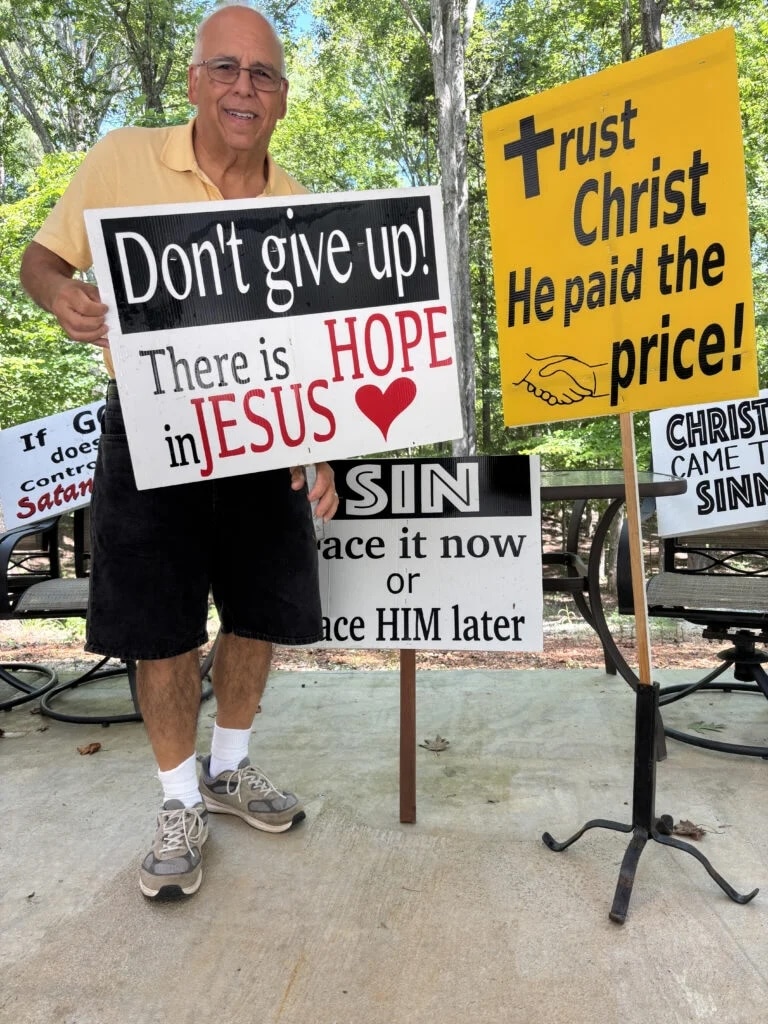
On July 15, 2025, Ernest Giardino filed a suit in the Columbia division of the district court of South Carolina, against the town of Chapin, South Carolina, challenging its ordinance on “Parades, Demonstrating, [and] Picketing.” This suit raises fundamental First and Fourteenth Amendment rights with respect to the free exercise of religion and freedoms of speech, press, and peaceable assembly, as well as to the state’s Religious Freedom Act.
Giardino is an evangelical Christian who has sought to share the gospel by holding and displaying 20-inch by 24-inch signs with evangelistic messages in public spaces. Messages included “Trust Christ He paid the price,” “He saved others—Jesus,” and “Seek ye the Lord while he may be found.” Giardino says he did so on his own without any amplification, without blocking pathways or disrupting traffic, or without interfering with ingress into local businesses.
Town’s attempt to restrict Giardino’s First Amendment freedoms
After doing so for about eight months, Giardino was informed that he needed to obtain a permit even though he claims such areas have non-religious signs, often attached to poles or place in the ground. After seeking a permit, he further found that it needed to be approved by the mayor (who had discretion as to whether to issue it or not), that he needed to apply for such a permit at least 14 days in advance, and that he could only display a sign in one place for 30 minutes or less.
Even after obtaining such a permit, which he found extremely limiting (for example, it was impossible for him to predict inclement weather two weeks in advance), police stopped him, and required him to keep it on his person. Giardino challenged this and other permit requirements.
After he says that town officials refused to respond to his complaints, Giardino reports that the planning and zoning manager said that “Our permit supersedes the Constitution because it’s a local ordinance.”
Constitutional arguments raised by suit
Giardino’s attorneys have argued that the ordinance and permitting requirements chill the speech of Giardino and others, are overly broad and discriminatory, are content based, lack narrow tailoring, require information that is not needed for speech in a public forum, vests the mayor and town officials with undue discretion, violates both the free exercise and free speech provisions of the First Amendment, and that its vagueness violates due process requirements.
Relevant U.S. Supreme Court decisions
U.S. Supreme Court decisions such as Cantwell v. Connecticut (1940) and Cox v, Louisiana (1965) have struck down similar laws that have granted undue discretion to licensing authorities. Cases such as Jones v. City of Opelika II (1943) and Murdock v. Pennsylvania (1943) have likewise invalidated licensing requirements, while Reed v. Town of Gilbert (2015) established that a city could not impose greater restrictions on religiously themed signs than on others.
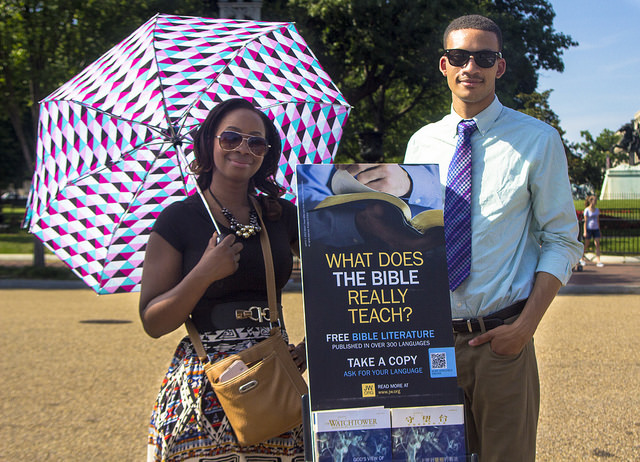
The idea that local ordinances might prevail over the U.S. Constitution directly contradicts the Supremacy Clause in Article VI of the U.S. Constitution and would effectively nullify not only the provisions of the First Amendment but those of the entire Bill of Rights. It also appears to ignore South Carolina’s own religious freedom act.
The need for prompt judicial action
Giardino has asked only for a reversal of the town’s policies and $1 in damages, but the damage to First Amendment freedoms are incalculable and deserve the court’s most urgent attention.
John Vile is a political science professor and dean of the Honors College at Middle Tennessee State University.