
First Amendment Encyclopedia
Prisoners' Rights
Navigate the complex landscape of Prisoners’ Rights and the First Amendment, balancing security and free expression.
Decisions in context
Follow the cases, doctrines and historical turning points that define the practical reach of First Amendment freedoms.
Articles in Prisoners' Rights
Browse this complete case collection in alphabetical order.

Encyclopedia
The Supreme Court in 2019 granted a stay of execution to a Texas prisoner who claimed prison rules denying him access to his Buddhist spiritual advisor violated the establishment clause of the First Amendment. In Murphy v. Collier, the court ruled this was "denominational discrimination."
Encyclopedia
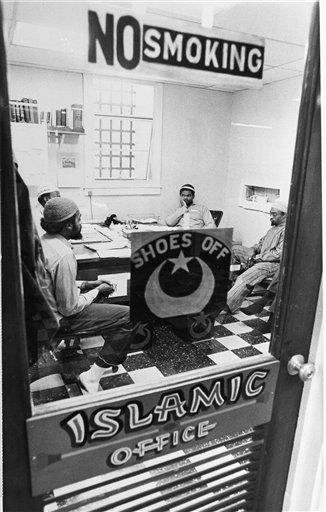
O’Lone v. Estate of Shabazz (1987) held that inmate religious rights may be restricted for security concerns without being in violation of the First Amendment.

Encyclopedia
Overton v. Bazzetta (2003) upheld prison non-contact visitation bans, reaffirming that prisons have broad discretion in disciplinary that affect inmates’ First Amendment rights.

Encyclopedia
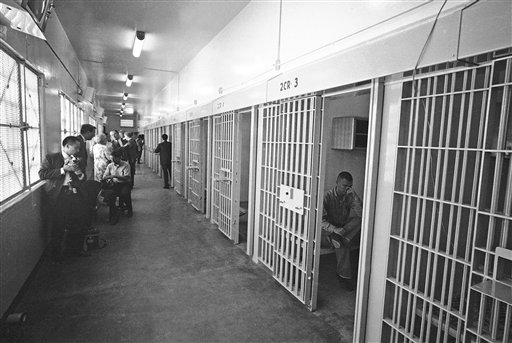
Pearson v. Callahan (2009) involved a Fourth Amendment search and seizure issue but has had a profound impact on much subsequent First Amendment litigation.
Encyclopedia
In Pell v. Procunier (1974), the Court upheld a ban on face-to-face media interviews with inmates, rejecting arguments that it interfered with First Amendment rights.
By John R. Vile
Encyclopedia
The First Amendment right of petition received some attention in Perttu v. Richards, which was based on a prisoner's right to a jury trial regarding a ...
By John R. Vile
Encyclopedia
Procunier v. Martinez (1974) established a protective standard of inmate First Amendment rights. Specifically, reviewed the constitutionality of inmate mail censorship.

Encyclopedia
The Supreme Court in Ramirez v. Collier (2022) said that a death row inmate's religious rights claims would likely prevail after Texas rejected his request for a pastor to pray over him and lay hands on him at his execution.
By John R. Vile

Encyclopedia
In Shaw v. Murphy (2001), the Supreme Court said that a prison inmate law clerk did not have a First Amendment right to assist another prisoner in legal matters.
By John R. Vile

Encyclopedia
Thornburgh v. Abbott (1989) held that federal prison restrictions relative to incoming publications or letters did not violate the First Amendment right to free speech.
By John R. Vile

Encyclopedia
Turner v. Safley (1987) determined that restrictions on inmates’ constitutional rights, including those of the First Amendment, were subject to a rational basis standard of review.

Encyclopedia
Wolff v. McDonnell (1974) said prisoners can receive confidential attorney correspondence, but the correspondence can be opened to ensure that the letters contain no contraband.
By John R. Vile

Continue exploring the Encyclopedia
Move between court cases, topics and the complete Encyclopedia.