
The U.S. Supreme Court on the last day of its 2025-26 term, overturned a provision of the Federal Election Campaign Act that limited the amount of money that a political party could spend in conjunction with a candidate (it had no such limits on independent expenditures on such candidates and their campaigns).
In so doing the Supreme Court repudiated an earlier decision in Federal Election Commission v. Colorado Republican Federal Campaign Committee (2001) [hereinafter referred to as Colorado II]. It also reiterated its increasing insistence that campaign contributions are a form of basic political speech, which can only be limited to avoid quid pro quo arrangements in which such monies are given with the expectation of direct financial or other benefits in return.
Court allows unlimited campaign spending by political parties on candidates
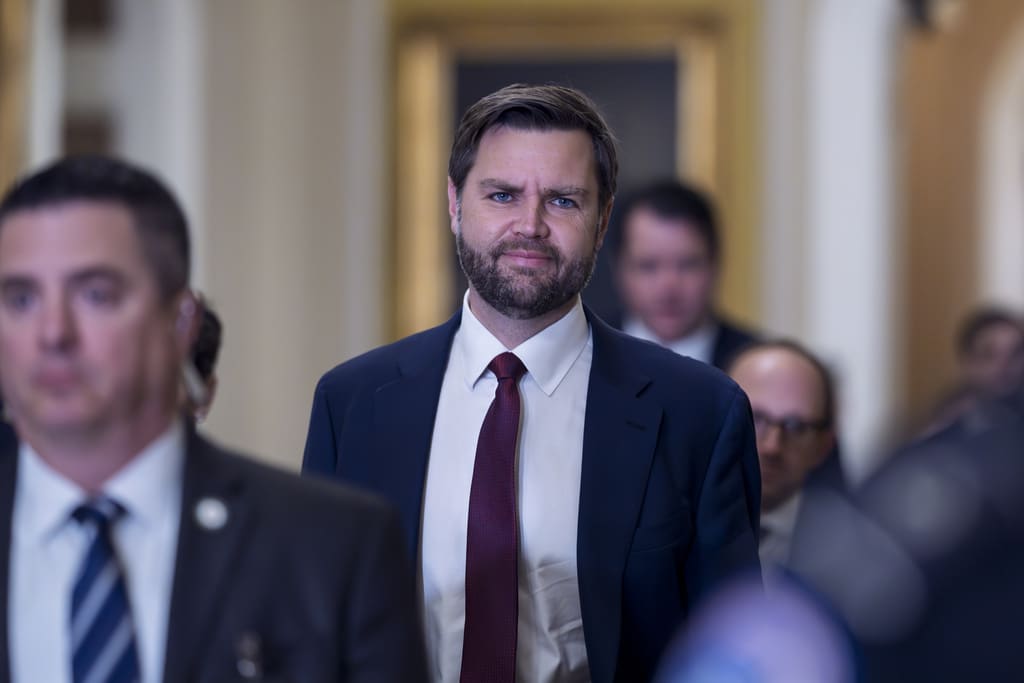
Justice Brett Kavanaugh wrote the decision for a 6-3 majority of the Court in the case. It had been brought by the National Republican Senatorial Committee, the National Congressional Committee, and then-candidate for Senate JD Vance (the current vice president) and then-Representative Steve Chabot. Relying on the decision in Colorado II, the U.S. 6th Circuit Court had rejected the challenge.
The U.S. Government refused to defend the law, and the court appointed a counsel to defend the 6th Circuit Court decision upholding it.
In affirming the Court’s jurisdiction in the case, Justice Kavanaugh recognized that the government had opposed enforcing the law but pointed out that private suits were still possible. It further noted that JD Vance still had legal standing because he had maintained an active “Statement of Candidacy” indicating his intention to run for the Senate in 2028.
Kavanaugh focuses on free speech, rejects fears of quid pro quo corruption
Kavanaugh said that the free speech clause of the First Amendment “embodies ‘a profound national commitment to the principle that debate on public issues should be uninhibited, robust, and wide-open.” He further noted that “The First Amendment’s protection of free speech has its ‘fullest and most urgent application precisely to the conduct of campaigns for political office.’”
Kavanaugh pointed pointed out that “(p)olitical parties articulate policy positions and platforms; select candidates through a primary or caucus process; and then support the election of those candidates in general election campaigns.” It was thus natural that they would work in conjunction with political candidates. A law restricting party coordination with candidates thus has the potential to inflict “a ‘stifling effect on the ability of the party to do what it exists to do.’”
Because restrictions on expenditures serve to limit speech, any such restrictions should be subject to “closely drawn” scrutiny. Decisions in McCutcheon v. FEC (2014) and Federal Election v. Cruz (2022) had further stressed that to survive such scrutiny, “a regulation may not be ‘disproportionate’ and must be ‘necessary’ and ‘narrowly tailored’ to its asserted goal.”
Kavanaugh identified four potential governmental interests that might justify the regulation at hand. No one in this case had believed that the first purpose of reducing wasteful and excessive campaign spending was sufficient. Likewise, Kavanaugh did not think that there was a special reason to regulate political party contributions to candidates, which was their central function.
Although the court recognized the value of preventing “quid pro quo corruption,” it had to exercise special caution in dealing with political speech. The Colorado decision had used an “anti-circumvention theory,” by which it sought to avoid dodging individual campaign contribution limits through circulating such contributions through parties. However, Kavanaugh pointed out that it would actually be the party, rather than the donor, who was making the contribution, and believed that other parts of the law already addressed this problem. He pointed out that parties were already subject to an “earmarking” requirement to disclose any gifts given through them by an individual to support the campaign of a specific candidate. He further argued that since the Colorado II decision, the Court had begun to subject contribution limits to more “rigorous” restrictions that were more narrowly tailored than those of the past.
Kavanaugh thought disclosure laws still allows discovery of potential corruption
Kavanaugh also argued that advances in technology made it easier for the public to discover large contributions, and that disclosure requirements constituted less restrictive alternatives than the limits on party coordination with candidates that the law imposed. He further observed that states that had eliminated similar restrictions had not ended up with an increase in quid pro quo transactions.
Kavanaugh argued that the decision in Colorado II had already been undermined by later decisions. He believed that subsequent experience had largely vindicated the dissenting opinion in that case by Justice Clarence Thomas, which had been joined by Chief Justice William Rehnquist, Justice Antonin Scalia, and Justice Anthony Kennedy.
Kavanaugh observed that as a result of other decisions, political action committees (PACs) and other outside groups contributed far more to campaigns than political parties and that the restrictions at issue may have contributed to their relative weakness. Recognizing that some American Founders had been suspicious of political parties, Kavanaugh observed that they “were even more famously suspicious of government suppression of political speech.”
Kagan thought reducing corruption was a 'compelling governmental interest'
Justice Elena Kagan authored the dissenting opinion, which was joined by Justices Sonia Sotomayor and Ketanji Brown Jackson. Kagan observed that the law at issue had been adopted after clear cases of quid pro quo contributions during the Nixon presidency. She further argued that the prevention of such compulsion represented a clear “compelling governmental interest.” She believed that eliminating the limit on party coordination with a candidate would allow such corruption to reemerge.
Kagan made further arguments on behalf of honoring precedents (the principle of stare decisis). She did not believe that alternate provisions of the law that the majority opinion had cited would be as effective in controlling quid pro quo corruption. She feared that the decision would lead to “a legal regime increasingly unable to stop political corruption, and thus to preserve our institutions’ democratic legitimacy.”
Justice Kavanaugh said that the decision “treats all political parties equally,” but there is general consensus that Republicans rely more heavily on large contributions than do Democrats and that the decision is thus likely to help them more than Democrats. The decision is, however, consistent with the Court’s decision in Citizens United v. Federal Election Commission, which had resulted in new infusions of money into campaigns, by striking down limits on independent campaign spending by corporations and unions.
John Vile is a political science professor and dean of the Honors College at Middle Tennessee State University.