In 2020, President Donald Trump contested the results in the presidential election that selected Joe Biden. Trump engaged in numerous court challenges to the election (almost none of which succeeded) and he attempted to get his vice president, members of Congress and state officials to contest official results.
Trump’s Jan. 6 speech is at center of civil suit
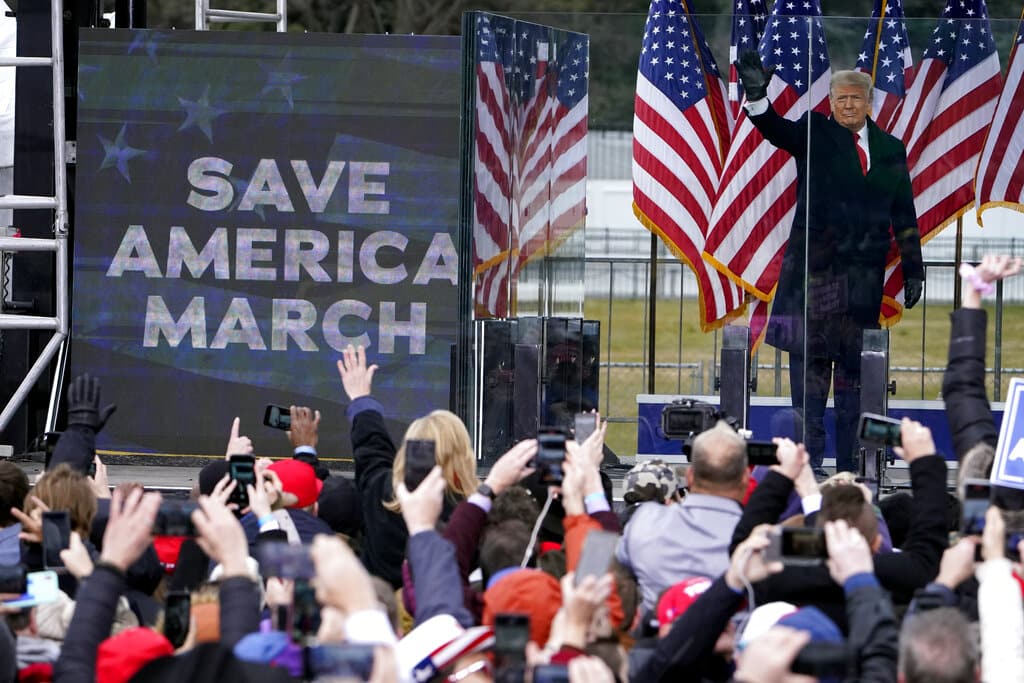
On Jan. 6, 2021, Trump gave a fiery speech on the White House Ellipse, in which he said: “We fight. We fight like hell and if you don’t fight like hell, you’re not going to have a country anymore.” Trump also urged members of the rally to “walk down Pennsylvania Avenue” to “take back our country.”
Supporters who had gathered for his support subsequently marched to the Capitol Building, which they breached. The resulting violence resulted in serious injuries and loss of life.
Suit claims speech was ‘incitement,’ not protected by First Amendment
Barbara Lee, a former U.S. representative from California, the NAACP, Capitol police officers and others filed a civil suit in federal courts against Donald Trump for some of his actions and for his speech, which they believe constituted a form of “incitement” not protected by the First Amendment.
Trump argued that his words and actions were official acts for which he should have immunity and that his speech was, in any case, not an incitement as defined by judicial precedents.
Judge Amit P. Mehta (an Obama appointee) of the U.S. District Court for the District of Columbia denied Trump’s motion to dismiss the suit in 2022, and the D.C. Circuit court affirmed his decision in 2023, sending the case back to the district court for further arguments.
Both sides then submitted lengthy briefs on the issue of immunity, which rested in large part on the U.S. Supreme Court decision in Trump v. United States (2024), which had extended fairly broad immunity for any actions done within the outer perimeters of his official responsibilities.
Judge: Immunity doesn't apply because speech was not part of official duties
In his decision, in Lee v. Trump (Case No. 21-cv-00400 (APM)), which he issued on March 31, 2026, Judge Mehta decided that Trump v. United States and other cases had distinguished the roles of an incumbent president as “office-holder” from those as an “office-seeker.” Mehta found that most of Trump’s claims to immunity in Lee v. Trump (other than those that took place in the White House or in conversations with other governmental officials such as his vice president) were connected to his desire to secure office rather than in pursuit of his official duties and that they were not immunized from prosecution.
Judge Mehta noted that his court had previously rejected Trump’s claim that the parts of his Ellipse speech should be dismissed because they were protected by the First Amendment free speech clause. In doing so, he had relied upon Brandenburg v. Ohio (1969), which had said that threats of imminent lawless action were not legitimate free speech. He also had distinguished Trump’s case from the opinion in Hess v. State of Indiana (1973), which had protected the speech of an anti-war protestor and NAACP v. Claiborne Hardware Co. (1982), which had upheld the right to boycott.
Trump argues that intent to incite violence must be shown
Trump argued that the decision in Counterman v. Colorado (2023), which required that an individual could not be convicted of a true threat unless he had some knowledge that what he said was threatening, called for reconsideration of Mehta’s earlier decision. The judge said, however, that Counterman (which had involved stalking) was not about the kind of incitement that the plaintiffs were alleging in this case.
Trump interpreted Counterman to require that the incitement doctrine could only apply in cases where “the words ‘specifically advocate imminent violence,’ the speaker intends to produce imminent disorder, and the words spoke are likely to have that result.” By contrast Judge Mehta believed that “the incitement inheres in particular words used in particular contexts.”
In reviewing Trump’s speech, he believed that “it is plausible that President Trump had the requisite intent to produce imminent disorder.” Moreover, he believed that subsequent testimony before Congress by Cassidy Hutchinson (a former White House aide who served as assistant to Chief of Staff Mark Meadows during the first Trump administration) and others, which had been contained in a select committee report, was relevant evidence that suggested that the president had known that members of the crowd were armed and that Trump’s state of mind at the time indicated that he might have known of the risks of violence that he was posing.
The judge further distinguished what Trump had said from a court decision in the case of a rap artist who held a concert knowing that his lyrics sometimes incited crowds. In Trump’s case, Trump had been telling his supporters for weeks that the election had been stolen from them and that they needed to take it back and had then directed them to participate in an unpermitted march.
Judge: Evidence against Trump was sufficient to allow case to proceed
The judge concluded that the evidence against Trump was sufficient to certify the First Amendment ruling for interlocutory review. This meant that the judge would not dismiss the case on the basis that it was protected First Amendment speech, but that it would proceed to a higher federal court for such a determination.
Judge Mehta further denied the Department of Justice’s Westfall Act Certification, which would have transferred any liability from Trump to the government on the basis, which Mehta’s opinion rejected, that Trump had been acting within the scope of his employment when he gave his speech to supporters on January 6.
Reporters Josh Gerstein and Kyle Cheney of Politico note that, while this case would limit presidential immunity, it “portends years of additional litigation and appeals, likely ensuring that Trump will be contending with the lawsuits for the remainder of his presidency. It also prolongs the wait for a resolution to one of the last remaining efforts by that day’s victims to pursue accountability.” Trump’s team continued to insist that he had been acting on behalf of the American people and that Democrats were conducting a “witch hunt” against him.
Notably, Trump has issued a blanket pardon to most of the January 6th protestors, including those involved in violent assaults on police officers.
John R. Vile is a political science professor and dean of the Honor College at Middle Tennessee State University.