
Even before the ratification of the First Amendment in 1791, a provision in Article VI of the U.S. Constitution required that “no religious test shall ever be required as a Qualification to any Office or public Trust under the United States.”
Although many states had adopted similar prohibitions, not all of them had done so. In 1776, North Carolina’s constitution had forbidden anyone from occupying a state office “who shall deny the being of God or the truth of the Protestant religion, or the divine authority either of the Old or New Testaments.”
Effort to exclude Henry, who was Jewish, from N. Carolina legislature
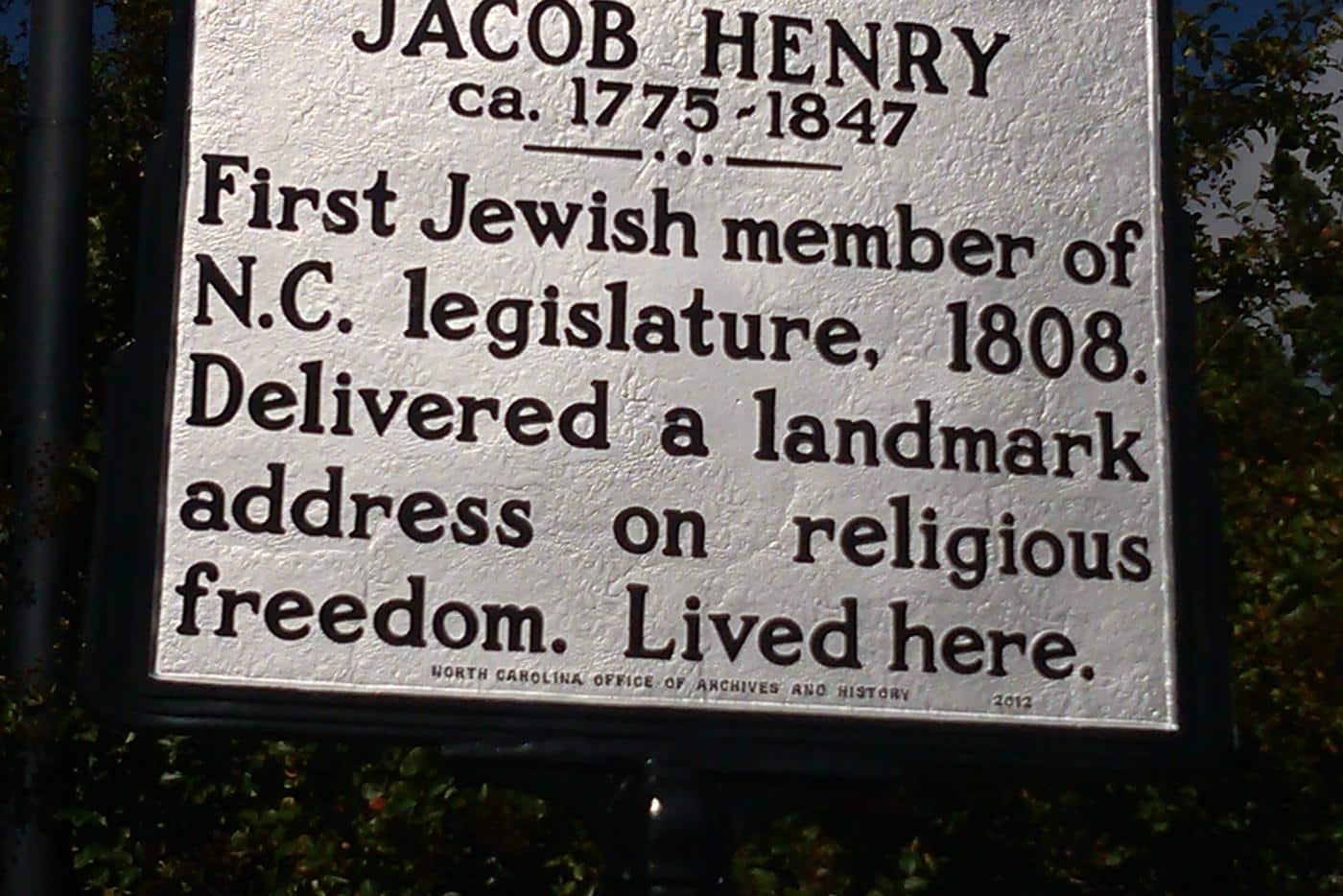
After Jacob Henry (c 1775-1847), of Carteret County, North Carolina, was elected to a second one-year term to the state legislature in 1809, fellow legislator Hugh Mills of Rockingham County objected that Henry, who was Jewish, had not taken the oath. He therefore said that he should be excluded from the assembly.
Although there were a number of procedural and evidentiary questions involved that may have also influenced this case, Henry subsequently delivered a persuasive speech highlighting freedom of religion. He successfully argued that he was entitled to take his seat because the constitutional provision requiring the oath contradicted the state’s accompanying declaration of rights, which had also been adopted in 1776 and had been patterned in part on the Virginia Declaration of Rights. It had declared “that all men have a natural and unalienable right to worship Almighty God according to the dictates of their own conscience.”
Henry’s speech argues Protestant oath conflicts with religious rights
Arguing that the North Carolina Declaration of Rights had recognized “natural rights” that were unalienable and paramount to other laws, Henry contended that “any attempt to alienate it either by the Constitution or by Law, must be vain and fruitless.” Attempting to explain this disparity between the Declaration of Rights and the state Constitution, Henry believed that the provision requiring a religious test oath must have derived from “the difficulty that human mind feels in suddenly emancipating itself from fetters by which it has long been enchained.”
Beyond this legal argument, however, Henry demonstrated the way in which ideas of religious freedom had grown in the wake of the American Revolution and the manner in which they were extended to religious minorities. He argued that only individuals who held “religious principles incompatible with the freedom and safety of the State,” should be excluded and that there was nothing in his religion that was so dangerous. He pointed out that the matter of an individual’s beliefs was “surely a question between a man and his Maker, and requires more human attributes to pronounce which of the numerous sects prevailing in the world, is most acceptable to the Deity.” In “this land of liberty,” no one “has a right to arraign him at the bar of any inquisition” for sincerely held beliefs. Attempts to use state power to enforce beliefs victimized “the sincere and pious” and turned the “light-minded” into “hypocrites.”
Reflecting views that Thomas Jefferson, James Madison, and others had articulated in disestablishing the church in their state of Virginia, Henry observed “that intolerance in matters of faith, had been from the earliest ages of the world, the severest torments by which mankind could be afflicted; and that governments were only concerned about the actions and conduct of men, and not his speculative notions.”
Noting the religious freedom distinguished the U.S. from European nations, Henry asked “Will you bind the conscience in chains, and fasten conviction upon the mind, in spite of the conclusions of reason, and of those ties and habitudes which are blended with every pulsation of the heart?” How, he asked, would the state decide which religion to favor or disfavor?
Henry said that “Nothing is more easily demonstrated that that the conduct alone is the subject of human laws, and that man ought to suffer civil disqualification for what he does, and not for which he thinks.” Noting that his own creed emphasized virtue and honor, Henry said that he did not inquire into the beliefs of others whose “actions are upright and their conduct just.”
Ending with a version of the Golden rule announced in the New Testament in Matt. 7:12, Henry exhorted that “whatever ye would that men should do unto you, do ye so even unto them, for such is the Law and Prophets.”
Henry kept his seat
Although Henry kept his seat, Adam Jortner has pointed out that, in the same year, Canada, which continued to apply British common law, excluded Ezekiel Hart from his local legislature to which he had been elected. It did so on the basis that because Jews were not considered to be citizens of England, they were also excluded from citizenship and the rights to hold public office in Canada.
In Torcaso v. Watkins (1962), the U.S. Supreme Court invalidated a Maryland test oath as a violation of the free exercise clause of the First Amendment as applied to the states by the 14th Amendment.
John R. Vile is a political science professor and dean of the Honors College at Middle Tennessee State University.