
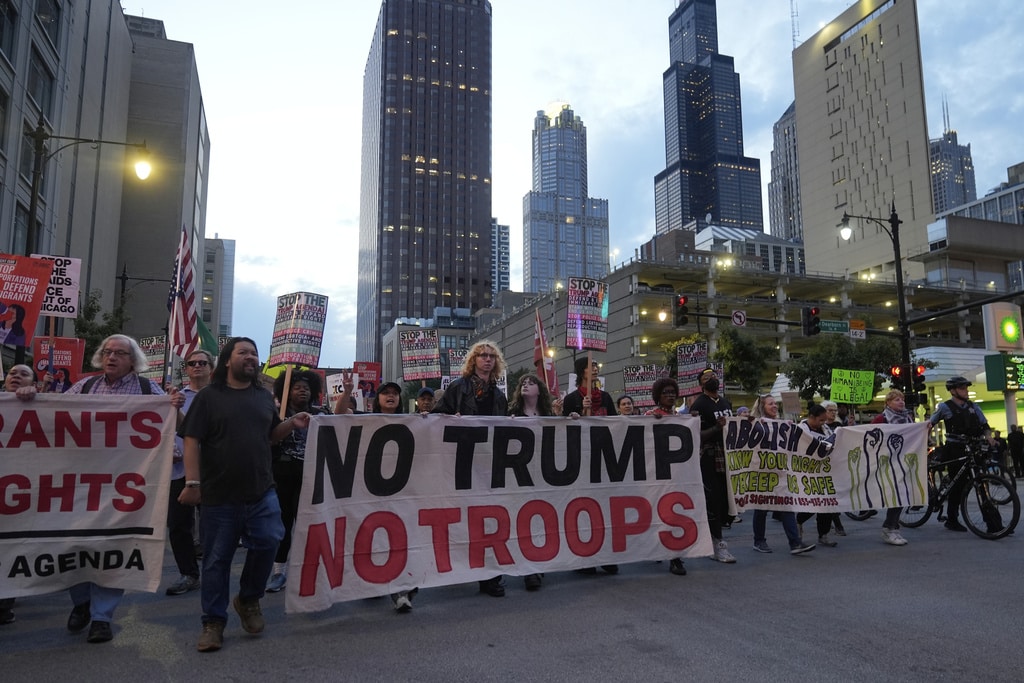
On Oct. 16, 2025, a three-judge panel of the U.S. Court of Appeals for the 7th Circuit upheld a district court decision enjoining President Donald Trump from deploying federalized members of the National Guard to a suburb in Chicago against the state governor’s wishes.
The appellate court in Illinois v. Trump, Case 25-2798, focused on arguments about whether a “rebellion” was occurring against immigration enforcement, triggering the president’s power to deploy the National Guard. At issue were demonstrations in the Chicago area against U.S. Immigration and Customs Enforcement officers, some of which had led to arrests of protesters.
The appellate court upheld the lower court’s decision that the demonstrations against ICE officers in Illinois did not rise to “rebellion or danger of rebellion” as specified in federal law as a qualified reason to deploy troops.
Trump has appealed the 7th Circuit decision to the Supreme Court, where the high court has asked litigants to file supplemental briefs.
Constitutional and statutory authority to deploy militia
Article I of the Constitution allowed Congress to call on the militia “to execute the Laws of the Union, suppress insurrections and repel Invasions.” After guaranteeing each state “a Republican form of Government,” Article IV of the U.S. Constitution further specifies that the national government “shall protect each of them against invasion; and on Application of the Legislature, or of the Executive (when the Legislature cannot be convened) against domestic Violence.”
In executing its powers, Congress has adopted 10 U.S. Code § 12406. It provides that:
Whenever—
the United States, or any of the Commonwealths or possessions, is invaded or is in danger of invasion by a foreign nation;
there is a rebellion or danger of a rebellion against the authority of the Government of the United States; or
the President is unable with the regular forces to execute the laws of the United States;
the President may call into Federal service members and units of the National Guard of any State in such numbers as he considers necessary to repel the invasion, suppress the rebellion, or execute those laws. Orders for these purposes shall be issued through the governors of the States or, in the case of the District of Columbia, through the commanding general of the National Guard of the District of Columbia.
The circuit court decision and First Amendment concerns
Several other lower courts have addressed presidential powers regarding immigration control and the use of military forces, but the circuit court in Illinois v. Trump directed special attention to First Amendment free expression concerns.
Although U.S. courts typically defer to presidential judgments involving military affairs, especially when they relate to other countries, the statutory language limits presidential action calling out troops within the United States for only three reasons. All of these were contested in the Chicago case and were examined by the trial court questioning federal authority to intervene.
Because other courts have already denied that the United States is being invaded by a foreign nation (Feuer 2025), the circuit court focused on determining whether a rebellion was taking place.
Court: 'Political opposition is not rebellion'
Although it was clear that there had been demonstrations against ICE actions outside its facility in Broadview, Illinois, some of which had led to arrests, the lower court did not think they constituted “rebellion or danger of rebellion” as specified in federal law.
The circuit court observed:
“Political opposition is not rebellion. A protest does not become a rebellion merely because the protestors advocate for myriad legal or policy changes, are well organized, call for significant changes to the structure of the U.S. government, use civil disobedience as a form of protest, or exercise their Second Amendment right to carry firearms as the law currently allows. Nor does a protest become a rebellion merely because of sporadic and isolated incidents of unlawful activity or even violence committed by rogue participants in the protest.”
Observing that violence “exceeds the scope of the First Amendment,” the court said “the problematic incidents in this record clearly fall within the considerable daylight between protected speech and rebellion.”
Court: Insufficient evident that protest has impeded immigration enforcement
The court further ruled that the national government had presented “insufficient evidence that protest activity in Illinois has significantly impeded the ability of federal officers to execute federal immigration laws.” It observed that ICE facilities had remained open and that “though federal officers have encountered sporadic disruptions, they have been quickly contained by local, state, and federal authorities.” Indeed, the court noted that the Trump Administration continued to tout the success of its efforts in the Chicago to round up undocumented individuals.
Weighing addition concerns about state police powers under the 10th Amendment, the court observed that “the deployment of National Guard members from Texas — an incursion on Illinois’s sovereignty — makes the constitutional injury especially significant.”
On Oct. 20, the 9th U.S. Circuit Court of Appeals overruled a district court to allow Trump to deploy National Guard troops to Portland, Oregon, under very similar circumstances. Cases involving differing opinions in different circuits are typically ultimately resolved by the U.S. Supreme Court.
Trump also has federalized the National Guard to fight crime, including in the District of Columbia and Memphis.
John R. Vile is a political science professor and dean of the Honors College at Middle Tennessee State University.