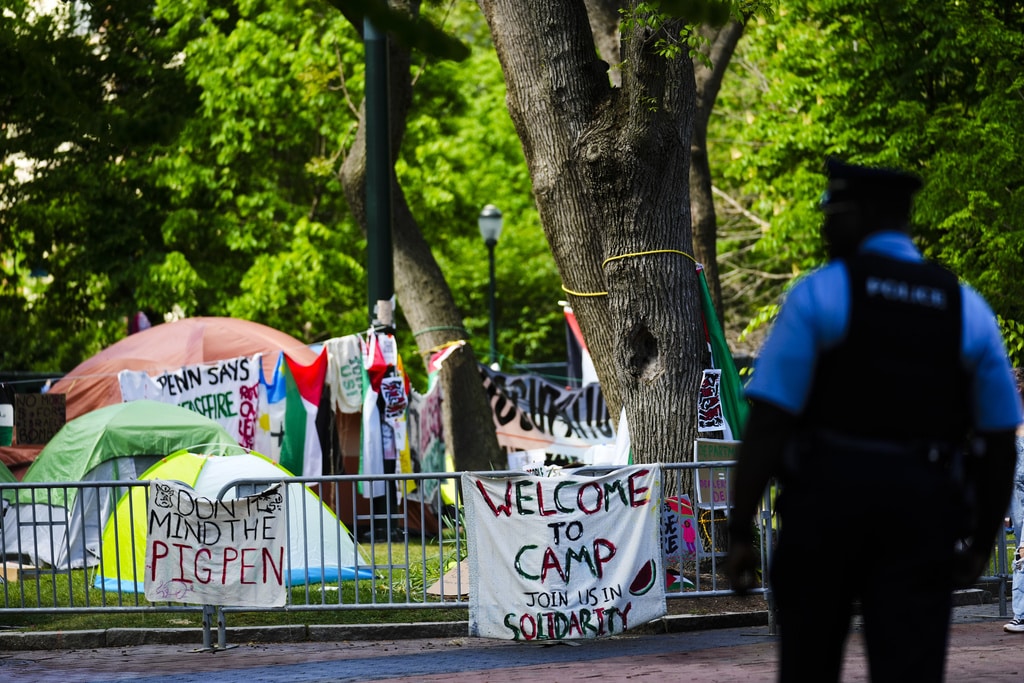
Protests on campus raise an interesting array of First Amendment issues and challenges. Students at a public college or university have a right to protest peaceably on campus subject to reasonable time, place and manner restrictions on speech.
This means that students have a right to protest but universities can impose reasonable limitations on where and when those protests take place so as not to disturb the operations of the university and its classrooms and other functions.
For example, a university can limit the use of loud sound amplification devices during student protests, as those will disturb the educational mission of the university and disturb classroom instruction. The university likely can prohibit overnight structures and campus tents as well.
However, when a university limits campus protests it must do it in a viewpoint-neutral and content-neutral way. This means that the university must impose its reasonable time, place and manner restrictions evenhandedly and across the board. It cannot single out a particular student protesting group and treat it differently than others. “The key is that any restrictions must be content-neutral and must apply to disruptive speech regardless of its subject or viewpoint.” (Chemerinsky and Gillman, Free Speech on Campus, p. 124).
Student protests occurred with frequency during the Civil Rights Movement in the 1960s particularly and continued with many student protests over the Vietnam War in the late 1960s and early 1970s. Student activism was a real phenomenon. A prime example of student activism was the Berkeley Free Speech Movement that featured Mario Salvo delivering his famous “Operation of the Machine” speech.
In recent years, there have been a wave of student protests over the Israeli-Palestine conflict and universities’ connections with Israel. These tensions escalated after the Hamas attack on Israel on October 7, 2023, and Israel’s subsequent invasion of the Gaza strip on October 27, 2023. The protests have varied significantly in terms of type of protesting, the intensity of the protests, and whether the protests included unlawful conduct. Pro-Palestinian demonstrators erected encampments at hundreds of universities. Some groups, such as the Palestine Students for Justice, contended that they were singled out and treated differently than other student protestors.
Students can protest in a variety of ways but such protests must be peaceful and not degenerate into unlawful conduct and violence. Chemerinsky and Gillman explain:
No one – including those who defended the encampments as ‘free speech’ – actually thinks that free speech principles allow any group of people, associated with a campus group or not, to simply set up space on a campus and claim a right to decide who can enter the space and who cannot. … Beyond that, some of what occurred, such as occupying buildings and acts of vandalism, violated the law and obviously can be punished. (Campus Speech and Academic Freedom, p. 41-42).
David L. Hudson, Jr. is a law professor at Belmont University who publishes widely on First Amendment topics. He is the author of a 12-lecture audio course on the First Amendment entitled Freedom of Speech: Understanding the First Amendment (Now You Know Media, 2018). He also is the author of many First Amendment books, including The First Amendment: Freedom of Speech (Thomson Reuters, 2012) and Freedom of Speech: Documents Decoded (ABC-CLIO, 2017).