
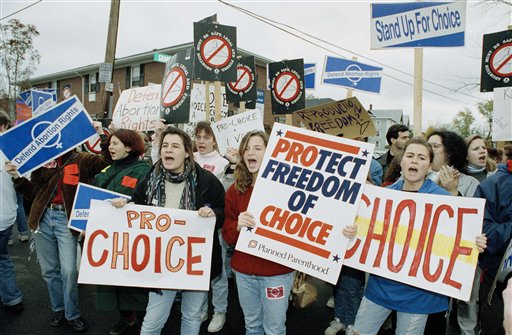
The Freedom of Access to Clinic Entrances Act of 1994 makes it a federal crime to physically obstruct the entrance to a clinic or to use force, the threat of force, or physical obstruction, such as a sit-in, to interfere with, injure, or intimidate clinic workers or women seeking abortions or other reproductive health services.
Some observers see the law as a way in which women can secure abortions without fear of harassment, but the opponents of abortion view it as violating their First Amendment free speech rights.
Offenders can receive fines, prison sentences
After its enactment by Congress, President Bill Clinton signed the Freedom of Access to Clinic Entrances Act into law. Fines for violent offenders for their first offense can be as high as $100,000, with prison sentences of one year. Repeat violent offenders can receive up to three years in prison and fines of up to $250,000. If the protest resulted in an injury to clinic staff or a patient, the prison sentence can go as high as 10 years.
In the case of first-time convictions of protesters who engage in nonviolent physical obstruction, such as sit-ins or blockades, the law allows judges to impose fines of up to $10,000 and six-month prison terms. Second convictions for these kinds of offenses are punishable by up to 18 months in jail and fines of up to $25,000. The individuals harmed by the protest activities may also sue the protesters for civil damages.
Law was prompted because protesters were blocking abortion clinics
Congress adopted the Freedom of Access to Clinic Entrances in reaction to the increasing number of blockades of abortion clinics by anti-abortion groups and the inability or unwillingness of local law enforcement officials to protect the clinics from intimidation and violence.
The law was introduced in Congress after the Supreme Court ruled in Bray v. Alexandria Women’s Health Clinic (1993) that federal court judges were not permitted to invoke a Reconstruction-era civil rights law, the 1871 Ku Klux Klan Act, against the harassment and protest activities that frequently occurred outside abortion clinic entrances. The KKK Act prohibited conspiracies by persons seeking to deprive “any persons or class of persons” of equal rights.
In the 6-3 Bray decision announced by Justice Antonin Scalia, the Court held that women seeking abortions were not within the class of people intended to be protected by the law, and the Court barred federal court judges from invoking the act to enjoin protest activity aimed at abortion clinics.
FACE has been upheld against First Amendment challenges
Reacting in part to the Bray decision, as well as to the growing violence of anti-abortion protesters, Reps. Charles E. Schumer, D-N.Y., and Constance Morella, R-Md., introduced new law in the House of Representatives in February 1993.
Congressional support was also spurred by the March 1993 shooting death of a Florida physician, Dr. David Gunn, and the wounding of another doctor in Wichita, Kan., by anti-abortion activists.
Numerous lower federal courts have upheld FACE from First Amendment challenges filed by anti-abortion protesters.
The cases include Terry v. Reno (D.D.C. 1996); United States v. Weslin (2d Cir. 1998); and United States v. Dinwiddie (8th Cir. 1996).
Provisions on interfering with religious freedom
The law also has a provision that prohibits the same physical obstruction or interference with a person exercising their religious freedom at places of worship.
In 2026, Attorney General Pam Bondi used this part of the law to file charges against more than 30 people who were protesting immigration enforcement at a church in Minnesota where the pastor works for Immigration and Customs Enforcement.
Among those charged are independent journalists Don Lemon and Georgia Fort and prominent local activist Nekima Levy Armstrong. Lemon insists he was at the church to chronicle the protest but was not a participant. The veteran journalist has vowed to fight what he called “baseless charges” and protect his free-speech rights.
In the Jan. 18, 2026, incident, people entered the Cities Church in St. Paul, Minnesota, chanting “ICE out” and “Renee Good.” Good was shot and killed by a U.S. Immigrations and Customs Enforcement officer, which led to public demonstrations throughout the city.
The provision of the Freedom of Access to Clinic Entrances Act that deals with places of religious worship prohibits “by force or threat of force or by physical obstruction, intentionally injures, intimidates or interferes with or attempts to injure, intimidate or interfere with any person lawfully exercising or seeking to exercise the First Amendment right of religious freedom at a place of worship…”
This article was originally published in 2009 and has been updated. Susan Gluck Mezey is a professor emeritus of political science at Loyola University Chicago; she holds an M.A. and Ph.D. from Syracuse University and a J.D. from DePaul University.