
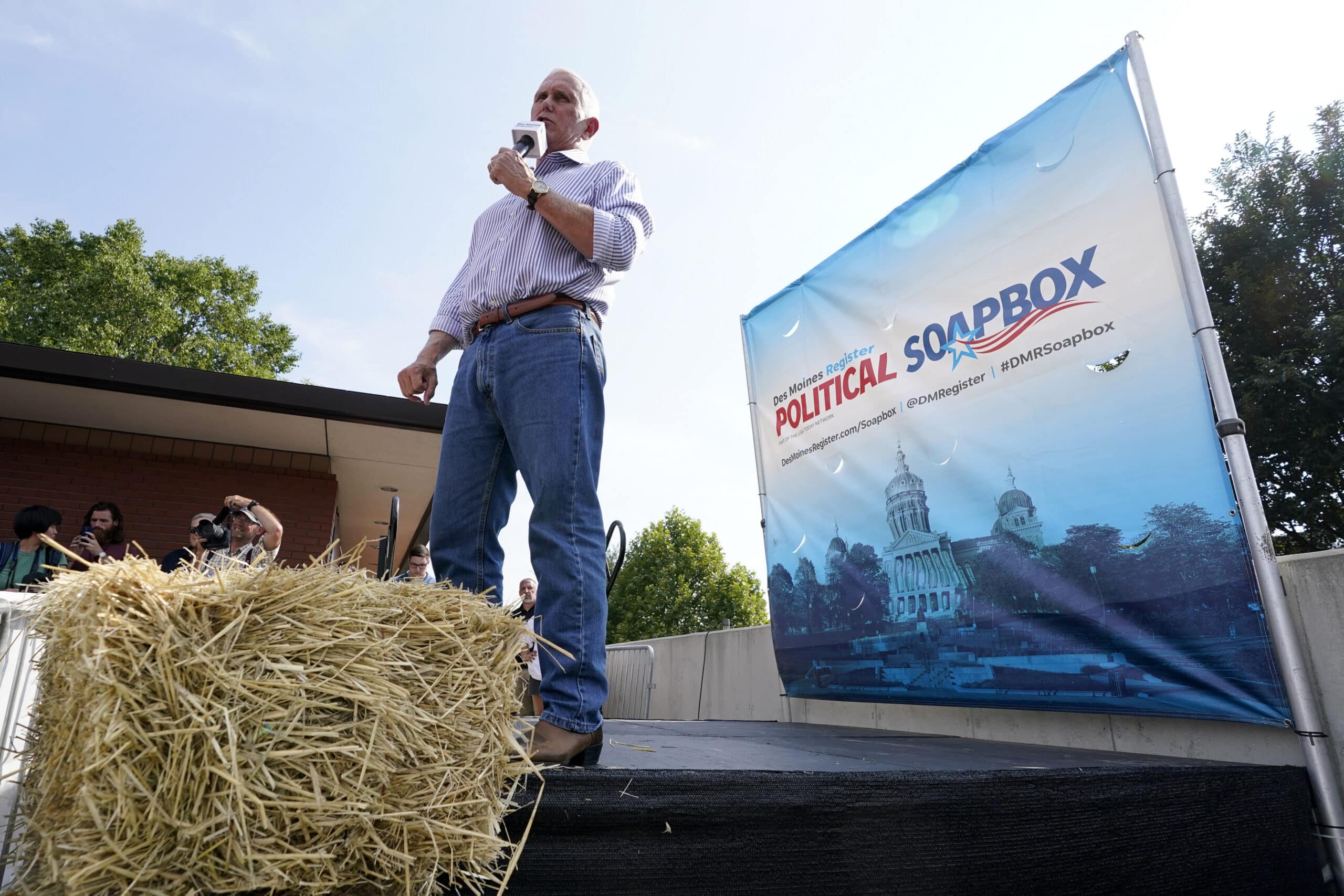
One of the more unusual court cases involving the First Amendment emerged from the 2024 elections after President Donald J. Trump, U.S. Rep. Mariannette Miller-Meeks, and former state senator Bradley Zaun sued pollster J. Ann Selzer, the Des Moines Register and Tribune, and the Gannett Co.
The plaintiffs sought damages for publishing results of a poll on Nov. 2 and 3, 2024, that showed presidential Democratic candidate Kamala Harris leading Trump in the state and Miller-Meeks’ opponent leading her even though both Trump and Miller Meeks won in the Nov. 5 election.
Trump, others claimed poll caused reputational harm
The plaintiffs alleged that the poll was so far off the mark that it was “so implausible that no objective pollster could have honestly advanced it,” and that it therefore must have been deliberately manipulated. They sought damages for reputational harm and for time and resources that they had to spend because of the poll.
On Sept. 23, 2026, District Court Judge Scott J. Beattle of the Fifth Judicial District of Iowa issued a 64-page opinion dismissing the suit with prejudice, meaning that the case cannot be refiled in Iowa courts.
Court’s decision was based on First Amendment law
Judge Beattle pointed out that the case strongly resembled that of New York Times v. Sullivan (1964) in that it was a private tort action in which damages could inhibit speech in the same manner as a criminal prosecution.
Beattle rejected the idea that the results of a poll became commercial speech, entitled to reduced protection, simply because they were published in a newspaper that sold its product. “Some of the most valued types of speech are speech produced for profit,” he wrote. “If the profit motive of a newspaper were determinative, every aspect of its operations, from the stories it chose to cover to the position it took in its editorials, would be open to regulation simply by showing that sales were a factor in its decision.”
Instead, Beattle argued that “Election polling is speech protected by the First Amendment, both because it involves a conversation between a pollster and a voter and because the poll itself is speech.” The judge observed that “Reporting such a poll during a presidential and congressional election year is speech about a matter of public concern, occupying the summit of the pyramid of First Amendment values.”

Not one of the unprotected categories
The decision went on to point out that the case did not fall under any of the narrow exceptions to First Amendment coverage such as “obscenity, defamation, incitement, fighting words, and fraud.” The judge paid particular attention to the plaintiffs’ claim that the poll and its publication involved fraud, which he limited to “a false claim made to secure money or other valuable consideration.”
He observed that the plaintiffs had neither established falsity nor inducement. “A poll is simply an estimate,” the judge said in the ruling. “A statement of conjecture about a future state of affairs is not provably false, even when the speaker is alleged to have known better.”
As to inducement, there was no evidence that the poll had attempted to extort “money or property” from the defendants, and any claims of damages were too amorphous to be actionable. The judge observed that the decision in United States v. Alvarez (2012), the stolen valor case, the Supreme Court had concluded that “to permit liability for false speech absent any evidence that the speech was used to gain a material advantage would confer a censorial power unprecedented in the Court’s cases and in our constitutional tradition.”
No actual malice
Further examining issues of libel, Beattie rejected the idea that the plaintiffs had established actual malice. “Plaintiffs are public figures, and the Iowa Poll dealt with a matter of public concern,” the judge said. Moreover, “a published estimate that proves to be inaccurate is evidence only of error; ill will directed at the subject of a publication is not evidence of doubt as to its truth.”
Prior restraint
The judge classified the plaintiff’s attempt to get an injunction against further false polls as involving prior restraint of publication, which he characterized as “the gravest and least attractive encroachment on the First Amendment” which is “subject to a strong presumption of unconstitutionality.” Like other “content-based regulation of core political speech,” it needed to be subject to strict scrutiny, which test it could not meet.
Having looked at the U.S. Constitution, Judge Beattie further ruled that the case did not fall under state laws involving fraud, which, he observed, differed from mere lying. He also reiterated the speculative nature of the damages that the plaintiffs had alleged in this case.
This case is considered to be a clear victory for First Amendment freedom of the press.
John R. Vile is a political science professor and dean of the Honors College at Middle Tennessee State University.