
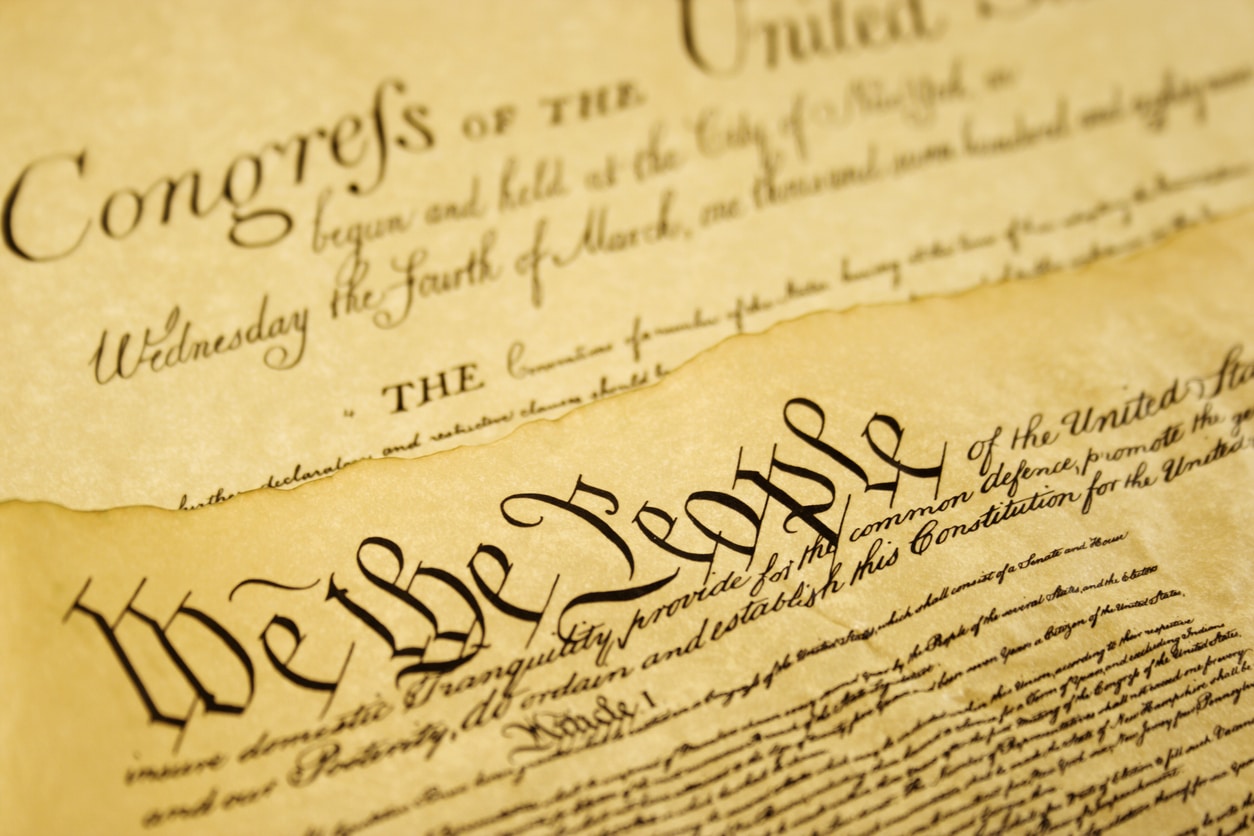
Courses in U.S. constitutional law are often divided into two semesters. The first semester generally deals chiefly with institutional structures that are outlined in the seven articles of the document, and the second semester typically highlights civil rights and liberties. The latter are most frequently tied to the provisions like the First Amendment, which are articulated in the Bill of Rights; the 14th Amendment, through which courts have applied most of those provisions against both state and federal governments; and in amendments that protect voting rights.
This functional distinction is artificial. The institutions that the Constitution established were not created so that Americans could brag about having three branches of government, a division of powers between state and national governments (federalism), or checks and balances, but as ways of protecting civil rights and liberties, such as those articulated in the First Amendment.
Arguments on behalf of separation of powers
In initially opposing the adoption of a separate bill of rights, in Federalist No. 84, Alexander Hamilton argued that the entire Constitution was “in every rational sense, and to every useful purpose, A BILL OF RIGHTS.”
In Federalist No. 47, James Madison argued that “The accumulation of all powers, legislative, executive, and judiciary, in the same hands, whether of one, a few, or many, and whether hereditary, self-appointed, or elective, may justly be pronounced the very definition of tyranny.”
In explaining the new Constitution, Madison accordingly argued in Federalist No. 51 that the Constitution divided the federal government into three branches so that “Ambition must be made to counteract ambition. The interest of the man must be connected with the constitutional rights of the place.” Observing that “If men were angels, no government would be necessary,” he said that “In framing a government which is to be administered by men over men, the great difficulty lies in this; you must first enable the government to control the governed; and in the next place oblige it control itself.”
Structure of U.S. Constitution
Numerous entries in this Encyclopedia focus on judicial decisions, many (but not all) of which have protected and expanded First Amendment freedoms. However, it is important to remember that the Founders established three different branches of government, all of which are obliged to adhere to the Constitution.
Article I outlines the legislative branch, which consists of a House of Representatives, which is elected on the basis of state populations, and the Senate, to which each state elects two members. Congress exercises the power to create laws. It is particularly entrusted with the power to tax and spend, which is commonly denominated as the power of the purse.
Article II outlines an executive branch, which makes an elected president the commander-in-chief of the U.S. military and vests him with power to nominate many federal officers and to enforce the law.
Article III outlines the judicial branch, consisting of members appointed by the president with the advice and consent of the Senate and headed by the U.S. Supreme Court.
Article IV further attempts to define the relationship between the national and state governments.
How the three branches check and balance one another
Americans on most occasions exercise their First Amendment and other rights fairly freely. Congress, and other legislative bodies, often adopt laws designed to enhance such freedoms, although state and national legislators are sometimes influenced by popular passions to restrict freedoms of unpopular groups that Footnote Four of the Carolene Products Case referred to as “discreet and insular minorities.”
Congress is divided into two houses in part to prevent such precipitous actions, but this bicameral structure does not always prove to be successful. Moreover, Congress does not enforce the laws but must act through the executive and judicial branches.
Courts have established that Congress has broad investigatory powers, and its hearings are sometimes televised. The House has power to impeach officials that it believed are guilty of bribery, treason, or other high crimes and misdemeanors, and the Senate has to power to convict and remove officials for such offenses.
The president, in turn, takes an oath to protect and defend the U.S. Constitution. Because he is also commander-in-chief of the armed forces, he is said to exercise “the power of the sword.” The president’s position gives him what Theodore Roosevelt described as an excellent “bully pulpit” to speak on behalf of his policies and political friends and against enemies, typically from a rival party. The president exercises the power to veto congressional laws, but two-thirds majorities of both houses can override such vetoes.
The actions of both branches and of many state actions may be checked by the federal judicial branch, which is headed by the U.S. Supreme Court and is often described as exercising the power of judgment. When presented with cases brought by parties with proper legal standing, U.S. courts exercise the power to interpret laws, known as statutory interpretation, and the power to invalidate laws or executive actions, known as judicial review, that they think are unconstitutional. Congress may pass new laws if it believes the courts have misinterpreted them. Unless a majority of justices change their mind or Congress and the state propose and ratify constitutional amendments, federal judicial decisions on constitutional matters are considered to be binding.
Role of separation of powers in informing the public
Constitutional boundaries are not always pellucid, but the rivalry among the three branches ideally leads to publicity, which allows the people to decide the degree to which each of the three branches are protecting rights. When the Bill of Rights was originally being argued, Thomas Jefferson argued that the very presence of a bill of rights would serve an educative function, bringing the people’s rights to their attention.
A recent example of this occurred when Sen. Mark Kelly of Arizona filed suit against Secretary of State Pete Hegseth (a member of the executive branch) for issuing a letter of censure against him because of a video that Hegseth disapproved of. Hegseth also threatened to cut Kelly’s military pension. Kelly argued that Hegseth’s actions violated both the First Amendment and separation of powers. In similar fashion, protestors against U.S. Immigration and Customs Enforcement in 2025 argued that the agency’s actions have restricted their First Amendment freedoms.
Conflict among the branches can be confusing, but it is often healthy. It reminds voters that they are ultimately responsible for electing individuals to government who support First Amendment and other constitutional values.
John R. Vile is a political science professor and dean of the Honors College at Middle Tennessee State University.