
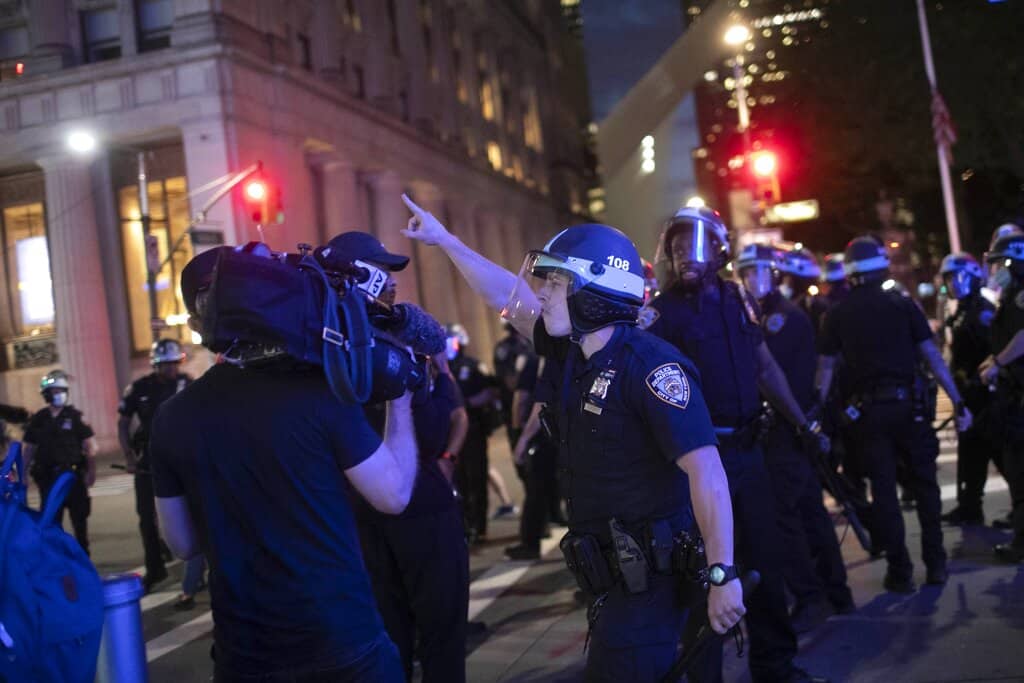
Police buffer zones, or “Halo laws,” refer to laws passed in a handful states that prohibit individuals (including journalists) from approaching a certain distance within police officers if ordered not to approach.
Such laws have been passed in Arizona, Florida, Indiana, Louisiana and Tennessee. So far, these laws have fared poorly in the courts when challenged on First Amendment free-speech grounds or Fourteenth Amendment vagueness grounds.
Supporters of the law argue that they are necessary for order and security reasons, including protecting police officers from danger. Critics challenge that the laws infringe on the First Amendment right to gather news, impose a chilling effect on journalists and are hopelessly vague.
7th Circuit: Indiana buffer zone law unconstitutional
For example, the 7th U.S. Circuit Court of Appeals affirmed a lower court’s ruling that Indiana’s police buffer zone law was unconstitutional in Reporters Committee for Freedom of the Press v. Rokita (2025). The law, called “the Unlawful Encroachment on an Investigation” law, prohibited individuals from approaching within 25 feet of police officers if the officers order the individuals to stay back.
A group of media entities challenged the law on First Amendment and 14th Amendment vagueness grounds. A federal district court ruled the law was too vague and did not address the facial First Amendment challenge.
On appeal, the 7th Circuit affirmed the lower court and determined that the law was “susceptible to arbitrary enforcement and is therefore unconstitutionally vague.” The law was too vague, the appeals court reasoned, because there is no indication when an officer initially issues the do-not-approach warning in the first place.
Louisiana buffer zone law blocked by federal judge
Similarly, a federal district court in Louisiana blocked that state’s police buffer zone law in Deep South Today v. Murrell (M.D. La. 2025). The law provided: “No person shall knowingly or intentionally approach within twenty-five feet of a peace officer who is lawfully engaged in the execution of his official duties after the peace officer has ordered the person to stop approaching or to retreat.”
Media entities contended that the law violated their First Amendment right to newsgathering and that it was unconstitutionally vague under the 14th Amendment. The court found that the plaintiffs’ First Amendment claims survived a motion to dismiss. Furthermore, the federal district court found a significant vagueness problem, writing: “Here, the Act not only lacks definite or determinate standards, it lacks any standards by which an officer, prosecutor, or trier of fact may evaluate a situation and determine if an order to retreat is appropriate.”
Tennessee has a similar 25-foot police buffer zone law that is being challenged in court. The case is Gannett Co. v. Long. Florida’s law differs from the others. It prohibits the knowing and willful resistance, obstruction, or opposition to police officers and their orders. It has not been challenged in court.
David L. Hudson, Jr. is a law professor at Belmont University who publishes widely on First Amendment topics. He is the author of a 12-lecture audio course on the First Amendment entitled Freedom of Speech: Understanding the First Amendment (Now You Know Media, 2018). He also is the author of many First Amendment books, including The First Amendment: Freedom of Speech (Thomson Reuters, 2012) and Freedom of Speech: Documents Decoded (ABC-CLIO, 2017).