
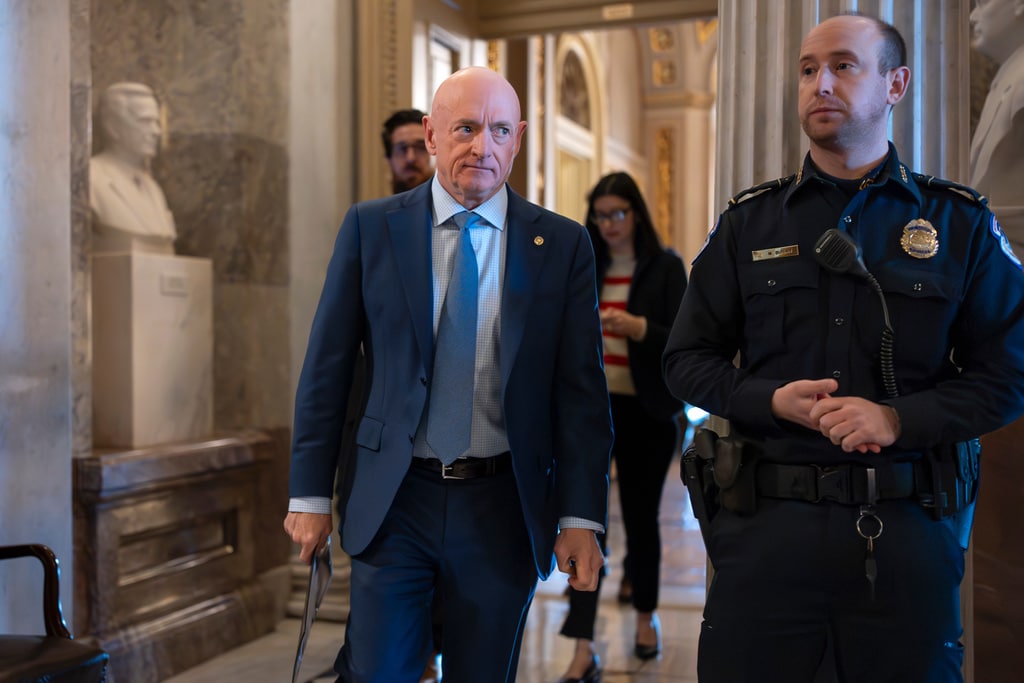
Democratic Senator Mark Kelly of Arizona is a retired Navy captain and former astronaut who has served in the U.S. Senate since 2020.
He is a member of the Senate Armed Forces Committee, the Senate Select Committee on Intelligence and other committees. He receives a military pension for his distinguished military service.
On Jan. 12, 2026, Kelly filed a complaint in the U.S. District Court for the District of Columbia for declaratory and injunctive relief against Secretary of Defense Pete Hegseth, the U.S. Department of Defense, Secretary of the Navy John Phelan, and the U.S. Department of the Navy.
On Feb. 12, the federal judge sided with Kelly, blocking the Pentagon from punishing him.
Hegseth's letter of censure
The complaint centered on a Secretarial Letter of Censure that Secretary Hegseth had filed against Kelly calling for consideration of a reduction of his rank and pay and for possible “criminal prosecution or further administrative action” if he continued making statements to which the Secretary had objected.
These statements had included criticism of: President Donald Trump’s deployment of National Guard troops in American cities; Trump’s strikes on boats allegedly carrying drugs in the Caribbean Sea and Pacific Ocean, including a “double tap” strike directed against two survivors of an initial strike; military leadership for “firing admirals and generals” and surrounding themselves with “yes men”; and the issuance of a video with five other members of Congress entitled “Don’t Give Up the Ship,” counseling members of the military that they had an obligation to disobey unlawful military orders.
Administration reaction to Kelly’s statements
These actions and statements had been highly criticized by administration officials, some of whom had previously also indicated that members of the military were not obligated to obey illegal orders that might constitute war crimes.
Presidential advisor Stephen Miller had characterized the video as a call for “insurrection” and as a “general call for rebellion.” Trump had referred to it as “SEDITIOUS BEHAVIOR AT THE HIGHEST LEVEL,” called for jailing the members of Congress and suggested that their offenses were “punishable by DEATH.”
Secretary Hegseth had referred to the six members of Congress as the “Seditious Six.” These and other comments had required Kelly, whose wife Gabby Giffords had, as a member of Congress, been wounded in an attempted assassination attempt, to seek special protection.
In issuing his letter of reprimand, Secretary Hegseth had claimed that Kelly had undermined the chain of command; counseled disobedience; created confusion about duty; brought discredit upon the armed forces; and engaged in conduct unbecoming an officer.
Kelly’s Response Alleging Constitutional Violations
Kelly’s legal complaint noted that Hegseth’s censure and threats of further punishment “have inflicted reputational harm related to the Senator’s service record, placed his grade and pay in jeopardy, and prejudged the outcome of the grade-determination proceeding.”
Kelly’s suit claimed that the Secretary’s actions violated the free speech provision of the First Amendment by punishing him for protected political speech. The complaint observed that such actions were “subject to strict scrutiny because they seek to punish Senator Kelly based on the content and viewpoint of his speech.”
Kelly’s complaint also relied on the Speech and Debate Clause in Article I, Section 6, of the U.S. Constitution, which is designed to protect the speech of members of Congress and is designed, according to Eastland v. U.S. Servicemen’s Fund (1975), to cover all “legislative activity” and not just “literal speech or debate.” Kelly noted that Congress was responsible for regulating the armed forces, that it had “authority over military and civilian defense appointments,” and that it had specifically legislated against war crimes.
Kelly’s complaint further argued that the actions taken and threatened against Kelly violated the separation of powers by threatening congressional independence and granting “the Executive a power over legislators that the Constitution does not contemplate.” It noted that Kelly was no longer a military officer and that “To Plaintiff’s knowledge, a sitting Member of Congress has never been subject to military punishment based solely on his speech.”
In addition, the complaint said that the government had not provided Kelly with due process and that it had violated the Administrative Procedure Act (APA) and exceeded statutory authority.
Kelly has said that he has “every right to say these things as an American, as a retired service member and as a U.S. senator” (Mineiro 2026) and that “If Pete Hegseth succeeds in silencing me, then he and every other secretary of defense who comes after him will have license to punish any retired veteran, of any political persuasion, for the things that they say” (Gregorian, Reilly, Kosnar and Thorp, 2026).
Court Actions
Hegseth’s petition for a temporary restraining order was converted into a motion for a preliminary injunction, which Judge Richard J. Leon, of the United States District Court for the District of Columbia (an appointee of George W. Bush) granted on Kelly’s behalf on Feb. 12, 2026.
Such an injunction required Leon to conclude that Kelly was “likely to succeed on the merits,” “likely to suffer irreparable harm in the absence of preliminary relief,” that “the balance of equities tips in his favor,” and that the “injunction is in the public interest.”
The judge viewed the case as within his jurisdiction. He put considerable emphasis on the fact that Kelly a “retired servicemember.” Although he did not specifically cite the Speech and Debate Clause, he also observed that Chase was “serving in Congress and exercising oversight responsibility over the military.” The case was particularly amenable to judicial oversight because it dealt with the First Amendment.
Judge Leon also rejected arguments that Kelly should first have to seek a remedy through the military before appealing to a court. He noted that Congress had not prescribed an exhaustion of remedies in such cases and that further delay would result in irreparable harm to Kelly’s First Amendment rights. He further observed that federal courts would have greater competence on First Amendment issues than an administrative board. Moreover, he doubted that any military board would be likely to buck the determination made by the Secretary of Defense. He further determined that the issue was “ripe” for a decision.
Judge Leon believed that Hegseth’s heavy-handed censure and threats of further prosecution was more than likely to chill exercises of First Amendment free speech rights by others in his position.
Noting his particular concern over “First Amendment Retaliation,” Leon observed that Kelly’s speech was “unquestionably protected speech” involving “matters of public concern” that are at the heart of the First Amendment. Whatever effect this speech might have if uttered by an active member of the military, the judge said that, as a retired captain,” Kelly was now a member of the “civilian community.” Responding to the idea that Congress intended to apply First Amendment restraints to retired servicemembers,” the judge responded “Horsefeathers!” and said that the government had not provided any cases that had said so.
Judge Leon stressed that there was a strong “casual link” between the letter of censure and other threatened action and suggested that the actions also constituted viewpoint discrimination.” He pointed out that ex-military members all the way back to Alexander Hamilton had exercised their rights to criticize military actions by sitting presidents.
What’s Next
The case can, of course, be appealed, but given Judge Leon’s clearly articulated view that Kelly has strong First Amendment protection, and his opinion that “Defendants’ [government’s] response is anemic!” there would appear little likelihood that his decision will be overturned.
In a related development, in what is considered to be a rebuke to the Department of Justice, on February 10, a grand jury refused to indict Kelly and other lawmakers who posted the video.
John R. Vile is a political science professor and dean of the Honors College at Middle Tennessee State University.