
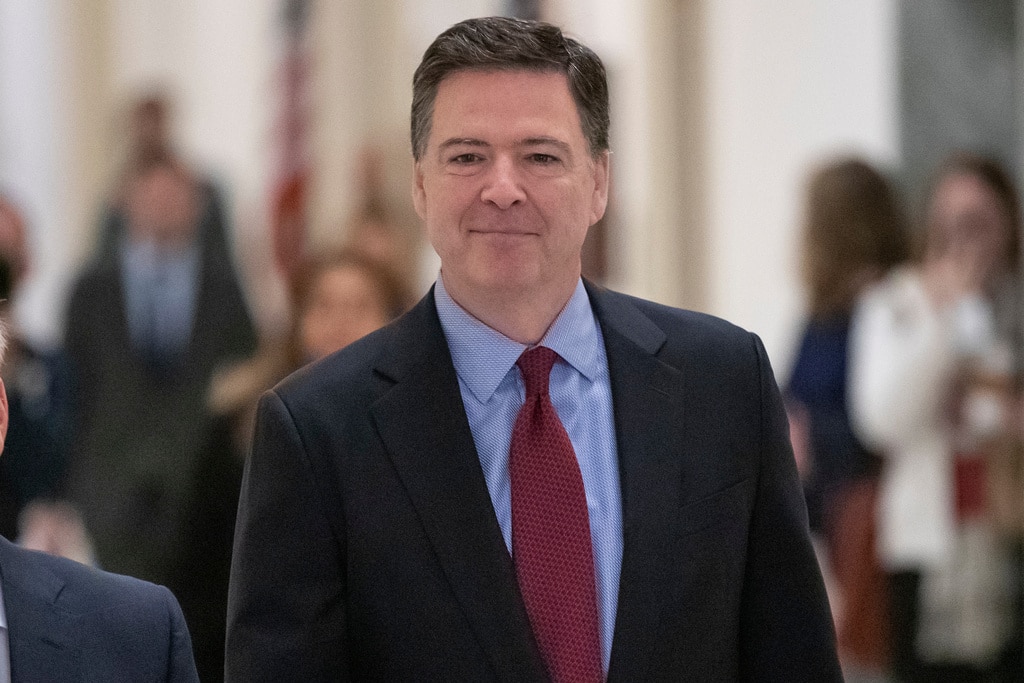
For several years, President Donald J. Trump has been at loggerheads with James Comey, the former director of the Federal Bureau of Investigation whom he fired. Trump blames Comey for the FBI investigation by special counsel Robert Mueller into whether Trump had conspired with Russians to sway the 2016 presidential election.
In 2025, Trump called upon the Justice Department to bring criminal charges against Comey, and a grand jury indicted him on charges of making a false statement to Congress and obstructing a congressional proceeding, both related to his testimony to a Senate Judicary Committee in 2020 about the FBI’s investigation. But a federal court threw the charges out because it found that Lindsey Halligan who had brought the charges had been illegally appointed as an interim U.S. attorney.
Charges against James Comey over “8647” seashell post
The new charges, which have been made by a North Carolina grand jury, allege that Comey had threatened to harm or kill Trump and to transmit the threat via interstate commerce. They stem from Comey’s Instagram post in May of 2025 portraying seashells which Comey discovered on a walk on a North Carolina beach spelling out 8647. The government alleges that the number “86” is a symbol for getting rid of something or somebody and that the number “47” is a reference to Trump, who is serving as the 47th U.S. president.
Comey, who subsequently deleted the post, says that he did not interpret “86” as a threat involving violence, that he will contest the charges, and that he is innocent.
Although there is no evidence that the events are linked, the new indictment comes in the wake of a thwarted attempted assassination against Trump and his cabinet at the Washington Correspondents Dinner at the Hilton Hotel in Washington, D.C.
Speech or true threat? Why a conviction is unlikely
Although some Republican members of Congress have defended the indictment, other individuals have argued that the charges against Comey are an example of a vindictive prosecution designed to silence presidential critics.
The Supreme Court has identified true threats as an exception to the categories of speech protected by the First Amendment, but to establish such a true threat, the government will have to prove that Comey had the intent to threaten the president’s life, and that it posed an actual danger to him.
In similar fashion, the doctrine of “fighting words,” which might also be invoked, generally involves face-to-face interactions that are likely to provoke an immediate physical reaction rather than internet postings.
It is possible that Trump considers that the process of being indicted will be a form of punishment even in the absence of a conviction.
Comey argues indictment was retaliation for protected speech
On July 28, 2026, Comey filed a 54-page memorandum in support of a motion to dismiss his indictments. In an extensive review of Trump’s negative statements and past threats to indict him, Comey argued that the government’s case should be dismissed with prejudice because the government sought the indictment in retaliation for Comey’s exercise of protected speech and in pursuit of President Trump’s animus against him. Citing political allies of the president who had issued far more direct and violent threats against his enemies, Comey further argued that the indictment was an example of selective prosecution that violated equal protection principles.
John R. Vile is a political science professor and dean of the Honors College at Middle Tennessee State University.