
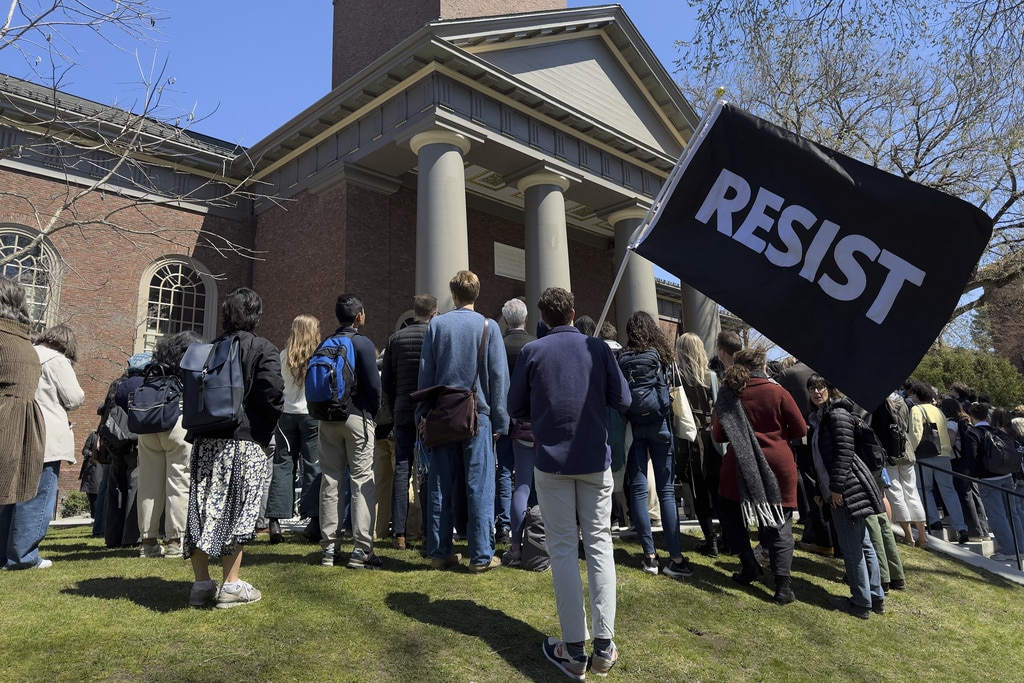
Especially during his second term, President Donald J. Trump has indicated his displeasure with some of the nation’s leading universities. He has charged that they responded inadequately to antisemitism on their campuses in the wake of the Hamas attack on Israel on Oct. 7, 2023, and they have continued to focus on diversity, equity, and inclusion (DEI) policies that he believes violate civil rights.
Trump has sought to raise taxes on college assets, withhold faculty grants
Trump's administration has accordingly attempted to penalize such institutions and change their policies (including those dealing with student admissions, ideological diversity on campuses and faculty hiring) by threatening to raise taxes on their assets and by withholding grants to their employees. Several such institutions have made changes or offered compensation to the government to avoid further sanctions. Still, the nation’s oldest college, Harvard University has, to date, sought instead to challenge Trump’s actions, which had resulted in the freezing and termination of more than $2 billion in governmental contracts and access to others in the future.
On Sept. 3, 2025, Harvard won a series of summary judgments in the U.S. District Court for the District of Massachusetts from Judge Allison D. Burroughs, a graduate of Middlebury College and the University of Pennsylvania Law School who was appointed by President Barack Obama in 2014. Her decisions, which the Trump Administration will undoubtedly appeal, focus in large part on First Amendment issues and on whether Trump’s actions followed procedures outlined in the law.
Jurisdictional and legal standing issues
The judge ruled in the combined cases: President and Fellows of Harvard College v. U.S. Department of Health and Human Services, American Association of University Professors-Harvard Chapter v. U.S. Department of Justice, 2025 WL 2528380 (U.S. District Court, D. Massachusetts).
The court first focused on jurisdictional issues. Although the government claimed that because the case largely involved monetary damages, it should begin in the Court of Federal Claims, Burroughs decided that First Amendment and other considerations provided her court with jurisdiction. She relied in part on the U.S. Supreme Court order in National Institutes of Health v. American Public Health Association (Aug. 21, 2025), in which a divided court had split jurisdiction in a case involving the American Public Health Association.
Judge Burroughs thought that the issues of monetary damages and violations of the First Amendment and Title VI of the Civil Rights Act were so associated that they should be tried together. The judge further believed that the parties had established legal standing by showing that they and their members had suffered injuries as a result of governmental actions that were likely redressable by the court. The judge also ruled that agency actions, which she reviewed in detail, were, for all practical purposes, final decisions subject to judicial review.
First Amendment issues
Although Harvard claimed that the government was retaliating against it for exercising its right to challenge government policies, the government claimed that, as a “government contractor,” Harvard's rights were circumscribed.
Harvard pointed out that it remained a private institution entitled to exercise academic freedom. It cited the Supreme Court decision in University of Michigan v. Ewing (1985) that upheld a university’s right to “autonomous decisionmaking” and other decisions regarding who and what is taught. It pointed out that the government had sought “to require Harvard to overhaul its governance, hiring, and academic programs to comport with the government’s ideology and prescribed viewpoint.”
Judge: Trump's assertion of defending Jewish students not supported
Although the government tied its actions to combating antisemitism, the court found that the record did not support the government’s assertion that “they were primarily or even substantially motivated by that goal (or that cutting funding to Harvard bore any relationship to achieving that aim).” The court noted that President Trump’s public statements — in one instance, he had described the university as “a JOKE” and “a 'Liberal mess'" — confirmed that he was exercising a personal vendetta against the university, rather than attempting to defend Jewish students.
This finding merged with arguments that the government was attempting to impose “unconstitutional conditions” that were “content- and viewpoint-based.”
In addressing whether the government was enforcing Title VI of the Civil Rights Act of 1964 by prohibiting discrimination based on race, color, or national origin, the judge observed that Harvard had taken specific efforts to address such issues, which the government had not considered nor responded to. Moreover, the government had not compiled a report demonstrating that such discrimination existed, particularly with respect to specific grants that often dealt with unrelated issues of health and public welfare.
The judge noted that many of the justifications the government offered were post hoc (after-the-fact) rationalizations. She also observed that “people and entities receiving federal funding are shielded against being labeled with the ‘irreversible stigma’ of ‘discriminator’ until a certain level of agency process has determined that there was misconduct that warranted termination.”
Rather than following procedures outlined in the Administrative Procedures Act, the judge noted that the government’s actions had been arbitrary and capricious and were not based on actual findings of discrimination by Harvard. Moreover, the government had not shown a tie between the grants it was cutting and alleged antisemitism on campus. The court noted that the government had cut funds to research involving diseases that were common to Jews as well as to other ethnicities.
Judge Burroughs concluded that “a review of the administrative record makes it difficult to conclude anything other than that Defendants used antisemitism as a smokescreen for a targeted, ideologically-motivated assault on this country’s premier universities, and did so in a way that runs afoul of the (Administrative Procedures Act), the First Amendment and Title VI.” She observed that “The First Amendment is important and the right to free speech must be zealously guarded. Free speech has always been the hallmark of our democracy.”
“If speech can be curtailed in the name of the Jewish people today, then just as easily the speech of the Jews (and anyone else) can be curtailed when the political winds change direction,” Burroughs wrote.
This decision comes at a time when lower courts have also ruled against Trump’s use of federal troops in Los Angeles, against his broad exercise of authority over tariffs, and against his use of the Alien Enemies Act to deport immigrants. The U.S. Supreme Court will likely confront many of these issues in its 2025-2026 session.