
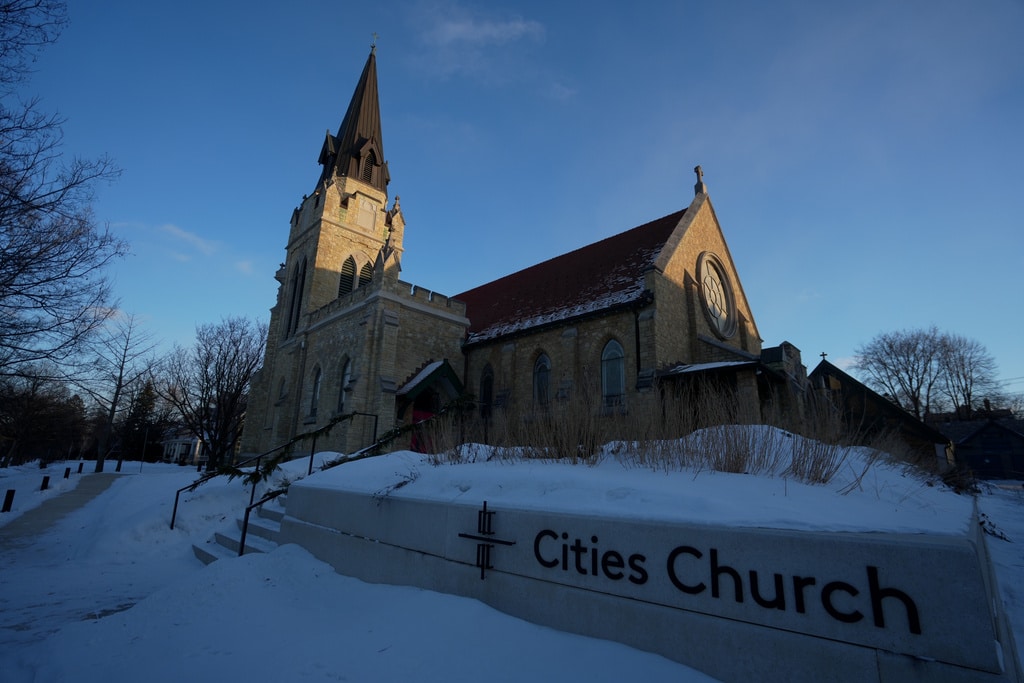
The right to engage in private worship is a key component of the right to free exercise of religion guaranteed by the First Amendment. In addition to free exercise protections, places of worship have the same right as other private establishments to exclude individuals who would make them an unwanted platform for protesters. Even public colleges and universities have the right to prevent protesters from disrupting classes.
Protesters at Cities Church in St. Paul, Minn.
One example in which this right to freedom of worship was threatened was on Jan. 18, 2026, when about three dozen protesters entered the Cities Church in St. Paul, Minnesota, chanting “ICE out” and “Renee Good.” Good was shot and killed by a U.S. Immigrations and Customs Enforcement officer, which led to public demonstrations that put the city on edge.
Protesters had apparently chosen the Southern Baptist Cities Church because one of the pastors, David Easterwood, heads the local field office of the U.S. Immigration and Customs Enforcement.
Southern Baptists, like members of other denominations, are divided over whether the church’s primary obligation is to help with governmental enforcement of the laws against illegal immigrants or to provide aid to immigrants many of whom have fled to the United States in reaction to political persecution, gang violence and poverty. Most church members of both persuasions would almost certainly draw the line at disrupting church services. In reaction to the disruption in St. Paul, Trey Turner, the head of the Minnesota-Wisconsin Baptist Convention, observed that “I believe we must be resolute in two areas: encouraging our churches to provide compassionate pastoral care to these (migrant) families and standing firm for the sanctity of our houses of worship” (The Associated Press, 2026).
The situation in Minnesota is further complicated by President Donald Trump’s announcement in early 2025 that immigration officers could make arrests at churches, which had previously been regarded as sanctuaries and exempt from such actions. Although it is not clear that the government has yet targeted such churches for arrests, such threats are likely also to deter some individuals from entering houses of worship.
Kevin Ezell, who heads the North American Mission Board, has described the action in Minnesota not as a “protest” but as “lawless harassment.” He observed that “No cause — political or otherwise — justifies the desecration of a sacred space or the intimidation and trauma inflicted on families gathered peacefully in the house of God” (The Associated Press, 2026).
Subsequent arrest of journalists
The issues surrounding the disruption of a church service at the Cities Church in St. Paul took a new turn on Jan. 30, 2026, when Attorney General Pam Bondi announced that it had also arrested two journalists, Don Lemon and Georgia Fort, who had been present and reported on the protest but had clearly stated that they were there not as part of the protests but as journalists.
This move is particularly problematic because the chief federal judge in Minneapolis had previously declared that the government had no probable cause for these arrests, which are extremely rare, but appear to be part of the Trump Administration’s ongoing conflict with members of the press.
Forman and Black Manifesto Precedent in 1969
Issues of church disruption are not completely new.
In 1969, civil rights leader James Forman disrupted a service at New York’s famed Riverside Church to present a Black Manifesto that called upon predominately white places of worship to provide reparations for African Americans for their earlier complicity in slavery and racism. Most churches did not agree to these demands.
Law limiting interference in church services
Although protesters might invoke their right of free speech, courts have routinely upheld the imposition of reasonable time, place, and manner restrictions on expression that would surely cover worship services.
Moreover, the Freedom of Access to Clinic Entrances Act of 1994 not only protected access to clinics, but also specifically amended the federal criminal code to prohibit: “intentionally injuring, intimidating, or interfering with, or attempting to injure, intimidate, or interfere, any person by force, threat of force, or physical obstruction exercising or seeking to exercise the First Amendment right of religious freedom at a place of religious worship.”
The Freedom of Access to Clinic Entrances was prompted by protesters who blocked the entrances of abortion clinics.
By February, Bondi had announced that her office had charged more than 30 people with violating the FACE Act in connection with the Cities Church protest.
John R. Vile is a political science professor and dean of the Honors College at Middle Tennessee State University.