
During his second term, President Donald Trump has exerted influence on higher educational institutions. He has cut federal grants and sought to limit student visas. He has imposed financial penalties on those he says have violated federal policies related to diversity, equity, and inclusion policies, have failed to protect Jewish students, or have given platforms for those advocating the Palestinian cause.
On Oct. 1, 2025, the Trump Administration offered to give preferential access to federal funding to nine universities in exchange for their agreement to ten conditions, which the government would oversee. Some involve First Amendment values.
Institutions singled out
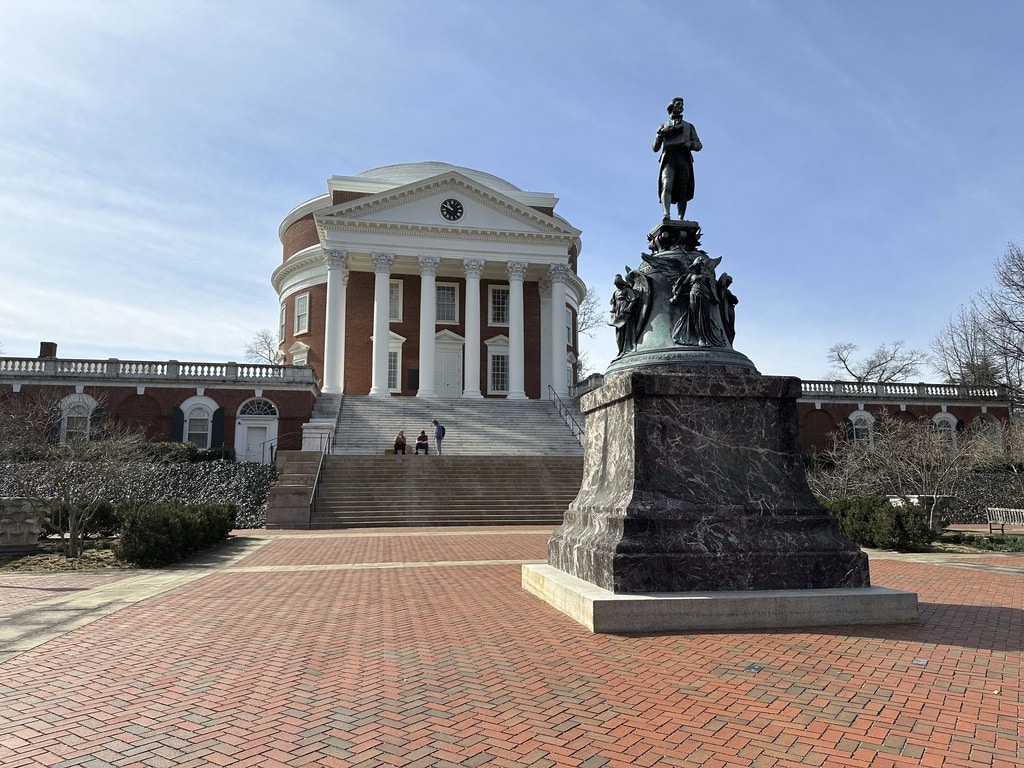
The institutions included a mix of elite private and public entities. They are Brown University, Dartmouth College, the Massachusetts Institute of Technology, the University of Pennsylvania, the University of Arizona, the University of Southern California, the University of Texas at Austin, the University of Virginia, and Vanderbilt University (Blinder and Bender 2025). The University of Texas at Austin expressed almost immediate interest in the compact, while the other institutions continue to study the plan, which has serious implications for First Amendment rights.
It is possible that the compact might serve as a prototype for policies involving other higher educational institutions in the future (Nash 2025).
Details of the Compact for Academic Excellence
In contrast to President Trump’s past criticisms, the plan’s introduction recognizes “American higher education” as “the envy of the world.” It notes that the federal government has helped such institutions through: “(i) access to student loans, grant programs, and federal contracts; (ii) funding for research directly or indirectly; (iii) approval of student and other visas in connection with university matriculation and instruction; and (iv) preferential treatment under the tax code.”
In what might well be a veiled threat, the compact observes that higher educational institutions “are free to develop models and values other than those below, if the institution elects to forego federal benefits.”
Equality in admissions
To become part of the proposed compact, such institutions must establish “equality in admissions.” The plan asserts that preferential treatment based on “sex, ethnicity, race, nationality, political views, sexual orientation, gender identity, religious associations, or proxies for any of those factors” “perpetuates a dangerous badge of inferiority, destroys confidence, and does nothing to identify or solve the most pressing challenges for aspiring young people.” It would require participating institutions to admit students on the basis of standardized tests (some universities dropped them or made them optional in the wake of the COVID-19 pandemic) or other “program-specific measures of accomplishments.”
Addressing the “marketplace of ideas & civil discourse,” the compact admirably states that “Truth-seeking is a core function of institutions of higher education” and lauds “an intellectually open campus environment, with a broad spectrum of ideological viewpoints present.”
Limits on belittling conservative views and ideas
Perhaps with the Charlie Kirk assassination in view, universities must commit to “transforming or abolishing institutional units that purposefully punish, belittle, and even spark violence against conservative ideas.” It further observed that “academic freedom is not absolute,” pointed to the need for “civility,” said that educational institutions should not “permit a heckler’s veto,” “harassment” or “calls for murder or genocide.”
Signatories to the compact would further agree to “nondiscrimination in faculty and administrative hiring,” and for “rigorous and meritocratic selection based on objective and measurable criteria.” They would also embrace “institutional neutrality” except when “external events have a direct impact upon the university.” Although university members are encouraged to comment on current events, they should “not purport to do so on behalf of the university of its sub-divisions.”
Requirements on interpreting gender words
Institutions would further agree to upholding “student learning” by resisting grade inflation or deflation, and by providing “single-sex spaces such as bathrooms and locker rooms, and fair competition, such as in sports.” They would also be required to interpret the words male, female, woman, and man “according to reproductive function and biological processes.”
Universities must freeze tuition rates for 5 years
In detailing “financial responsibility,” the compact called upon signatories to freeze “effective tuition rates” (it is unclear whether the term “effective” would allow for inflation adjustments) for the following five years. In another proviso, the compact also called for refunding the tuition of students who dropped out during their first year of undergraduate studies.
In an interesting twist, the signatories with more than $2 million in endowments per student [it does not appear that any of the institutions contacted so qualify] would have to exempt students in “hard science programs” from tuition except for those from families of substantial means. Colleges and universities (many of which might already do so) would also give full credit for classes taken from the Joint Service Transcripts of veterans.
Limits on foreign students
In discussing “foreign entanglements,” the compact outlined procedures that institutions would have to follow. These include limiting schools from accepting more than 15% of undergraduates from foreign countries in general or more than 5% from any one nation. Such foreign students would be screened so as to exclude “students who demonstrate hostility to the United States, its allies, or its values,” and would be expected to receive “instruction in American civics.”
The compact provides exceptions for religious institutions to “maintain preferences for religious affiliation or belief in hiring and admission,” for single-sex institutions for “sex-based preferences,” and for any institution that wished to limit foreign enrollment. It also included enforcement provisions requiring annual reports, annual outside reviews, and oversight by the Department of Justice.”
President’s power to condition aid on agreeing to policy
Institutions of higher learning are hardly exempt from criticisms even within academe. Many such institutions have already aligned admissions policies with Supreme Court decisions involving affirmative action policies. Others have strengthened protections for Jewish students, attempted to provide forums for individuals of diverse viewpoints, sought to address grade inflation, and attempted to cut down tuition costs.
The proposed compact nonetheless raises a number of critical issues. Foremost is the question of the degree to which a president has the right to set educational policy (especially at private institutions) and condition aid on compliance with such policy. Notably, the president does not cite any statutory authority from Congress to justify the conditions in the compact. Moreover, the 10th Amendment suggests that states have primary “police powers” over such policies within their jurisdictions.
Can president handpick universities for special treatment?
A second question concerns the degree to which the president, or any other governmental authority, can pick out particular institutions for special treatment. At least initially, it remains unclear how the president selected the institutions that he did (does he expect them to comply or is he hoping to pick a fight?) or whether those whose leaders refuse to sign the compact will be subject to special penalties, which those not asked to join might be able to escape.
Potential viewpoint discrimination
Third, it is not clear whether the president’s concern for the protection of “conservative ideas” is intended to extend equally to other ideas. If not, the compact would appear to involve content and/or viewpoint discrimination.
Fourth, it is not initially clear how state colleges and universities will respond if they get caught between the demands of state of federal authorities. In California, Gov. Gavin Newsom threatened to withdraw state funding from the University of Southern California if it acceded to federal demands (“Trump makes colleges an offer they can refuse,” 2025).
This administration initiative seems in line with President Trump’s attempt to exert pressure on the Smithsonian Institution, the Kennedy Center, and law firms.
On Oct. 10, Massachusetts Institute of Technology's president, Sally Kornbluth, publicly rejected the Trump compact, as other present and current university administrators questioned what it would do to educational independence and finances (Quilantan, 2025).
As of the end of October 2025, the only two of the nine institutions that had not turned down the invitation to accept the compact were Vanderbilt, which had expressed misgivings, and University of Texas-Austin, which had not responded. The idea of extending the offer to other universities appears to have been tabled (Nossel 2025).
John R. Vile is a political science professor and dean of the Honors College at Middle Tennessee State University.