Trump Guidelines on Workplace Religious Freedoms
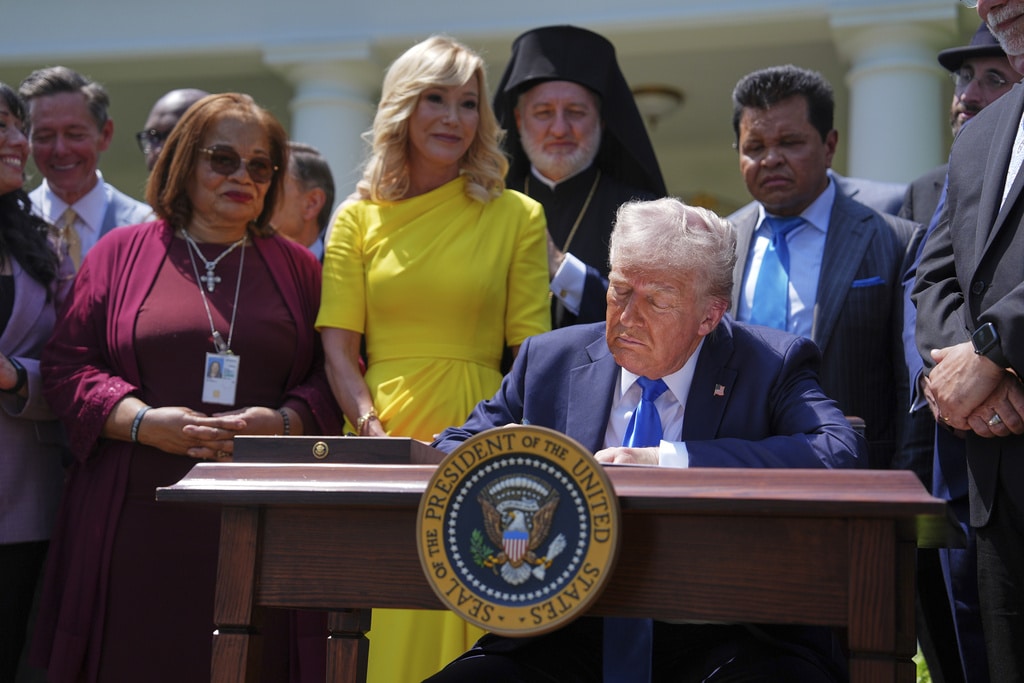
President Donald Trump, surrounded by religious leaders, signs an executive order establishing the Religious Liberty Commission, during a National Day of Prayer event in the Rose Garden of the White House, Thursday, May 1, 2025, in Washington. Later, the U.S. Office of Personnel Management issued a memorandum on guidelines to protect religious expression in federal government workplaces. (AP Photo/Evan Vucci)
On July 28, 2025, Scott Kupor, the director of the U.S. Office of Personnel Management, issued a memorandum entitled “Protecting Religious Expression in the Federal Workplace.”
The memorandum did not indicate whether it superseded previous guidelines issued by the Clinton Administration in 1997, but it relied on President Donald Trump’s executive orders “Eradicating Anti-Christian Bias” and the “Establishment of the Religious Liberty Commission,” both of which were issued earlier in the year. The memorandum also relied heavily on two U.S. Supreme Court opinions, Kennedy v. Bremerton School District (2022), and Groff v. Dejoy (2023), which came after the Clinton Administration.
The court in Kennedy upheld the right of a public-school football coach to offer a prayer on the football field after a game. In Groff, the court overturned an earlier decision in Trans World Airlines, Inc. v. Hardison (1977), by deciding that employers must accommodate religion in the workplace (in this case, religiously based objections to work on Sundays) unless doing so imposed an “undue hardship” (rather than mere de minimis costs) on other employees.
Memoradum lists permitted religious conduct of workers
The memorandum began by observing that President Trump was committed to “reaffirming ‘America’s unique and beautiful tradition of religious liberty,’” and that “The Federal workforce should be a welcoming place for Federal employees who practice a religious faith.” It further noted that Title VII had sought to protect religious freedom, not by demanding “mere neutrality with religious practices,” but giving such practices “favored treatment.” It stated that “Employees must be allowed to engage in private religious expression in work areas to the same extent that they may engage in nonreligious private expression,” but that agencies may regulate “the time, place and manner of all employee speech, provided such regulations do not discriminate based on content or viewpoint (including religious viewpoints).”
The memorandum listed permitted employee conduct under its guidelines.:: “Display and Use of Items Used for Religious Purposes or Religious Icons,” including the display of bibles and the wearing of religious jewelry; “Expressions By Groups of Federal Employees” during off-duty times; “Conversations Between Federal Employees,” providing they were “not harassing in nature”; “Expressions Among or Directed at Members of the Public,” albeit not pursuant to their public duties; and “Expressions in Areas Accessible to the Public.”
The memorandum included a one-page appendix illustrating specific examples of appropriate religious expression in each category.
Concerns
Notably, this memorandum seeks to provide workplace protections like those proposed in the Workplace Religious Freedom Act, as an amendment to Title VII of the Civil Rights Act of 1964.
Although he did not think this was as bad as some other Trump initiatives that he opposed, Professor Douglas Laycock, an emeritus professor of law, noted that his primary concern was that the memorandum should have cautioned supervisors about making sure that their employees understood that they were under no obligation to comply with a supervisor’s religious opinions or practices (Sullivan 2025).
By contrast, Andrew Walker, an associate dean at the Southern Baptist Theological Seminary, interpreted the memorandum as simply “reaffirming the First Amendment, that has proper caveats if you’re not engaging in harassing behavior.”
John R. Vile is a political science professor and dean of the Honors College at Middle Tennessee State University.
Cite This Article Click to view APA, MLA, Chicago, and Bluebook formats
Use the formats below to cite this encyclopedia entry.
Vile, J. R. (2025, August 7). Trump Guidelines on Workplace Religious Freedoms. The First Amendment Encyclopedia. https://firstamendment.mtsu.edu/article/trump-guidelines-on-workplace-religious-freedoms/
Vile, John R. "Trump Guidelines on Workplace Religious Freedoms." The First Amendment Encyclopedia, 7 Aug. 2025, https://firstamendment.mtsu.edu/article/trump-guidelines-on-workplace-religious-freedoms/.
Vile, John R. "Trump Guidelines on Workplace Religious Freedoms." The First Amendment Encyclopedia. August 7, 2025. https://firstamendment.mtsu.edu/article/trump-guidelines-on-workplace-religious-freedoms/.
John R. Vile, Trump Guidelines on Workplace Religious Freedoms, The First Amendment Encyclopedia (Aug. 7, 2025), https://firstamendment.mtsu.edu/article/trump-guidelines-on-workplace-religious-freedoms/.